Department of Cardiology, Shanghai Rui Jin Hospital, Shanghai, People’s Republic of China.
Diabetes Care. 2013 May;36(5):1312-20. doi: 10.2337/dc12-1411. Epub 2012 Dec 10.
To investigate whether glycation level of apoprotein (apo)A-I is associated with coronary artery disease (CAD) and plaque progression in patients with type 2 diabetes.
Among 375 consecutive type 2 diabetic patients undergoing quantitative coronary angiography (QCA) and intravascular ultrasound (IVUS), 82 patients with nonsignificant stenosis (luminal diameter narrowing <30% [group I]) and 190 patients with significant CAD (luminal diameter stenosis ≥70% [group II]) were included for analysis of apoA-I glycation level and serum activity of lecithin: cholesterol acyltransferase (LCAT). The control group had 136 healthy subjects. At the 1-year follow-up, angiography and IVUS were repeated mainly in group II patients for plaque progression assessment.
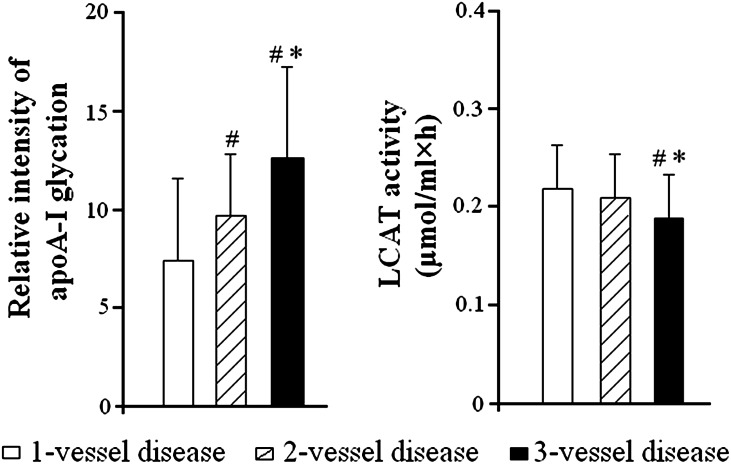
Relative intensity of apoA-I glycation by densitometry was increased, and serum LCAT activity was decreased stepwise across groups control, I, and II. These two measurements were associated with the number of diseased coronary arteries and extent index in group II. During 1-year follow-up, QCA detected 45 patients with plaque progression in 159 subjects, and IVUS found 38 patients with plaque progression in 127 subjects. Baseline relative intensity of apoA-I glycation was significantly increased in patients with plaque progression compared with those without, with values associated with changes in QCA and IVUS measurements. Multivariable regression analysis revealed that baseline relative intensity of apoA-I glycation was an independent determinant of CAD and plaque progression in type 2 diabetic patients.
ApoA-I glycation level is associated with the severity of CAD and coronary artery plaque progression in type 2 diabetic patients.
探讨载脂蛋白(apo)A-I 的糖化水平是否与 2 型糖尿病患者的冠状动脉疾病(CAD)和斑块进展有关。
在 375 例连续接受定量冠状动脉造影(QCA)和血管内超声(IVUS)检查的 2 型糖尿病患者中,82 例无明显狭窄(管腔直径狭窄<30%[I 组])和 190 例有明显 CAD(管腔直径狭窄≥70%[II 组])的患者进行了 apoA-I 糖化水平和血清卵磷脂:胆固醇酰基转移酶(LCAT)活性分析。对照组有 136 名健康受试者。在 1 年随访时,主要对 II 组患者进行了重复血管造影和 IVUS 检查,以评估斑块进展情况。
通过密度计测量,apoA-I 糖化的相对强度逐渐增加,血清 LCAT 活性逐渐降低,依次跨越对照组、I 组和 II 组。这两项测量与 II 组患者患病冠状动脉数量和程度指数相关。在 1 年随访期间,QCA 在 159 名患者中检测到 45 名斑块进展患者,IVUS 在 127 名患者中发现 38 名斑块进展患者。与没有斑块进展的患者相比,有斑块进展的患者的基线 apoA-I 糖化相对强度显著增加,且与 QCA 和 IVUS 测量的变化相关。多变量回归分析显示,基线 apoA-I 糖化相对强度是 2 型糖尿病患者 CAD 和冠状动脉斑块进展的独立决定因素。
apoA-I 的糖化水平与 2 型糖尿病患者 CAD 的严重程度和冠状动脉斑块进展有关。