Shen Ying, Ding Feng Hua, Sun Jia Teng, Pu Li Jin, Zhang Rui Yan, Zhang Qi, Chen Qiu Jing, Shen Wei Feng, Lu Lin
Department of Cardiology, Rui Jin Hospital, Shanghai Jiaotong University School of Medicine, 197 Rui Jin Road II, Shanghai, 200025, People's Republic of China.
Institute of Cardiovascular Disease, Shanghai Jiaotong University School of Medicine, Shanghai, People's Republic of China.
Cardiovasc Diabetol. 2015 May 13;14:52. doi: 10.1186/s12933-015-0221-4.
To investigate whether apolipoprotein A (apoA)-I glycation and paraoxonase (PON) activities are associated with the severity of coronary artery disease (CAD) in patients with type 2 diabetes mellitus (T2DM).
Relative intensity of apoA-I glycation and activities of high-density lipoprotein (HDL)-associated PON1 and PON3 were determined in 205 consecutive T2DM patients with stable angina with (n = 144) or without (n = 61) significant CAD (luminal diameter stenosis ≥ 70 %). The severity of CAD was expressed by number of diseased coronary arteries, extent index, and cumulative coronary stenosis score (CCSS).
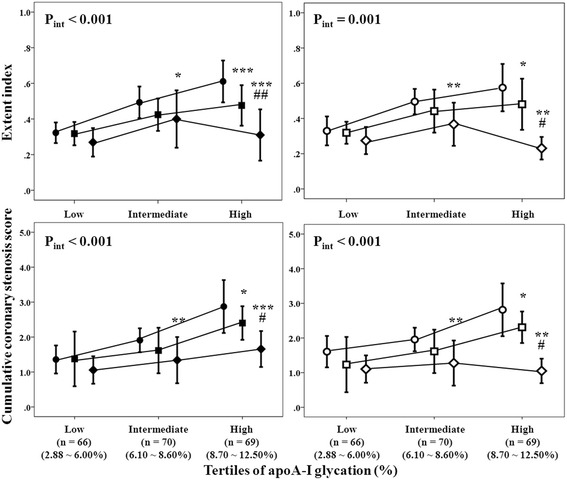
The relative intensity of apoA-I glycation was higher but the activities of HDL-associated PON1 and PON3 were lower in diabetic patients with significant CAD than in those without. The relative intensity of apoA-I glycation increased but the activities of HDL-associated PON1 and PON3 decreased stepwise from 1 - to 3 - vessel disease patients (P for trend < 0.001). After adjusting for possible confounding variables, the relative intensity of apoA-I glycation correlated positively, while the activities of HDL-associated PON1 and PON3 negatively, with extent index and CCSS, respectively. At high level of apoA-I glycation (8.70 ~ 12.50 %), low tertile of HDL-associated PON1 (7.03 ~ 38.97U/mL) and PON3 activities (7.11 ~ 22.30U/mL) was associated with a 1.97- and 2.49- fold increase of extent index and 1.73- and 2.68- fold increase of CCSS compared with high tertile of HDL-associated PON1 (57.85 ~ 154.82U/mL) and PON3 activities (39.63 ~ 124.10U/mL), respectively (all P < 0.01).
Elevated apoA-I glycation and decreased activities of HDL-associated PON1 and PON3, and their interaction are associated with the presence and severity of CAD in patients with T2DM.
研究载脂蛋白A(apoA)-I糖基化及对氧磷酶(PON)活性是否与2型糖尿病(T2DM)患者冠状动脉疾病(CAD)的严重程度相关。
对205例连续性稳定型心绞痛的T2DM患者进行检测,其中有严重CAD(管腔直径狭窄≥70%)的患者144例,无严重CAD的患者61例。测定apoA-I糖基化的相对强度以及高密度脂蛋白(HDL)相关的对氧磷酶1(PON1)和对氧磷酶3(PON3)的活性。CAD的严重程度用病变冠状动脉数量、范围指数和累积冠状动脉狭窄评分(CCSS)表示。
有严重CAD的糖尿病患者apoA-I糖基化的相对强度较高,但HDL相关的PON1和PON3活性较低。从单支血管病变到三支血管病变患者,apoA-I糖基化的相对强度升高,而HDL相关的PON1和PON3活性逐步降低(趋势P<0.001)。在调整可能的混杂变量后,apoA-I糖基化的相对强度分别与范围指数和CCSS呈正相关,而HDL相关的PON1和PON3活性分别与范围指数和CCSS呈负相关。在apoA-I糖基化高水平(8.7012.50%)时,HDL相关的PON1低三分位数(7.0338.97U/mL)和PON3活性(7.1122.30U/mL)与范围指数分别增加1.97倍和2.49倍、CCSS分别增加1.73倍和2.68倍相关,而HDL相关的PON1高三分位数(57.85154.82U/mL)和PON3活性(39.63~124.10U/mL)时与之相比(所有P<0.01)。
apoA-I糖基化升高、HDL相关的PON1和PON3活性降低及其相互作用与T2DM患者CAD的存在及严重程度相关。