Department of Genetics, University of Georgia, Athens, Georgia, United States of America.
PLoS One. 2012;7(12):e51388. doi: 10.1371/journal.pone.0051388. Epub 2012 Dec 7.
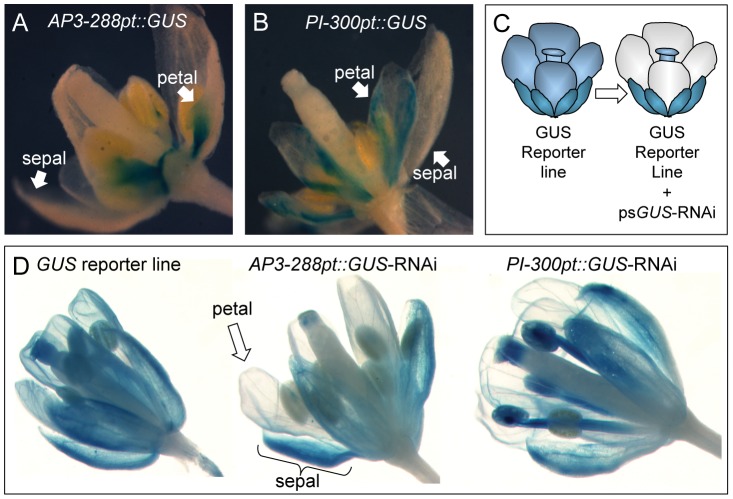
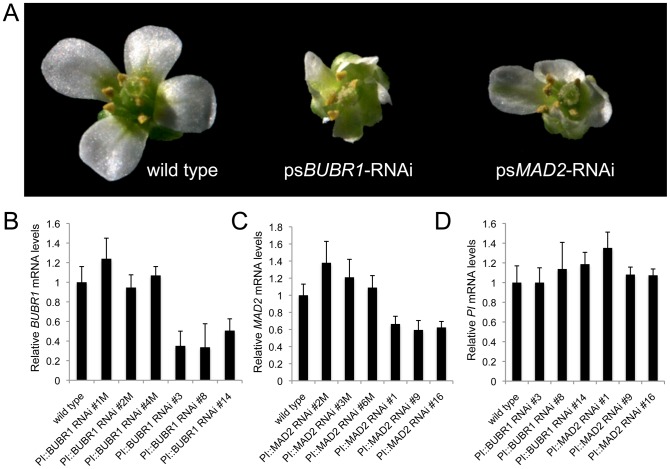
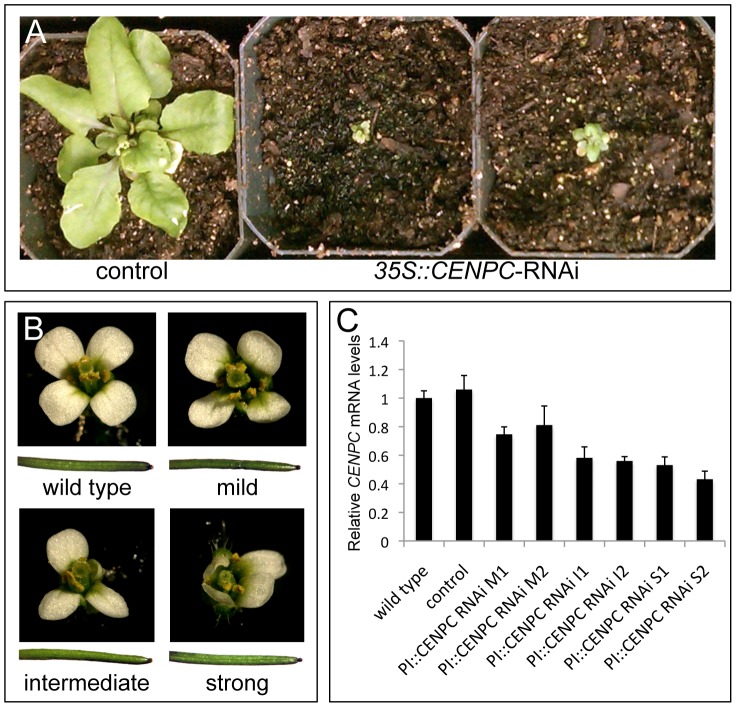
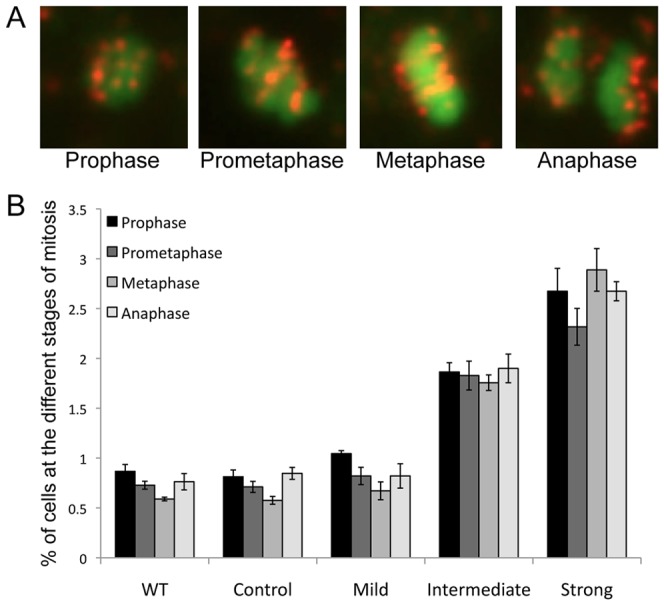
A large fraction of the genes in plants can be considered essential in the sense that when absent the plant fails to develop past the first few cell divisions. The fact that angiosperms pass through a haploid gametophyte stage can make it challenging to propagate such mutants even in the heterozygous condition. Here we describe a tissue-specific RNAi method that allows us to visualize cell division phenotypes in petals, which are large dispensable organs. Portions of the APETALA (AP3) and PISTILLATA (PI) promoters confer early petal-specific expression. We show that when either promoter is used to drive the expression of a beta-glucuronidase (GUS) RNAi transgene in plants uniformly expressing GUS, GUS expression is knocked down specifically in petals. We further tested the system by targeting the essential kinetochore protein CENPC and two different components of the Spindle Assembly Checkpoint (MAD2 and BUBR1). Plant lines expressing petal-specific RNAi hairpins targeting these genes exhibited an array of petal phenotypes. Cytological analyses of the affected flower buds confirmed that CENPC knockdown causes cell cycle arrest but provided no evidence that either MAD2 or BUBR1 are required for mitosis (although both genes are required for petal growth by this assay). A key benefit of the petal-specific RNAi method is that the phenotypes are not expressed in the lineages leading to germ cells, and the phenotypes are faithfully transmitted for at least four generations despite their pronounced effects on growth.
植物中很大一部分基因可以被认为是必需的,因为当这些基因缺失时,植物无法发育到第一次细胞分裂之后的阶段。被子植物经历一个单倍体配子体阶段的事实使得即使在杂合子条件下,也很难繁殖这些突变体。在这里,我们描述了一种组织特异性 RNAi 方法,该方法允许我们在花瓣中观察细胞分裂表型,花瓣是大的、可自由取舍的器官。APETALA (AP3) 和 PISTILLATA (PI) 启动子的部分区域赋予了早期花瓣特异性表达。我们表明,当任一启动子被用于驱动 β-葡糖苷酸酶(GUS)RNAi 转基因在均匀表达 GUS 的植物中的表达时,GUS 表达在花瓣中特异性下调。我们进一步通过靶向必需的着丝粒蛋白 CENPC 和纺锤体组装检查点(MAD2 和 BUBR1)的两个不同组件来测试该系统。表达针对这些基因的花瓣特异性 RNAi 发夹的植物系表现出一系列花瓣表型。受影响的花蕾的细胞学分析证实,CENPC 敲低导致细胞周期停滞,但没有证据表明 MAD2 或 BUBR1 是有丝分裂所必需的(尽管这两个基因都需要通过该测定来促进花瓣生长)。花瓣特异性 RNAi 方法的一个关键优势是表型不会在生殖细胞的谱系中表达,并且尽管它们对生长有明显影响,但表型至少可以传递四代。