Institut Pasteur, Unit of Epidemiology and Pathophysiology of Oncogenic Viruses, Paris, France.
Clin Microbiol Infect. 2013 Feb;19(2):E118-28. doi: 10.1111/1469-0691.12075. Epub 2012 Dec 14.
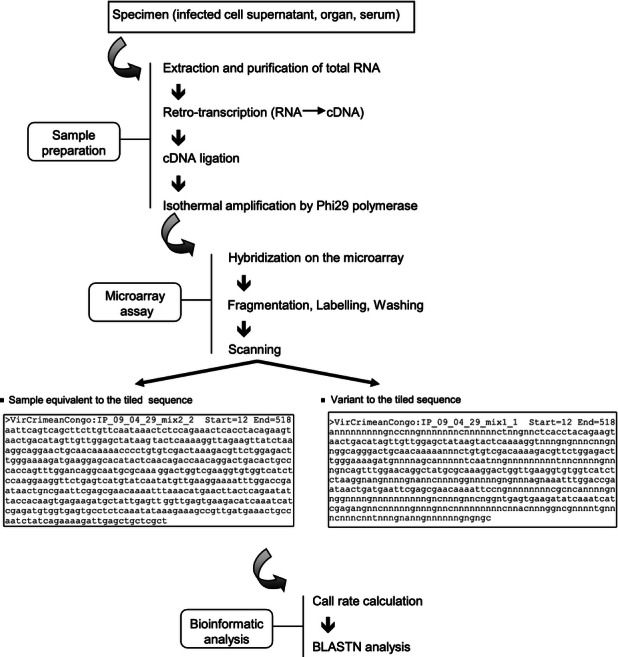
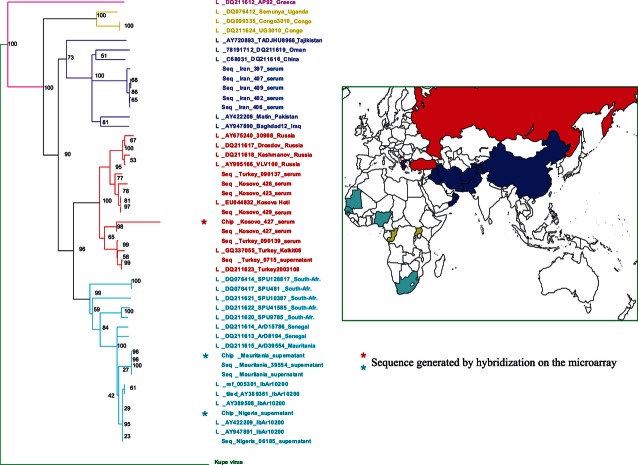
Several haemorrhagic fevers are caused by highly pathogenic viruses that must be handled in Biosafety level 4 (BSL-4) containment. These zoonotic infections have an important impact on public health and the development of a rapid and differential diagnosis in case of outbreak in risk areas represents a critical priority. We have demonstrated the potential of a DNA resequencing microarray (PathogenID v2.0) for this purpose. The microarray was first validated in vitro using supernatants of cells infected with prototype strains from five different families of BSL-4 viruses (e.g. families Arenaviridae, Bunyaviridae, Filoviridae, Flaviviridae and Paramyxoviridae). RNA was amplified based on isothermal amplification by Phi29 polymerase before hybridization. We were able to detect and characterize Nipah virus and Crimean-Congo haemorrhagic fever virus (CCHFV) in the brains of experimentally infected animals. CCHFV was finally used as a paradigm for epidemics because of recent outbreaks in Turkey, Kosovo and Iran. Viral variants present in human sera were characterized by BLASTN analysis. Sensitivity was estimated to be 10(5) -10(6) PFU/mL of hybridized cDNA. Detection specificity was limited to viral sequences having ~13-14% of global divergence with the tiled sequence, or stretches of ~20 identical nucleotides. These results highlight the benefits of using the PathogenID v2.0 resequencing microarray to characterize geographical variants in the follow-up of haemorrhagic fever epidemics; to manage patients and protect communities; and in cases of bioterrorism.
几种出血热是由高致病性病毒引起的,必须在生物安全 4 级(BSL-4)条件下进行处理。这些人畜共患病感染对公共卫生有重要影响,在风险地区爆发时快速和差异化诊断的发展是当务之急。我们已经证明了 DNA 重测序微阵列(PathogenID v2.0)在这方面的潜力。该微阵列首先在体外使用来自五个不同 BSL-4 病毒家族(例如,Arenaviridae、Bunyaviridae、Filoviridae、Flaviviridae 和 Paramyxoviridae)的原型株感染细胞的上清液进行验证。在杂交之前,基于 Phi29 聚合酶的等温扩增扩增 RNA。我们能够在实验感染动物的脑组织中检测和表征尼帕病毒和克里米亚-刚果出血热病毒(CCHFV)。由于土耳其、科索沃和伊朗最近爆发了疫情,最终将 CCHFV 用作流行病的范例。通过 BLASTN 分析对存在于人血清中的病毒变体进行了表征。估计杂交 cDNA 的敏感性为 10(5) -10(6) PFU/mL。检测特异性仅限于与平铺序列具有约 13-14%全球差异的病毒序列,或约 20 个相同核苷酸的片段。这些结果强调了使用 PathogenID v2.0 重测序微阵列在出血热流行的后续监测中、在管理患者和保护社区以及在生物恐怖主义情况下对地理变异进行特征描述的优势。