Mazzola Laura T, Kelly-Cirino Cassandra
Emerging Threats Programme, Foundation for Innovative New Diagnostics (FIND), Geneva, Switzerland.
BMJ Glob Health. 2019 Feb 20;4(Suppl 2):e001114. doi: 10.1136/bmjgh-2018-001114. eCollection 2019.
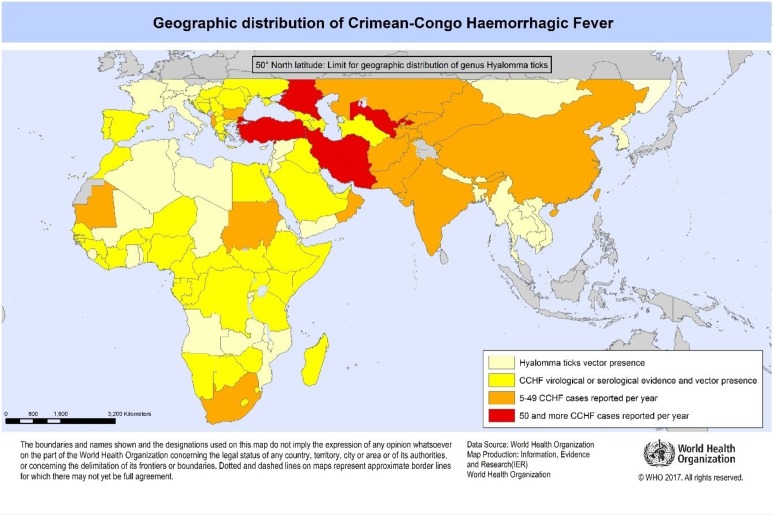
Crimean-Congo haemorrhagic fever (CCHF) is a widespread tickborne disease that circulates in wild and domestic animal hosts, and causes severe and often fatal haemorrhagic fever in infected humans. Due to the lack of treatment options or vaccines, and a high fatality rate, CCHF virus (CCHFV) is considered a high-priority pathogen according to the WHO R&D Blueprint. Several commercial reverse transcriptase PCR (RT-PCR) and serological diagnostic assays for CCHFV are already available, including febrile agent panels to distinguish CCHFV from other viral haemorrhagic fever agents; however, the majority of international laboratories use inhouse assays. As CCHFV has numerous amplifying animal hosts, a cross-sectoral 'One Health' approach to outbreak prevention is recommended to enhance notifications and enable early warning for genetic and epidemiological shifts in the human, animal and tick populations. However, a lack of guidance for surveillance in animals, harmonisation of case identification and validated serodiagnostic kits for animal testing hinders efforts to strengthen surveillance systems. Additionally, as RT-PCR tests tend to be lineage-specific for regional circulating strains, there is a need for pan-lineage sensitive diagnostics. Adaptation of existing tests to point-of-care molecular diagnostic platforms that can be implemented in clinic or field-based settings would be of value given the potential for CCHFV outbreaks in remote or low-resource areas. Finally, improved access to clinical specimens for validation of diagnostics would help to accelerate development of new tests. These gaps should be addressed by updated target product profiles for CCHFV diagnostics.
克里米亚-刚果出血热(CCHF)是一种广泛传播的蜱传疾病,在野生动物和家畜宿主中传播,可导致受感染人类出现严重且往往致命的出血热。由于缺乏治疗方法或疫苗,且病死率高,根据世界卫生组织研发蓝图,CCHF病毒(CCHFV)被视为高优先级病原体。目前已有几种用于CCHFV的商业逆转录聚合酶链反应(RT-PCR)和血清学诊断检测方法,包括用于区分CCHFV与其他病毒性出血热病原体的发热病原体检测板;然而,大多数国际实验室使用内部检测方法。由于CCHFV有众多扩增动物宿主,建议采用跨部门的“同一健康”方法来预防疫情,以加强通报,并对人类、动物和蜱虫种群的基因和流行病学变化进行早期预警。然而,缺乏动物监测指南、病例识别的协调统一以及经过验证的用于动物检测的血清学诊断试剂盒,阻碍了加强监测系统的努力。此外,由于RT-PCR检测往往对区域流行毒株具有谱系特异性,因此需要泛谱系敏感诊断方法。鉴于CCHFV在偏远或资源匮乏地区有爆发的可能性,将现有检测方法适用于可在临床或现场环境中实施的即时分子诊断平台将具有重要意义。最后,增加获取用于诊断验证的临床标本的机会,将有助于加速新检测方法的开发。这些差距应通过更新CCHFV诊断的目标产品简介来加以解决。