Magee-Womens Research Institute, Department of Obstetrics and Gynecology, School of Medicine, Pittsburgh, PA, USA.
Department of Bioengineering, Swanson School of Engineering, University of Pittsburgh, Pittsburgh, PA, USA.
BJOG. 2013 Jan;120(2):233-243. doi: 10.1111/1471-0528.12085.
To compare the impact of the prototype prolapse mesh Gynemesh PS with that of two new-generation lower stiffness meshes, UltraPro and SmartMesh, on vaginal morphology and structural composition.
A mechanistic study employing a nonhuman primate model.
Magee-Womens Research Institute at the University of Pittsburgh.
Parous rhesus macaques, with similar age, weight, parity and Pelvic Organ Prolapse-Questionnaire scores.
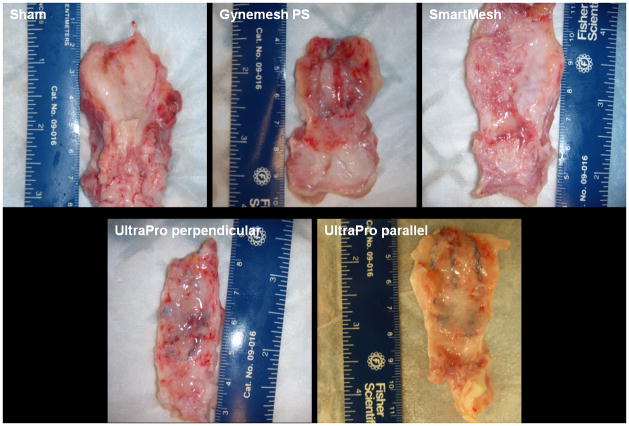
Following Institutional Animal Care Use Committee approval, 50 rhesus macaques were implanted with Gynemesh PS (n = 12), UltraPro with its blue line perpendicular to the longitudinal axis of vagina (n = 10), UltraPro with its blue line parallel to the longitudinal axis of vagina (n = 8) or SmartMesh (n = 8) via sacrocolpopexy following hysterectomy. Sham-operated animals (n = 12) served as controls.
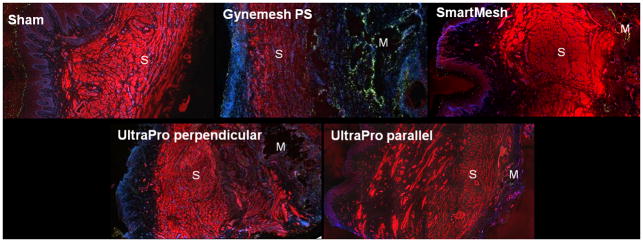
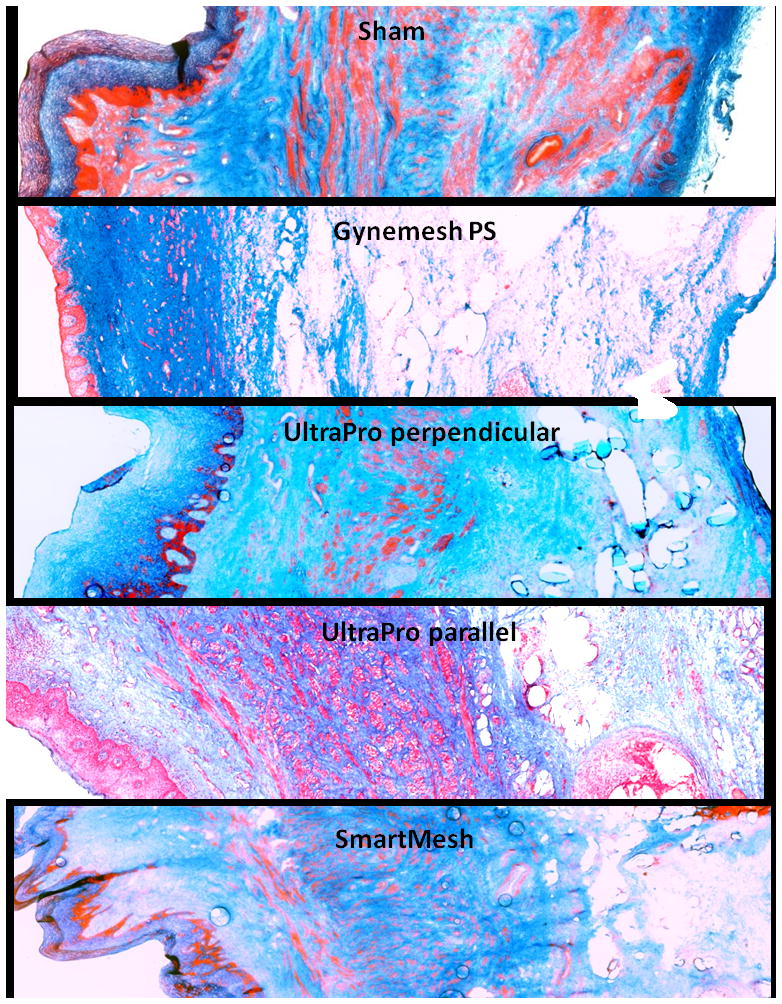
The mesh-vagina complex was removed after 12 weeks and analysed for histomorphology, in situ cell apoptosis, total collagen, elastin, glycosaminoglycan content and total collagenase activity. Appropriate statistics and correlation analyses were performed accordingly.
Relative to sham and the two lower stiffness meshes, Gynemesh PS had the greatest negative impact on vaginal histomorphology and composition. Compared with sham, implantation with Gynemesh PS caused substantial thinning of the smooth muscle layer (1557 ± 499 μm versus 866 ± 210 μm, P = 0.02), increased apoptosis particularly in the area of the mesh fibres (P = 0.01), decreased collagen and elastin content (20%, P = 0.03 and 43%, P = 0.02, respectively) and increased total collagenase activity (135%, P = 0.01). Glycosaminoglycan, a marker of tissue injury, was highest with Gynemesh PS compared with sham and other meshes (P = 0.01).
Mesh implantation with the stiffer mesh Gynemesh PS induced a maladaptive remodelling response consistent with vaginal degeneration.
比较原型脱垂网片 Gynemesh PS 与两种新一代低弹性网片 UltraPro 和 SmartMesh 对阴道形态和结构组成的影响。
采用非人灵长类动物模型的机制研究。
匹兹堡大学 Magee-Womens 研究所。
产后期恒河猴,年龄、体重、产次和盆腔器官脱垂问卷评分相似。
在机构动物护理使用委员会批准后,50 只恒河猴通过经阴道子宫切除术进行骶骨阴道固定术植入 Gynemesh PS(n = 12)、UltraPro 蓝色线与阴道纵轴垂直(n = 10)、UltraPro 蓝色线与阴道纵轴平行(n = 8)或 SmartMesh(n = 8)。假手术动物(n = 12)作为对照。
在 12 周后取出网片-阴道复合体,进行组织形态学、原位细胞凋亡、总胶原、弹性蛋白、糖胺聚糖含量和总胶原酶活性分析。相应地进行了适当的统计和相关性分析。
与假手术和两种低弹性网片相比,Gynemesh PS 对阴道组织形态和组成的负面影响最大。与假手术相比,植入 Gynemesh PS 导致平滑肌层明显变薄(1557 ± 499 μm 比 866 ± 210 μm,P = 0.02),特别是在网片纤维区域的凋亡增加(P = 0.01),胶原和弹性蛋白含量减少(20%,P = 0.03 和 43%,P = 0.02),总胶原酶活性增加(135%,P = 0.01)。糖胺聚糖是组织损伤的标志物,与假手术和其他网片相比,Gynemesh PS 最高(P = 0.01)。
较硬网片 Gynemesh PS 的网片植入引起了与阴道退化一致的适应性重塑反应。