Division of Geriatrics Research, Department of Internal Medicine, Southern Illinois University School of Medicine Springfield, IL, USA.
Front Genet. 2012 Dec 13;3:288. doi: 10.3389/fgene.2012.00288. eCollection 2012.
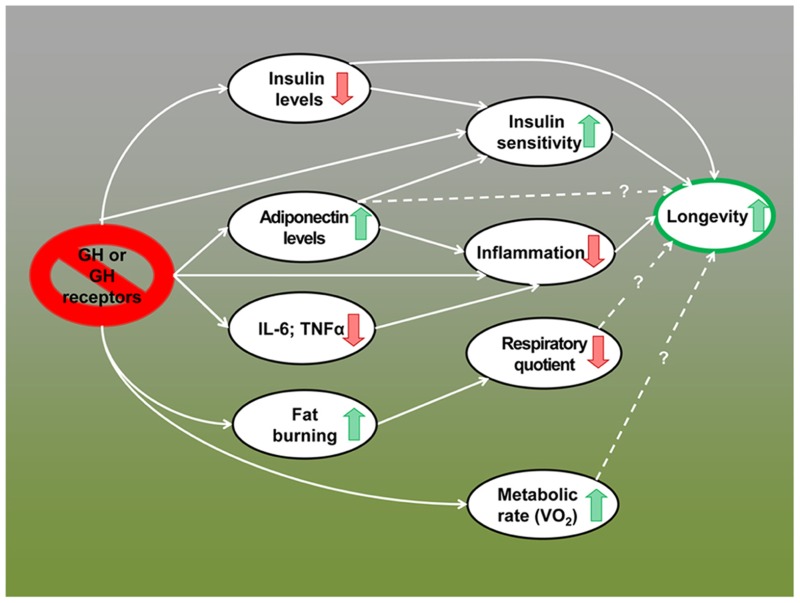
Genetic suppression of insulin/insulin-like growth factor signaling (IIS) can extend longevity in worms, insects, and mammals. In laboratory mice, mutations with the greatest, most consistent, and best documented positive impact on lifespan are those that disrupt growth hormone (GH) release or actions. These mutations lead to major alterations in IIS but also have a variety of effects that are not directly related to the actions of insulin or insulin-like growth factor I. Long-lived GH-resistant GHR-KO mice with targeted disruption of the GH receptor gene, as well as Ames dwarf (Prop1(df)) and Snell dwarf (Pit1(dw)) mice lacking GH (along with prolactin and TSH), are diminutive in size and have major alterations in body composition and metabolic parameters including increased subcutaneous adiposity, increased relative brain weight, small liver, hypoinsulinemia, mild hypoglycemia, increased adiponectin levels and insulin sensitivity, and reduced serum lipids. Body temperature is reduced in Ames, Snell, and female GHR-KO mice. Indirect calorimetry revealed that both Ames dwarf and GHR-KO mice utilize more oxygen per gram (g) of body weight than sex- and age-matched normal animals from the same strain. They also have reduced respiratory quotient, implying greater reliance on fats, as opposed to carbohydrates, as an energy source. Differences in oxygen consumption (VO(2)) were seen in animals fed or fasted during the measurements as well as in animals that had been exposed to 30% calorie restriction or every-other-day feeding. However, at the thermoneutral temperature of 30°C, VO(2) did not differ between GHR-KO and normal mice. Thus, the increased metabolic rate of the GHR-KO mice, at a standard animal room temperature of 23°C, is apparently related to increased energy demands for thermoregulation in these diminutive animals. We suspect that increased oxidative metabolism combined with enhanced fatty acid oxidation contribute to the extended longevity of GHR-KO mice.
胰岛素/胰岛素样生长因子信号转导(IIS)的遗传抑制可以延长蠕虫、昆虫和哺乳动物的寿命。在实验室小鼠中,对寿命有最大、最一致和最有记录证明的积极影响的突变是那些破坏生长激素(GH)释放或作用的突变。这些突变导致 IIS 的重大改变,但也有许多与胰岛素或胰岛素样生长因子 I 的作用无关的影响。靶向破坏 GH 受体基因的长寿 GH 抵抗 GHR-KO 小鼠,以及缺乏 GH(以及催乳素和 TSH)的 Ames 矮小(Prop1(df)) 和 Snell 矮小(Pit1(dw)) 小鼠,体型矮小,身体成分和代谢参数发生重大改变,包括皮下脂肪增加、相对脑重量增加、肝脏缩小、胰岛素血症、轻度低血糖、脂联素水平和胰岛素敏感性增加以及血清脂质减少。Ames、Snell 和雌性 GHR-KO 小鼠的体温降低。间接热量法显示,Ames 矮小和 GHR-KO 小鼠每克体重消耗的氧气比来自同一品系的性别和年龄匹配的正常动物多。它们的呼吸商也降低,这意味着它们更依赖脂肪作为能量来源,而不是碳水化合物。在测量期间喂食或禁食的动物以及暴露于 30%热量限制或隔日喂养的动物中都观察到耗氧量(VO(2)) 的差异。然而,在 30°C 的热中性温度下,GHR-KO 和正常小鼠之间的 VO(2) 没有差异。因此,在标准动物室温 23°C 下,GHR-KO 小鼠的代谢率增加显然与这些矮小动物对体温调节的能量需求增加有关。我们怀疑增加的氧化代谢与增强的脂肪酸氧化相结合,导致 GHR-KO 小鼠的寿命延长。