Center for Molecular Biology of Inflammation (ZMBE), Institute of Infectiology, Westfälische Wilhelms-Universität Münster Münster, Germany.
Front Cell Infect Microbiol. 2012 Dec 14;2:160. doi: 10.3389/fcimb.2012.00160. eCollection 2012.
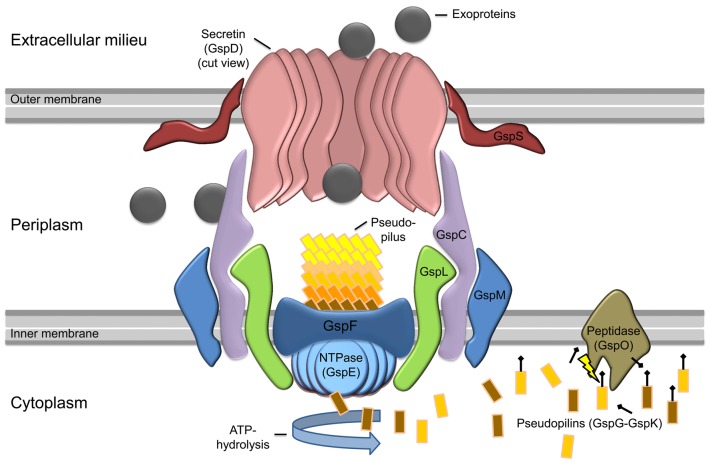
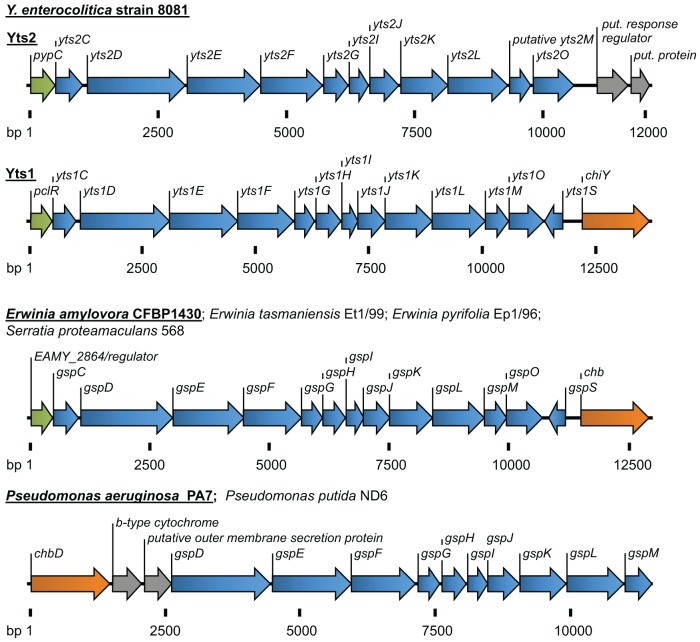
In Yersinia species, type III secretion (T3S) is the most prominent and best studied secretion system and a hallmark for the infection process of pathogenic Yersinia species. Type II secretion (T2S), on the other hand, is less well-characterized, although all Yersinia species, pathogenic as well as non-pathogenic, possess one or even two T2S systems. The only Yersinia strain in which T2S has so far been studied is the human pathogenic strain Y. enterocolitica 1b. Mouse infection experiments showed that at least one of the two T2S systems of Y. enterocolitica 1b, termed Yts1, is involved in dissemination and colonization of deeper tissues like liver and spleen. Interestingly, in vitro studies revealed a complex regulation of the Yts1 system, which is mainly active at low temperatures and high Mg(2+)-levels. Furthermore, the functional characterization of the proteins secreted in vitro indicates a role of the Yts1 machinery in survival of the bacteria in an environmental habitat. In silico analyses identified Yts1 homologous systems in bacteria that are known as plant symbionts or plant pathogens. Thus, the recent studies point to a dual function of the Yts1 T2S systems, playing a role in virulence of humans and animals, as well as in the survival of the bacteria outside of the mammalian host. In contrast, the role of the second T2S system, Yts2, remains ill defined. Whereas the T3S system and its virulence-mediating role has been intensively studied, it might now be time to also focus on the T2S system and its role in the Yersinia lifestyle, especially considering that most of the Yersinia isolates are not found in infected humans but have been gathered from various environmental samples.
在耶尔森氏菌属中,III 型分泌系统(T3S)是最突出和研究最多的分泌系统,也是致病性耶尔森氏菌属感染过程的标志。另一方面,II 型分泌系统(T2S)的特征不太明显,尽管所有致病性和非致病性的耶尔森氏菌都拥有一个甚至两个 T2S 系统。迄今为止,只有人类致病性菌株 Y. enterocolitica 1b 对 T2S 进行了研究。小鼠感染实验表明,Y. enterocolitica 1b 的两个 T2S 系统之一,称为 Yts1,至少参与了肝脏和脾脏等深部组织的传播和定植。有趣的是,体外研究揭示了 Yts1 系统的复杂调控,该系统主要在低温和高 Mg2+水平下活跃。此外,体外分泌蛋白的功能特征表明,Yts1 机制在细菌在环境栖息地中的存活中发挥作用。计算机分析在已知作为植物共生体或植物病原体的细菌中鉴定出 Yts1 同源系统。因此,最近的研究表明 Yts1 T2S 系统具有双重功能,既在人类和动物的毒力中发挥作用,也在哺乳动物宿主外的细菌存活中发挥作用。相比之下,第二个 T2S 系统 Yts2 的作用仍未明确。虽然 T3S 系统及其毒力介导作用已得到深入研究,但现在可能是时候也关注 T2S 系统及其在耶尔森氏菌生活方式中的作用了,特别是考虑到大多数耶尔森氏菌分离株不是在感染的人类中发现的,而是从各种环境样本中收集的。