Hur Junguk, Ozgür Arzucan, Xiang Zuoshuang, He Yongqun
Unit for Laboratory Animal Medicine, University of Michigan, 48109, Ann Arbor, MI, USA.
J Biomed Semantics. 2012 Dec 20;3(1):18. doi: 10.1186/2041-1480-3-18.
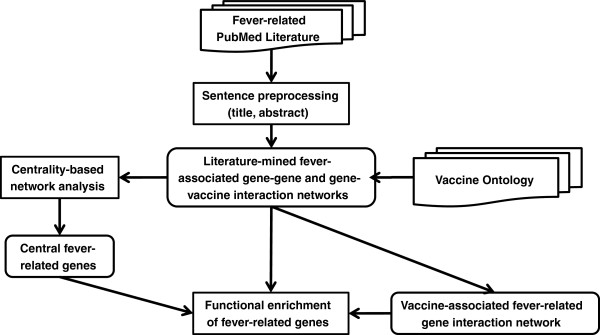
Fever is one of the most common adverse events of vaccines. The detailed mechanisms of fever and vaccine-associated gene interaction networks are not fully understood. In the present study, we employed a genome-wide, Centrality and Ontology-based Network Discovery using Literature data (CONDL) approach to analyse the genes and gene interaction networks associated with fever or vaccine-related fever responses.
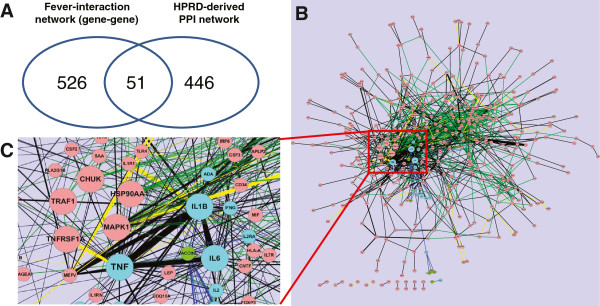
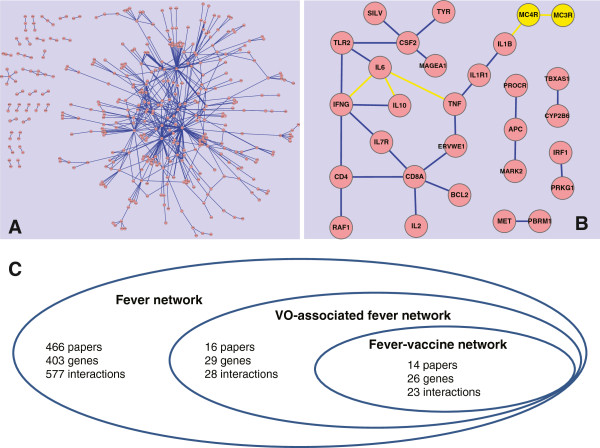
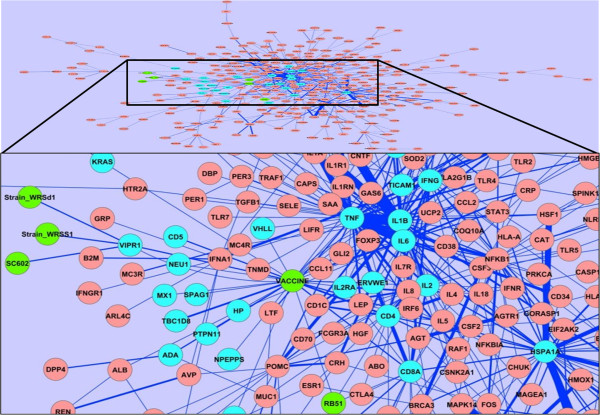
Over 170,000 fever-related articles from PubMed abstracts and titles were retrieved and analysed at the sentence level using natural language processing techniques to identify genes and vaccines (including 186 Vaccine Ontology terms) as well as their interactions. This resulted in a generic fever network consisting of 403 genes and 577 gene interactions. A vaccine-specific fever sub-network consisting of 29 genes and 28 gene interactions was extracted from articles that are related to both fever and vaccines. In addition, gene-vaccine interactions were identified. Vaccines (including 4 specific vaccine names) were found to directly interact with 26 genes. Gene set enrichment analysis was performed using the genes in the generated interaction networks. Moreover, the genes in these networks were prioritized using network centrality metrics. Making scientific discoveries and generating new hypotheses were possible by using network centrality and gene set enrichment analyses. For example, our study found that the genes in the generic fever network were more enriched in cell death and responses to wounding, and the vaccine sub-network had more gene enrichment in leukocyte activation and phosphorylation regulation. The most central genes in the vaccine-specific fever network are predicted to be highly relevant to vaccine-induced fever, whereas genes that are central only in the generic fever network are likely to be highly relevant to generic fever responses. Interestingly, no Toll-like receptors (TLRs) were found in the gene-vaccine interaction network. Since multiple TLRs were found in the generic fever network, it is reasonable to hypothesize that vaccine-TLR interactions may play an important role in inducing fever response, which deserves a further investigation.
This study demonstrated that ontology-based literature mining is a powerful method for analyzing gene interaction networks and generating new scientific hypotheses.
发热是疫苗最常见的不良事件之一。发热以及疫苗相关基因相互作用网络的详细机制尚未完全明确。在本研究中,我们采用基于文献数据的全基因组、中心性和本体的网络发现(CONDL)方法,分析与发热或疫苗相关发热反应相关的基因和基因相互作用网络。
从PubMed摘要和标题中检索到超过170,000篇与发热相关的文章,并使用自然语言处理技术在句子层面进行分析,以识别基因和疫苗(包括186个疫苗本体术语)及其相互作用。这产生了一个由403个基因和577个基因相互作用组成的通用发热网络。从与发热和疫苗均相关的文章中提取了一个由29个基因和28个基因相互作用组成的疫苗特异性发热子网。此外,还确定了基因 - 疫苗相互作用。发现疫苗(包括4个特定疫苗名称)与26个基因直接相互作用。使用生成的相互作用网络中的基因进行基因集富集分析。此外,利用网络中心性指标对这些网络中的基因进行了优先级排序。通过使用网络中心性和基因集富集分析,有可能做出科学发现并产生新的假设。例如,我们的研究发现通用发热网络中的基因在细胞死亡和对伤口的反应方面更富集,而疫苗子网在白细胞激活和磷酸化调节方面有更多的基因富集。疫苗特异性发热网络中最核心的基因预计与疫苗诱导的发热高度相关,而仅在通用发热网络中处于核心地位的基因可能与一般发热反应高度相关。有趣的是,在基因 - 疫苗相互作用网络中未发现Toll样受体(TLR)。由于在通用发热网络中发现了多个TLR,因此有理由推测疫苗 - TLR相互作用可能在诱导发热反应中起重要作用,这值得进一步研究。
本研究表明,基于本体的文献挖掘是分析基因相互作用网络和产生新的科学假设的有力方法。