Departamento de Biologia, Instituto de Biociências, Universidade Estadual Paulista, UNESP, Rio Claro, São Paulo, Brazil.
BMC Genet. 2012 Dec 26;13:109. doi: 10.1186/1471-2156-13-109.
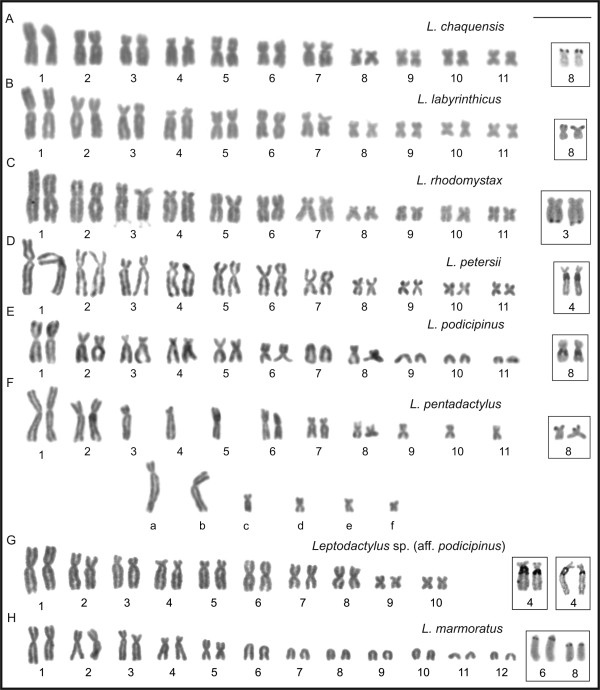
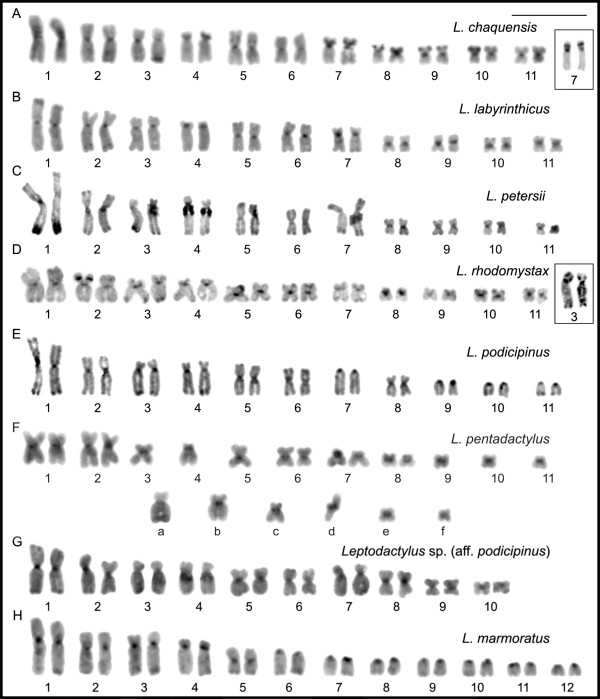
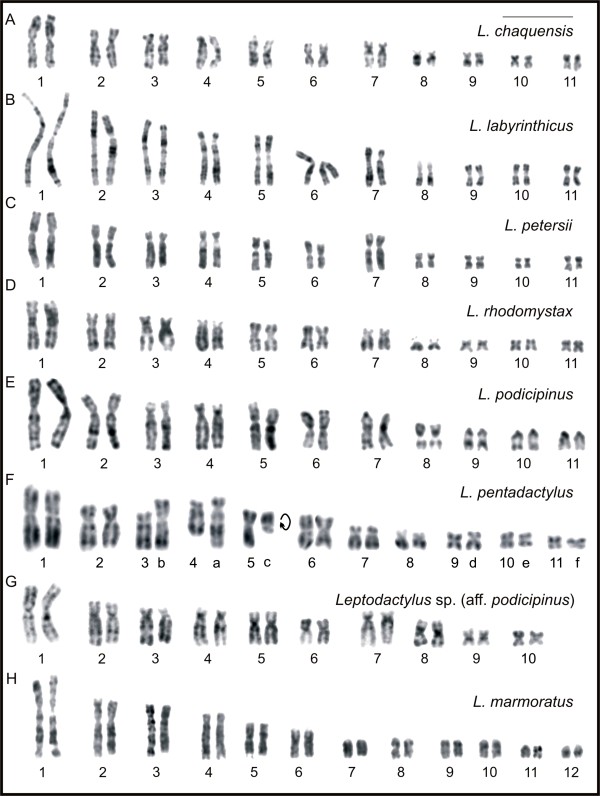
The karyotypes of Leptodactylus species usually consist of 22 bi-armed chromosomes, but morphological variations in some chromosomes and even differences in the 2n have been reported. To better understand the mechanisms responsible for these differences, eight species were analysed using classical and molecular cytogenetic techniques, including replication banding with BrdU incorporation.
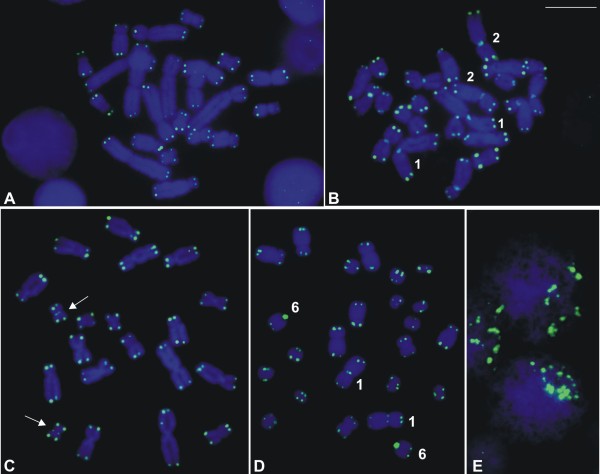
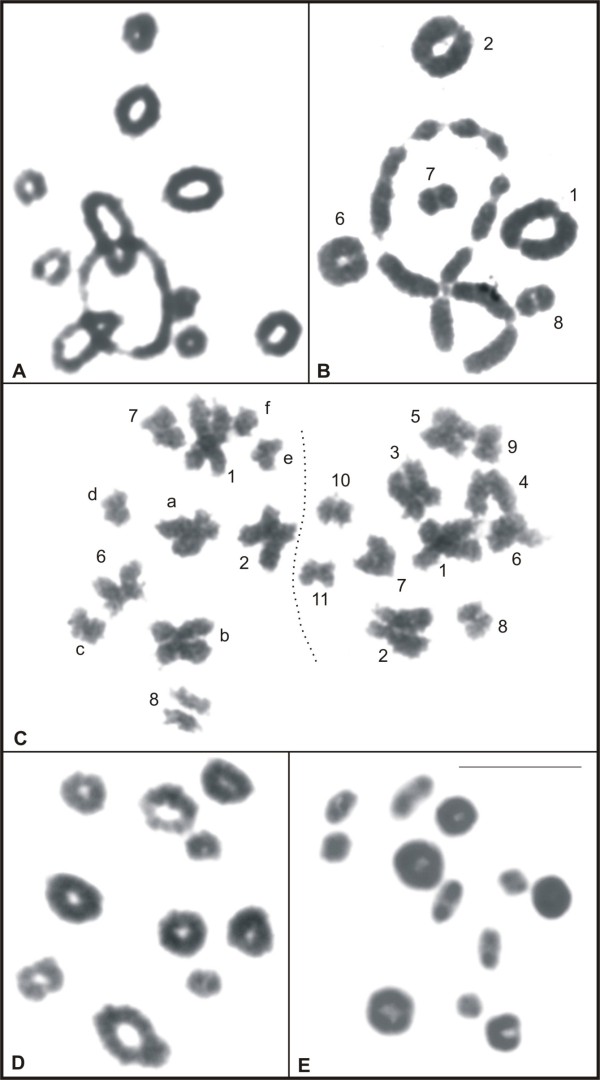
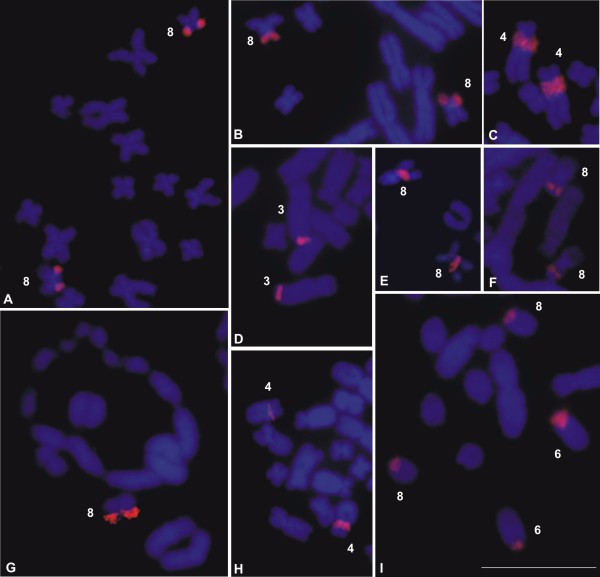
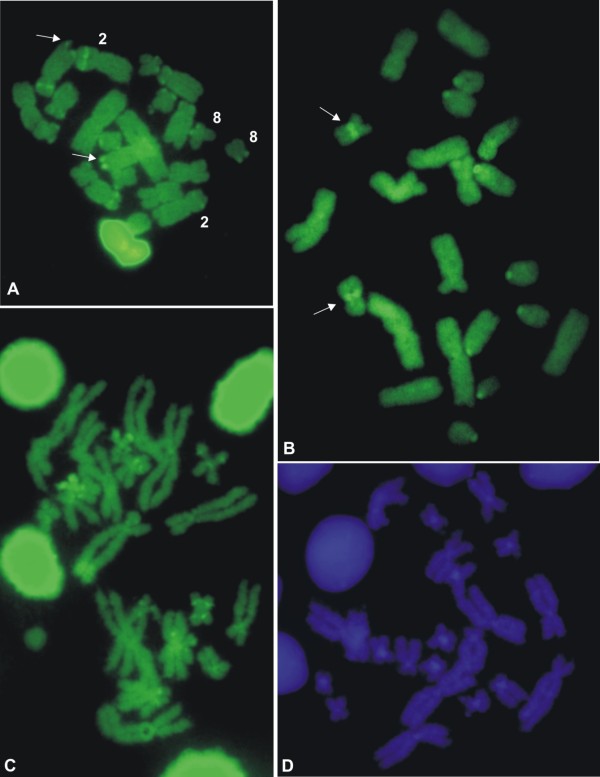
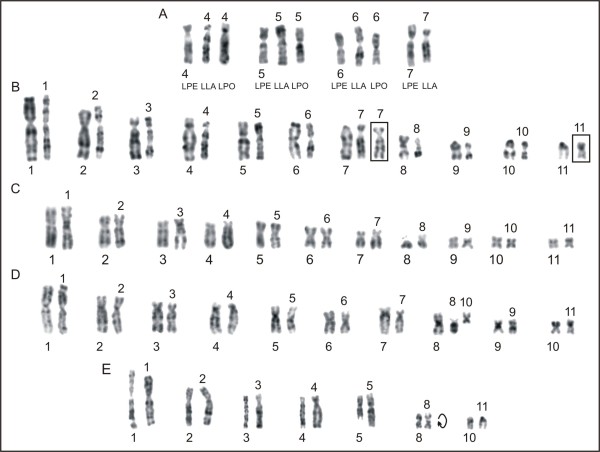
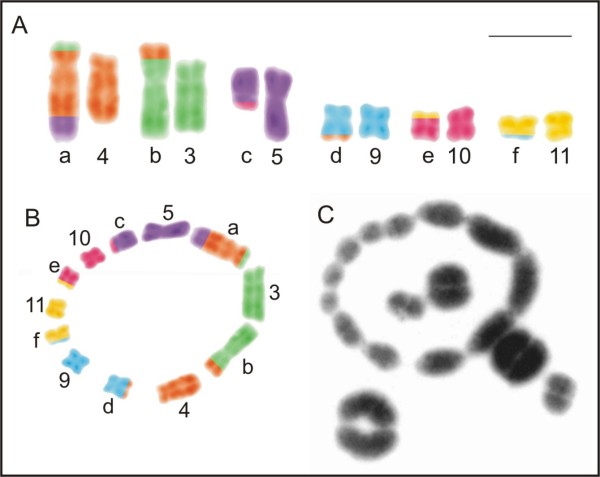
Distinct chromosome numbers were found: 2n = 22 in Leptodactylus chaquensis, L. labyrinthicus, L. pentadactylus, L. petersii, L. podicipinus, and L. rhodomystax; 2n = 20 in Leptodactylus sp. (aff. podicipinus); and 2n = 24 in L. marmoratus. Among the species with 2n = 22, only three had the same basic karyotype. Leptodactylus pentadactylus presented multiple translocations, L. petersii displayed chromosome morphological discrepancy, and L. podicipinus had four pairs of telocentric chromosomes. Replication banding was crucial for characterising this variability and for explaining the reduced 2n in Leptodactylus sp. (aff. podicipinus). Leptodactylus marmoratus had few chromosomes with a similar banding patterns to the 2n = 22 karyotypes. The majority of the species presented a single NOR-bearing pair, which was confirmed using Ag-impregnation and FISH with an rDNA probe. In general, the NOR-bearing chromosomes corresponded to chromosome 8, but NORs were found on chromosome 3 or 4 in some species. Leptodactylus marmoratus had NORs on chromosome pairs 6 and 8. The data from C-banding, fluorochrome staining, and FISH using the telomeric probe helped in characterising the repetitive sequences. Even though hybridisation did occur on the chromosome ends, telomere-like repetitive sequences outside of the telomere region were identified. Metaphase I cells from L. pentadactylus confirmed its complex karyotype constitution because 12 chromosomes appeared as ring-shaped chain in addition to five bivalents.
Species of Leptodactylus exhibited both major and minor karyotypic differences which were identified by classical and molecular cytogenetic techniques. Replication banding, which is a unique procedure that has been used to obtain longitudinal multiple band patterns in amphibian chromosomes, allowed us to outline the general mechanisms responsible for these karyotype differences. The findings also suggested that L. marmoratus, which was formerly included in the genus Adenomera, may have undergone great chromosomal repatterning.
通常,滑跖蟾属物种的核型由 22 对双臂染色体组成,但已有报道称,一些染色体存在形态变异,甚至 2n 也存在差异。为了更好地了解导致这些差异的机制,我们使用经典和分子细胞遗传学技术(包括 BrdU 掺入的复制带型分析)对 8 个物种进行了分析。
发现了不同的染色体数目:2n = 22 见于 Leptodactylus chaquensis、L. labyrinthicus、L. pentadactylus、L. petersii、L. podicipinus 和 L. rhodomystax;2n = 20 见于 Leptodactylus sp.(近似 podicipinus);2n = 24 见于 L. marmoratus。在 2n = 22 的物种中,只有三种具有相同的基本核型。Leptodactylus pentadactylus 存在多种易位,L. petersii 存在染色体形态差异,而 L. podicipinus 则有四对端着丝粒染色体。复制带型分析对于描述这种变异性以及解释 Leptodactylus sp.(近似 podicipinus)中减少的 2n 至关重要。Leptodactylus marmoratus 的少数染色体具有与 2n = 22 核型相似的带型模式。大多数物种具有单一的 NOR 着丝粒对,这通过 Ag 浸渍和使用 rDNA 探针的 FISH 得到了证实。一般来说,NOR 着丝粒对对应于第 8 号染色体,但在一些物种中,NOR 位于第 3 号或 4 号染色体上。Leptodactylus marmoratus 的 NOR 位于第 6 号和第 8 号染色体对上。C-带、荧光染料染色和使用端粒探针的 FISH 数据有助于描述重复序列。尽管在染色体末端发生了杂交,但在端粒区域之外发现了类似于端粒的重复序列。Leptodactylus pentadactylus 的中期 I 细胞证实了其复杂的核型组成,因为除了五个二价体外,还有 12 条染色体呈现为环形链。
滑跖蟾属物种表现出明显的核型差异,这些差异可通过经典和分子细胞遗传学技术来识别。复制带型分析是一种独特的程序,用于在两栖动物染色体中获得纵向多重带型,它使我们能够概述导致这些核型差异的一般机制。研究结果还表明,曾被归入 Adenomera 属的 L. marmoratus 可能经历了巨大的染色体重排。