IRCCS San Martino University Hospital - IST National Cancer Research Institute and the University of Genoa, Academic Unit of Medical Oncology UOC Oncologia Medica B, Largo Rosanna Benzi 10, 16132 Genoa, Italy.
BMC Cancer. 2012 Dec 28;12:625. doi: 10.1186/1471-2407-12-625.
The purpose of the present study was to evaluate the prognostic value of POSTN expression following prostatectomy.
Periostin (POSTN) expression in prostate cancer (PCa) and in normal specimens was evaluated in 90 patients by an immuno-reactive score(IRS) based on the intensity of immunostaining and on the quantity of stained cells. The t-test was applied to compare IRS values in cancer specimens to values in normal specimens. Pearson's test was used to correlate POSTN expression to clinical pathologic features. PSA progression-free and survival curves were constructed by the Kaplan-Meier method and compared using the log-rank test. Multi-parametric models were constructed according to the Cox technique adding all the covariates predicting for either PSA progression or death into the models after univariate analysis.
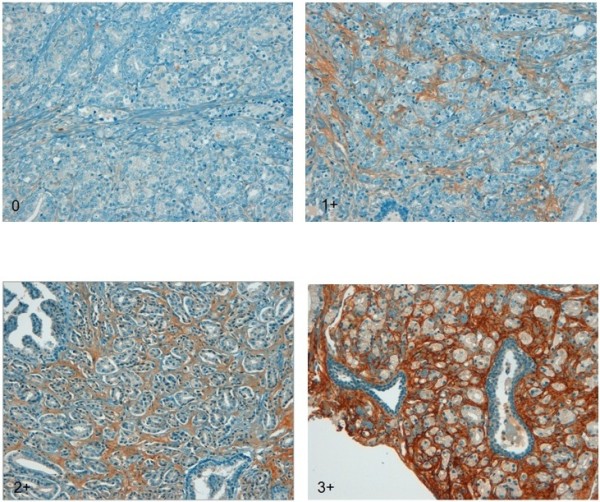
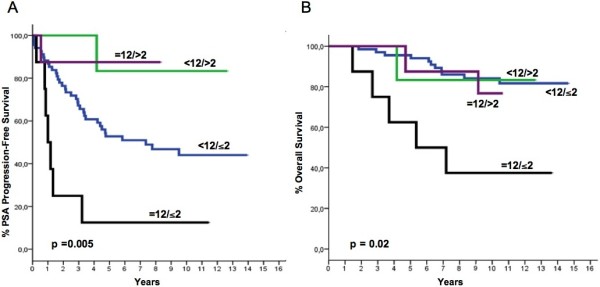
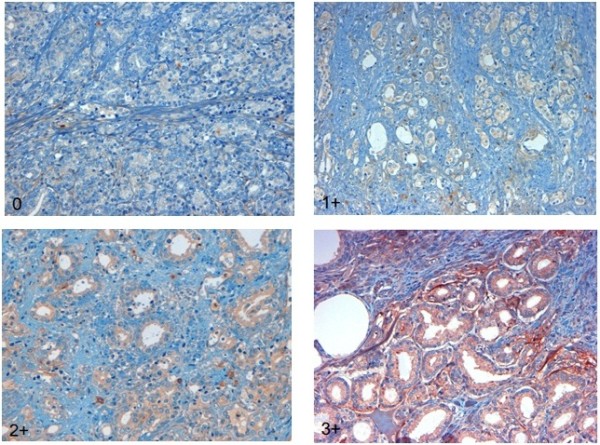
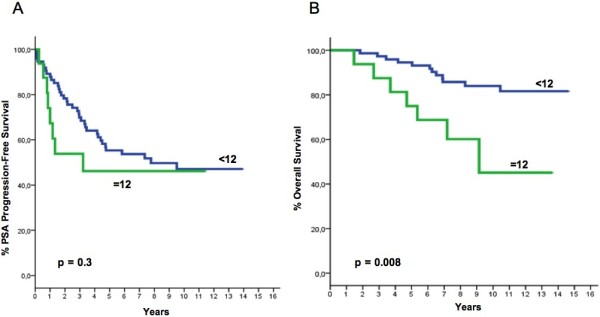
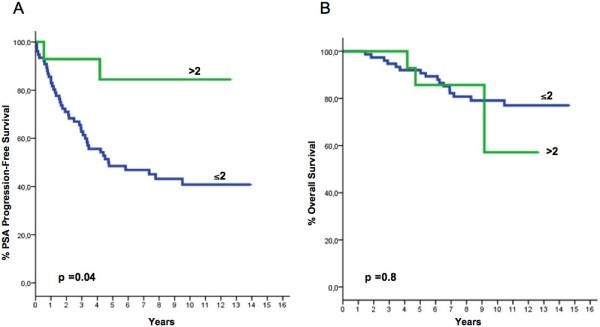
Both stromal and epithelial POSTN expression were significantly increased in tumor tissues. In particular, we found stromal expression to be significantly higher than epithelial expression as compared to normal tissues (p<0.000 and p=0.001).A significant correlation between POSTN epithelial expression and extra-prostatic extension was found (p=0.03). While high stromal expression was significantly associated with shorter survival (p=0.008), a low epithelial score significantly correlated with shorter PSA-free survival (p=0.04), suggesting that POSTN plays an apparently opposing biological role depending on its compartmentalization.Regardless of the mechanism that is involved, patients showing both high stromal and low epithelial expression made up a subgroup with a very bleak prognosis.
Although requiring further validation through larger studies, our findings show that POSTN might represent a novel prognostic marker for PCa.
本研究旨在评估前列腺切除术后 POSTN 表达的预后价值。
通过免疫反应评分(IRS)评估 90 例前列腺癌(PCa)和正常标本中的periostin(POSTN)表达,IRS 基于免疫染色的强度和染色细胞的数量。采用 t 检验比较癌症标本中 IRS 值与正常标本中 IRS 值的差异。采用 Pearson 检验分析 POSTN 表达与临床病理特征的相关性。采用 Kaplan-Meier 方法构建 PSA 无进展生存和总生存曲线,并通过对数秩检验进行比较。根据 Cox 技术构建多参数模型,在单因素分析后将所有预测 PSA 进展或死亡的协变量添加到模型中。
肿瘤组织中基质和上皮 POSTN 表达均显著增加。特别是,与正常组织相比,我们发现基质表达明显高于上皮表达(p<0.000 和 p=0.001)。POSTN 上皮表达与前列腺外延伸显著相关(p=0.03)。虽然高基质表达与较短的生存时间显著相关(p=0.008),但低上皮评分与较短的 PSA 无进展生存时间显著相关(p=0.04),表明 POSTN 发挥着明显相反的生物学作用,取决于其分布位置。无论涉及的机制如何,表现出高基质和低上皮表达的患者构成了预后极差的亚组。
尽管需要通过更大的研究进一步验证,但我们的研究结果表明,POSTN 可能是 PCa 的一种新的预后标志物。