Key Laboratory of Vegetation Restoration and Management of Degraded Ecosystems, South China Botanical Garden, Chinese Academy of Sciences, Guangzhou, China.
PLoS One. 2012;7(12):e52071. doi: 10.1371/journal.pone.0052071. Epub 2012 Dec 20.
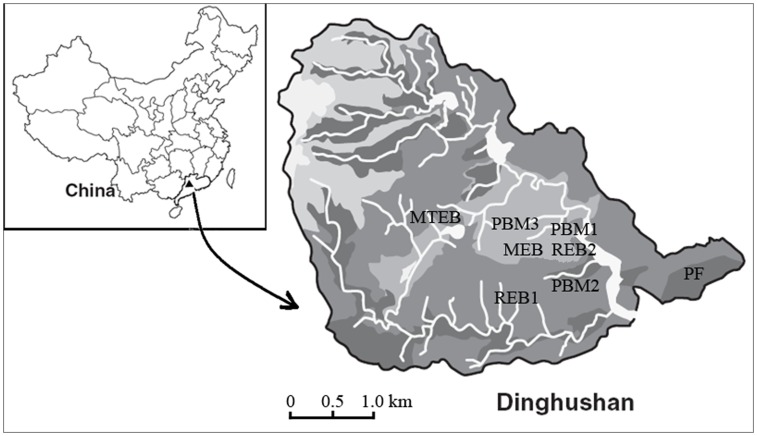
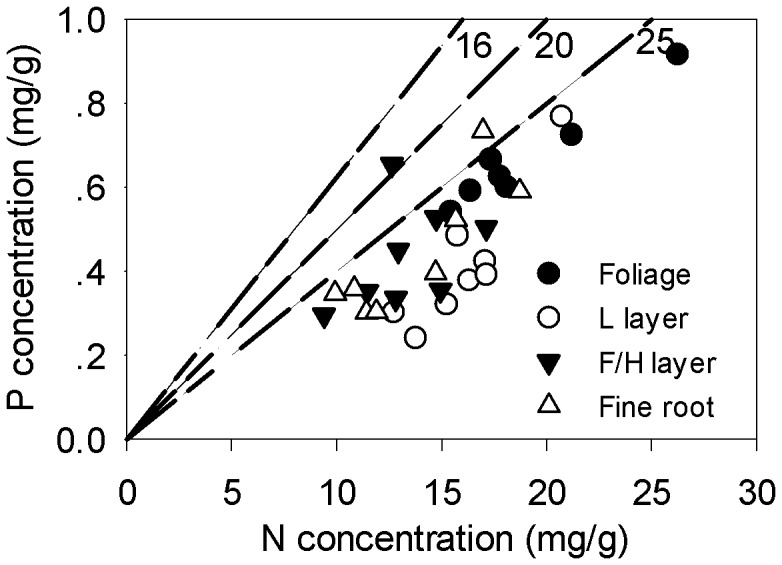
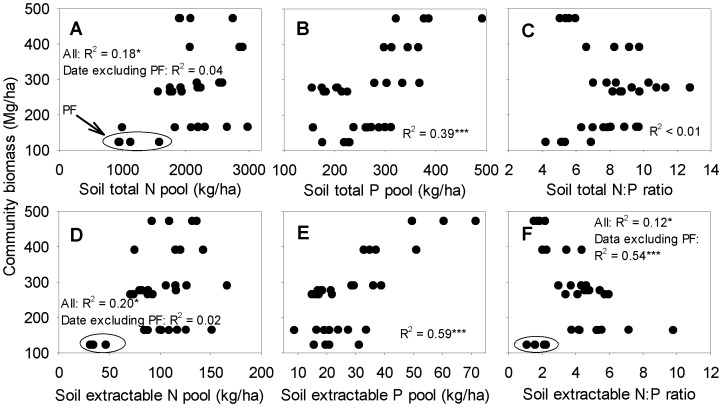
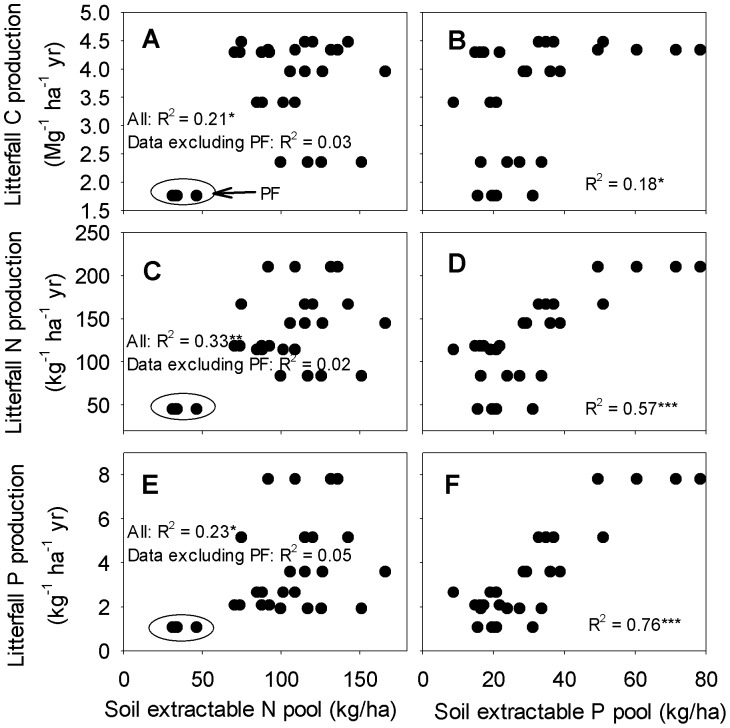
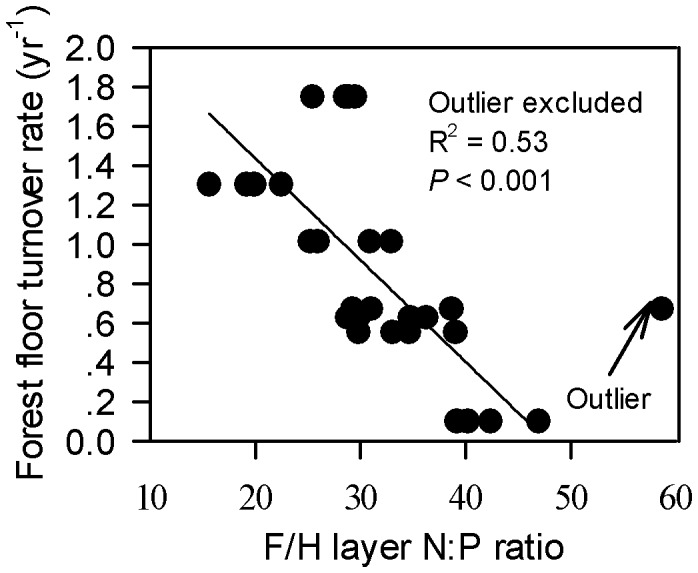
Nitrogen (N) is considered the dominant limiting nutrient in temperate regions, while phosphorus (P) limitation frequently occurs in tropical regions, but in subtropical regions nutrient limitation is poorly understood. In this study, we investigated N and P contents and N:P ratios of foliage, forest floors, fine roots and mineral soils, and their relationships with community biomass, litterfall C, N and P productions, forest floor turnover rate, and microbial processes in eight mature and old-growth subtropical forests (stand age >80 yr) at Dinghushan Biosphere Reserve, China. Average N:P ratios (mass based) in foliage, litter (L) layer and mixture of fermentation and humus (F/H) layer, and fine roots were 28.3, 42.3, 32.0 and 32.7, respectively. These values are higher than the critical N:P ratios for P limitation proposed (16-20 for foliage, ca. 25 for forest floors). The markedly high N:P ratios were mainly attributed to the high N concentrations of these plant materials. Community biomass, litterfall C, N and P productions, forest floor turnover rate and microbial properties were more strongly related to measures of P than N and frequently negatively related to the N:P ratios, suggesting a significant role of P availability in determining ecosystem production and productivity and nutrient cycling at all the study sites except for one prescribed disturbed site where N availability may also be important. We propose that N enrichment is probably a significant driver of the potential P limitation in the study area. Low P parent material may also contribute to the potential P limitation. In general, our results provided strong evidence supporting a significant role for P availability, rather than N availability, in determining ecosystem primary productivity and ecosystem processes in subtropical forests of China.
氮(N)被认为是温带地区的主要限制养分,而磷(P)限制则经常发生在热带地区,但在亚热带地区,养分限制的情况了解甚少。本研究在中国鼎湖山生物圈保护区的 8 个成熟和古老的亚热带森林(林龄>80 年)中,调查了叶片、林下地被物、细根和矿物土壤中的 N 和 P 含量及其 N:P 比,以及它们与群落生物量、凋落物 C、N 和 P 产量、林下地被物周转率和微生物过程的关系。叶片、凋落物(L)层和发酵与腐殖质(F/H)层混合物以及细根的平均 N:P 比(基于质量)分别为 28.3、42.3、32.0 和 32.7。这些值高于提出的 P 限制的临界 N:P 比(叶片为 16-20,林下地被物约为 25)。显著高的 N:P 比主要归因于这些植物材料的高 N 浓度。群落生物量、凋落物 C、N 和 P 产量、林下地被物周转率和微生物特性与 P 措施的关系更为密切,而与 N 的关系则经常为负相关,这表明在所有研究地点(除了一个受规定干扰的地点),P 的可用性在确定生态系统生产力和生产力以及养分循环方面起着重要作用,而在这个受规定干扰的地点,N 的可用性可能也很重要。我们提出,N 富集可能是该研究区域潜在 P 限制的一个重要驱动因素。低 P 母质也可能导致潜在的 P 限制。总的来说,我们的结果提供了强有力的证据,支持了 P 可用性在决定中国亚热带森林生态系统初级生产力和生态系统过程中的重要作用,而不是 N 可用性。