School of Social Sciences and Psychology, University of Western Sydney, Locked Bag 1797, Penrith, NSW 2751, Australia.
BMC Psychiatry. 2013 Jan 3;13:4. doi: 10.1186/1471-244X-13-4.
Engagement in Deliberate Self-Harm (DSH) is commonly measured by behavioural scales comprised of specific methods of self-harm. However, there is a scarcity of information about the degree to which the methods relate to the same DSH construct although such scales are routinely used to provide a DSH total score. This study addresses the shortfall by evaluating the dimensionality of six commonly used behavioural measures of DSH.
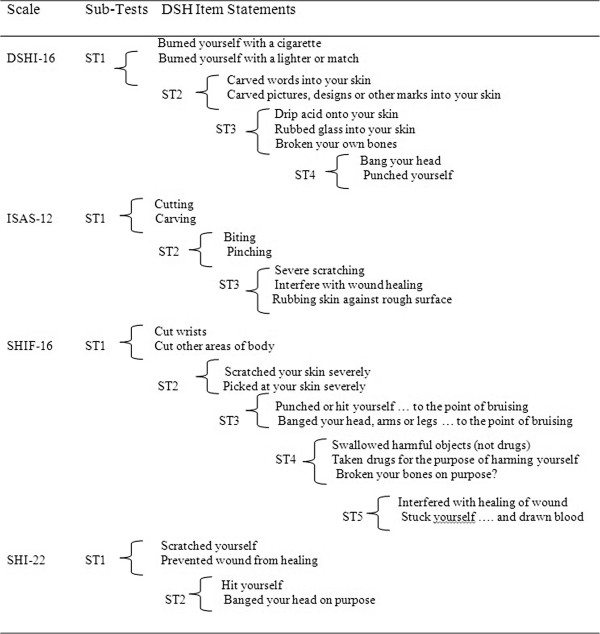
The DSH measures were Self-Injury Questionnaire Treatment Related (SIQTR), Self-Injurious Thoughts and Behaviors Interview (SITBI), Deliberate Self-Harm Inventory (DSHI), Inventory of Statements About Self-Injury (ISAS), Self-Harm Information Form (SHIF) and Self-Harm Inventory (SHI). The behavioural scales contained in each measure were administered to 568 young Australians aged 18 to 30 years (62% university students, 21% mental health patients, and 17% community members). Scale quality was examined against the stringent standards for unidimensional measurement provided by the Rasch model.
According to the stringent post-hoc tests provided by the Rasch measurement model, there is support for the unidimensionality of the items contained within each of the scales. All six scales contained items with differential item functioning, four scales contained items with local response dependency, and one item was grossly misfitting (due to a lack of discrimination).
This study supports the use of behavioural scales to measure a DSH construct, justifies the summing of items to form a total DSH score, informs the hierarchy of DSH methods in each scale, and extends the previous evidence for reliability and external validity (as provided by test developers) to a more complete account of scale quality. Given the overall adequacy of all six scales, clinicians and researchers are recommended to select the scale that best matches their adopted definition of DSH.
故意自伤(DSH)的行为通常通过包含自伤特定方法的行为量表来衡量。然而,尽管这些量表通常用于提供 DSH 总分,但关于这些方法与同一 DSH 结构的关联程度的信息却很少。本研究通过评估六种常用的 DSH 行为测量方法的维度来弥补这一不足。
DSH 测量方法包括自我伤害问卷治疗相关(SIQTR)、自我伤害思维和行为访谈(SITBI)、故意自伤量表(DSHI)、自我伤害陈述量表(ISAS)、自我伤害信息表(SHIF)和自我伤害量表(SHI)。每个量表中包含的行为量表均在 568 名年龄在 18 至 30 岁的澳大利亚年轻人(62%为大学生,21%为精神健康患者,17%为社区成员)中进行了测试。量表质量根据 Rasch 模型提供的严格的一维测量标准进行了检验。
根据 Rasch 测量模型提供的严格事后检验,每个量表中包含的项目都支持一维性。所有六个量表都包含具有不同项目功能的项目,四个量表包含具有局部响应依赖性的项目,一个项目严重拟合不良(由于缺乏区分度)。
本研究支持使用行为量表来测量 DSH 结构,证明了将项目相加形成 DSH 总分的合理性,为每个量表中的 DSH 方法层次结构提供了信息,并扩展了以前关于可靠性和外部有效性的证据(由测试开发者提供),以更完整地说明量表质量。鉴于所有六个量表的总体充分性,建议临床医生和研究人员选择最符合其采用的 DSH 定义的量表。