Centre for Population Health Sciences and Global Health Academy, The University of Edinburgh Medical School, Edinburgh, Scotland, UK.
J Glob Health. 2012 Dec;2(2):020402. doi: 10.7189/jogh.02.020402.
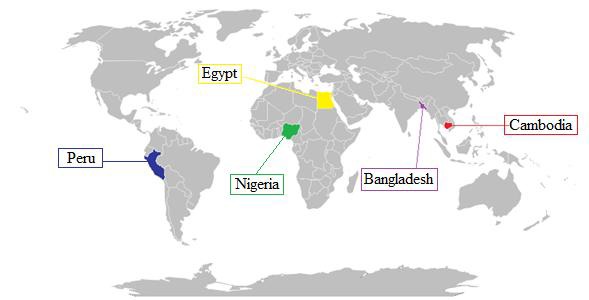
The aim of this study was to populate the Equitable Impact Sensitive Tool (EQUIST) framework with all necessary data and conduct the first implementation of EQUIST in studying cost-effectiveness of community case management of childhood pneumonia in 5 low- and middle-income countries with relation to equity impact.
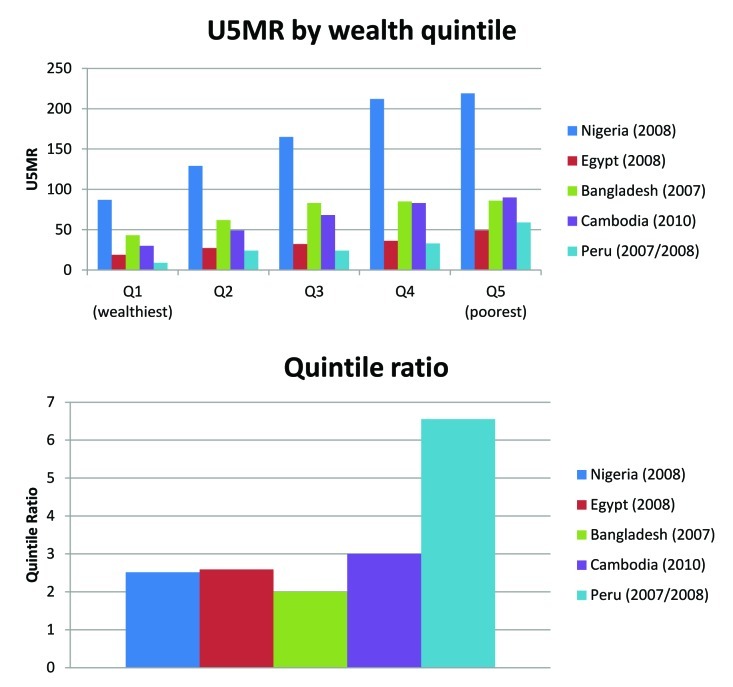
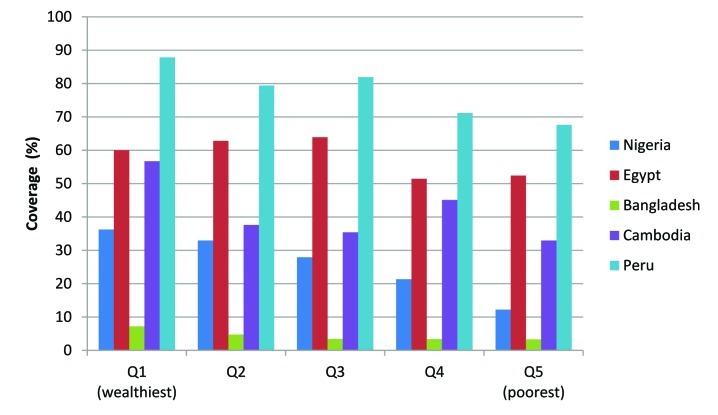
Wealth quintile-specific data were gathered or modelled for all contributory determinants of the EQUIST framework, namely: under-five mortality rate, cost of intervention, intervention effectiveness, current coverage of intervention and relative disease distribution. These were then combined statistically to calculate the final outcome of the EQUIST model for community case management of childhood pneumonia: US$ per life saved, in several different approaches to scaling-up.
The current 'mainstream' approach to scaling-up of interventions is never the most cost-effective. Community-case management appears to strongly support an 'equity-promoting' approach to scaling-up, displaying the highest levels of cost-effectiveness in interventions targeted at the poorest quintile of each study country, although absolute cost differences vary by context.
The relationship between cost-effectiveness and equity impact is complex, with many determinants to consider. One important way to increase intervention cost-effectiveness in poorer quintiles is to improve the efficiency and quality of delivery. More data are needed in all areas to increase the accuracy of EQUIST-based estimates.
本研究旨在利用 EQUIST 框架填充所有必要数据,并首次将 EQUIST 应用于研究 5 个中低收入国家中儿童肺炎社区管理的成本效益及其与公平性影响的关系。
为 EQUIST 框架的所有贡献决定因素(即:五岁以下儿童死亡率、干预成本、干预效果、当前干预覆盖率和相对疾病分布)收集或建模了特定于五分位数的财富数据。然后,通过统计方法将这些数据结合起来,计算儿童肺炎社区管理的 EQUIST 模型的最终结果:以美元/挽救生命数表示,采用了几种不同的扩大规模方法。
目前干预措施的“主流”扩大规模方法并非最具成本效益。社区病例管理似乎强烈支持“促进公平”的扩大规模方法,在针对每个研究国家最贫穷五分位数的干预措施中显示出最高的成本效益水平,尽管绝对成本差异因背景而异。
成本效益和公平性影响之间的关系是复杂的,需要考虑许多决定因素。在较贫穷的五分位数中提高干预措施的成本效益的一种重要方法是提高提供的效率和质量。需要在所有领域收集更多数据,以提高基于 EQUIST 的估计的准确性。