Department of Population Medicine, Ontario Veterinary College, University of Guelph, Guelph, ON, Canada.
BMC Vet Res. 2013 Jan 5;9:2. doi: 10.1186/1746-6148-9-2.
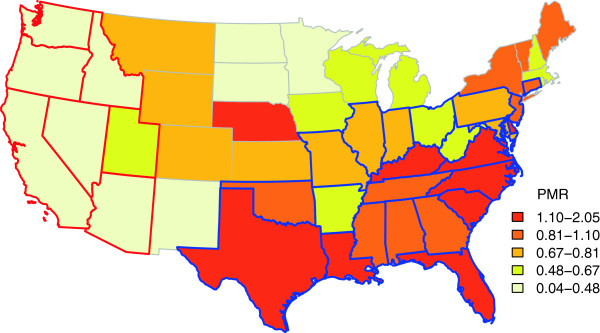
Although feline immunodeficiency virus (FIV) and feline leukemia virus (FeLV) have similar risk factors and control measures, infection rates have been speculated to vary in geographic distribution over North America. Since both infections are endemic in North America, it was assumed as a working hypothesis that their geographic distributions were similar. Hence, the purpose of this exploratory analysis was to investigate the comparative geographical distribution of both viral infections. Counts of FIV (n=17,108) and FeLV (n=30,017) positive serology results (FIV antibody and FeLV ELISA) were obtained for 48 contiguous states and District of Columbia of the United States of America (US) from the IDEXX Laboratories website. The proportional morbidity ratio of FIV to FeLV infection was estimated for each administrative region and its geographic distribution pattern was visualized by a choropleth map. Statistical evidence of an excess in the proportional morbidity ratio from unity was assessed using the spatial scan test under the normal probability model.
This study revealed distinct spatial distribution patterns in the proportional morbidity ratio suggesting the presence of one or more relevant and geographically varying risk factors. The disease map indicates that there is a higher prevalence of FIV infections in the southern and eastern US compared to FeLV. In contrast, FeLV infections were observed to be more frequent in the western US compared to FIV. The respective excess in proportional morbidity ratio was significant with respect to the spatial scan test (p < 0.05).
The observed variability in the geographical distribution of the proportional morbidity ratio of FIV to FeLV may be related to the presence of an additional or unique, but yet unknown, spatial risk factor. Putative factors may be geographic variations in specific virus strains and rate of vaccination. Knowledge of these factors and the geographical distributions of these infections can inform recommendations for testing, management and prevention. However, further studies are required to investigate the potential association of these factors with FIV and FeLV.
尽管猫免疫缺陷病毒(FIV)和猫白血病病毒(FeLV)具有相似的危险因素和控制措施,但据推测,它们在北美的感染率在地理分布上有所不同。由于这两种感染在北美的流行,因此假设它们的地理分布相似是一个工作假设。因此,本探索性分析的目的是调查这两种病毒感染的比较地理分布。从 IDEXX 实验室网站获得了美国 48 个毗邻州和哥伦比亚特区的 FIV(n=17,108)和 FeLV(n=30,017)阳性血清学结果(FIV 抗体和 FeLV ELISA)的计数。对每个行政区的 FIV 与 FeLV 感染的比例发病率进行了估计,并通过专题地图可视化其地理分布模式。使用正态概率模型下的空间扫描检验评估了比例发病率超过 1 的统计证据。
本研究揭示了比例发病率的不同空间分布模式,表明存在一个或多个相关且具有地理差异的危险因素。疾病地图表明,与 FeLV 相比,美国南部和东部的 FIV 感染更为普遍。相比之下,与 FIV 相比,西部的 FeLV 感染更为普遍。就空间扫描检验而言,比例发病率的相应过剩具有统计学意义(p<0.05)。
观察到 FIV 与 FeLV 比例发病率的地理分布存在可变性,这可能与存在额外的或独特但尚未知的空间危险因素有关。推测因素可能是特定病毒株和疫苗接种率的地理差异。了解这些因素以及这些感染的地理分布可以为检测、管理和预防提供建议。然而,需要进一步研究来调查这些因素与 FIV 和 FeLV 的潜在关联。