Aida Virginia, Pliasas Vasilis C, Neasham Peter J, North J Fletcher, McWhorter Kirklin L, Glover Sheniqua R, Kyriakis Constantinos S
Department of Pathobiology, College of Veterinary Medicine, Auburn University, Auburn, AL, United States.
Emory-University of Georgia (UGA) Center of Excellence for Influenza Research and Surveillance (CEIRS), Auburn, AL, United States.
Front Vet Sci. 2021 Apr 15;8:654289. doi: 10.3389/fvets.2021.654289. eCollection 2021.
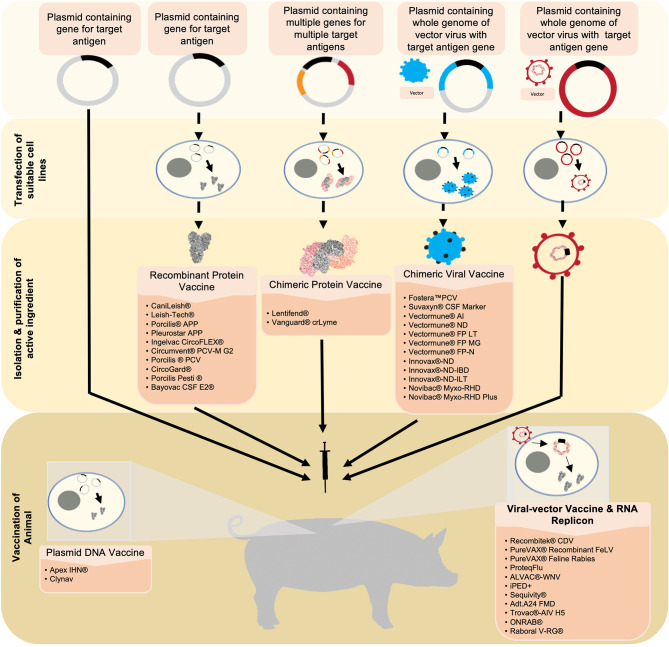
The success of inactivated and live-attenuated vaccines has enhanced livestock productivity, promoted food security, and attenuated the morbidity and mortality of several human, animal, and zoonotic diseases. However, these traditional vaccine technologies are not without fault. The efficacy of inactivated vaccines can be suboptimal with particular pathogens and safety concerns arise with live-attenuated vaccines. Additionally, the rate of emerging infectious diseases continues to increase and with that the need to quickly deploy new vaccines. Unfortunately, first generation vaccines are not conducive to such urgencies. Within the last three decades, veterinary medicine has spearheaded the advancement in novel vaccine development to circumvent several of the flaws associated with classical vaccines. These third generation vaccines, including DNA, RNA and recombinant viral-vector vaccines, induce both humoral and cellular immune response, are economically manufactured, safe to use, and can be utilized to differentiate infected from vaccinated animals. The present article offers a review of commercially available novel vaccine technologies currently utilized in companion animal, food animal, and wildlife disease control.
灭活疫苗和减毒活疫苗的成功提高了牲畜生产力,促进了粮食安全,并降低了多种人类、动物和人畜共患疾病的发病率和死亡率。然而,这些传统疫苗技术并非毫无缺陷。灭活疫苗对某些特定病原体的效力可能欠佳,而减毒活疫苗则存在安全性问题。此外,新发传染病的发生率持续上升,因此需要迅速部署新疫苗。不幸的是,第一代疫苗并不适合应对此类紧急情况。在过去三十年中,兽医学率先推动了新型疫苗开发的进展,以规避与传统疫苗相关的若干缺陷。这些第三代疫苗,包括DNA、RNA和重组病毒载体疫苗,可诱导体液免疫和细胞免疫反应,生产成本低,使用安全,并且可用于区分感染动物和接种疫苗的动物。本文综述了目前用于伴侣动物、食用动物和野生动物疾病防控的新型商用疫苗技术。