Department of Infection Control Science, Juntendo University, Tokyo, Japan.
BMC Microbiol. 2013 Jan 7;13:2. doi: 10.1186/1471-2180-13-2.
The spread of MRSA strains at hospitals as well as in the community are of great concern worldwide. We characterized the MRSA clones isolated at Tunisian hospitals and in the community by comparing them to those isolated in other countries.
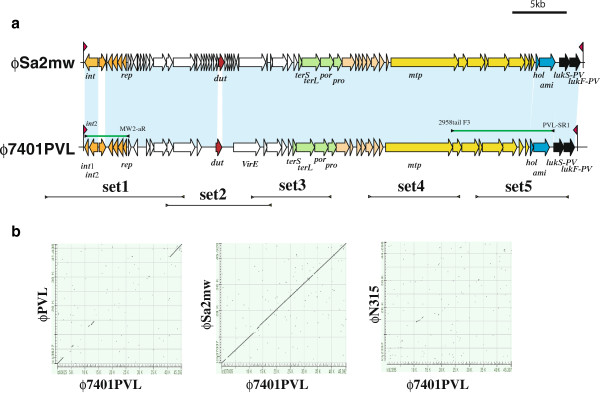
We characterized 69 MRSA strains isolated from two Tunisian university hospitals between the years 2004-2008. Twenty-two of 28 (79%) community-associated MRSA (CA-MRSA) strains and 21 of 41 (51%) healthcare-associated MRSA (HA-MRSA) strains were PVL-positive. The PVL-positive strains belonged to predicted founder group (FG) 80 in MLST and carried either type IVc SCCmec or nontypeable SCCmec that harbours the class B mec gene complex. In contrast, very diverse clones were identified in PVL-negative strains: three FGs (5, 15, and 22) for HA-MRSA strains and four FGs (5, 15, 45, and 80) for CA-MRSA strains; and these strains carried the SCCmec element of either type I, III, IVc or was nontypeable. The nucleotide sequencing of phi7401PVL lysogenized in a CA-MRSA strain JCSC7401, revealed that the phage was highly homologous to phiSA2mw, with nucleotide identities of more than 95%. Furthermore, all PVL positive strains were found to carry the same PVL phage, since these strains were positive in two PCR studies, identifying gene linkage between lukS and mtp (major tail protein) and the lysogeny region, both of which are in common with phi7401PVL and phiSa2mw.
Our experiments suggest that FG80 S. aureus strains have changed to be more virulent by acquiring phi7401PVL, and to be resistant to β-lactams by acquiring SCCmec elements. These novel clones might have disseminated in the Tunisian community as well as at the Tunisian hospitals by taking over existing MRSA clones.
耐甲氧西林金黄色葡萄球菌 (MRSA) 菌株在医院和社区的传播引起了全球的极大关注。我们通过比较从突尼斯医院和社区分离的 MRSA 克隆与其他国家分离的克隆,对其进行了特征描述。
我们对 2004 年至 2008 年期间从突尼斯两所大学医院分离的 69 株 MRSA 菌株进行了特征描述。28 株社区相关 MRSA (CA-MRSA) 菌株中有 22 株(79%)和 41 株医疗保健相关 MRSA (HA-MRSA) 菌株中有 21 株(51%)为 PVL 阳性。PVL 阳性菌株在 MLST 中属于预测的创始人群(FG)80,携带类型 IVc SCCmec 或不可分型 SCCmec,其中包含 B 类 mec 基因复合物。相比之下,在 PVL 阴性菌株中鉴定出了非常多样化的克隆:HA-MRSA 菌株中有 3 个 FG(5、15 和 22),CA-MRSA 菌株中有 4 个 FG(5、15、45 和 80);这些菌株携带的 SCCmec 元件类型为 I、III、IVc 或不可分型。在 CA-MRSA 菌株 JCSC7401 中溶原化的 phi7401PVL 的核苷酸测序表明,该噬菌体与 phiSA2mw 高度同源,核苷酸同一性超过 95%。此外,所有 PVL 阳性菌株都携带相同的 PVL 噬菌体,因为这些菌株在两项 PCR 研究中均呈阳性,该两项研究确定了 lukS 和 mtp(主要尾部蛋白)与溶原区域之间的基因连接,这两个区域与 phi7401PVL 和 phiSa2mw 均相同。
我们的实验表明,FG80 金黄色葡萄球菌菌株通过获得 phi7401PVL 而变得更具毒性,并通过获得 SCCmec 元件而对β-内酰胺类药物产生耐药性。这些新型克隆可能已经通过接管现有的 MRSA 克隆在突尼斯社区以及突尼斯医院中传播。