Department of Radiation Oncology, University Medical Centre Mannheim, University of Heidelberg, Mannheim, 68167, Germany.
Radiat Oncol. 2013 Jan 7;8:9. doi: 10.1186/1748-717X-8-9.
Intraoperative radiotherapy (IORT) is a new treatment approach for early stage breast cancer. This study reports on the effects of IORT on radiation-related quality of life (QoL) parameters.
Two hundred and thirty women with stage I-III breast cancer (age, 31 to 84 years) were entered into the study. A single-center subgroup of 87 women from the two arms of the randomized phase III trial TARGIT-A (TARGeted Intra-operative radioTherapy versus whole breast radiotherapy for breast cancer) was analyzed. Furthermore, results were compared to non-randomized control groups: n = 90 receiving IORT as a tumor bed boost followed by external beam whole breast radiotherapy (EBRT) outside of TARGIT-A (IORT-boost), and n = 53 treated with EBRT followed by an external-beam boost (EBRT-boost). QoL was collected using the European Organization for Research and Treatment of Cancer Quality of Life Questionnaires C30 (QLQ-C30) and BR23 (QLQ-BR23). The mean follow-up period in the TARGIT-A groups was 32 versus 39 months in the non-randomized control groups.
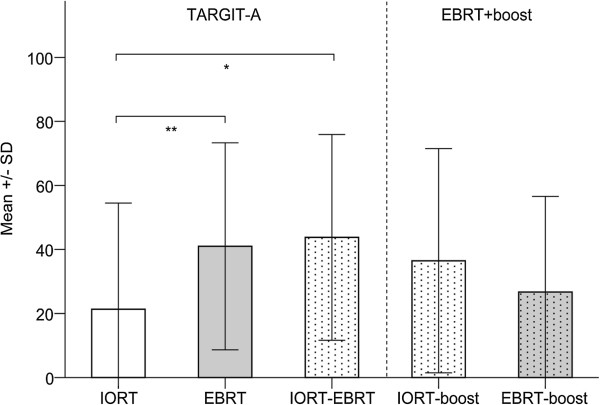
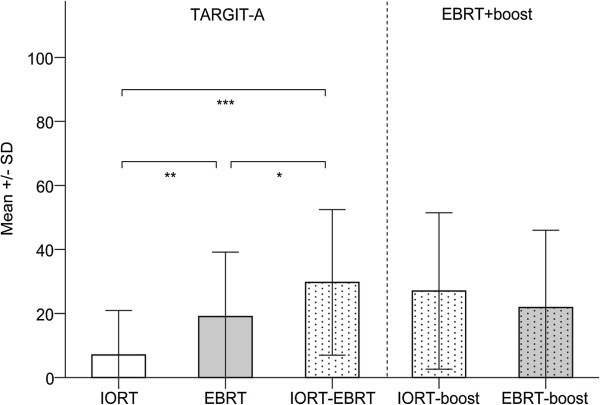
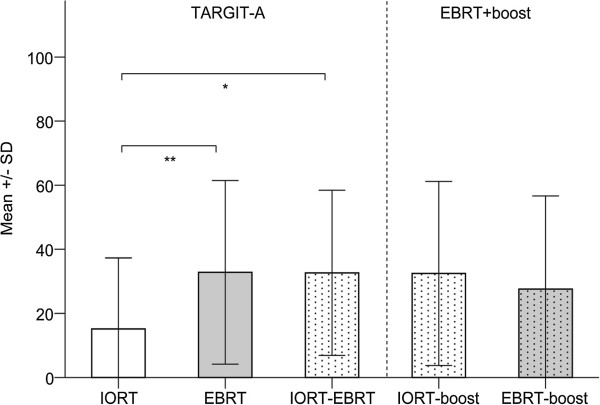
Patients receiving IORT alone reported less general pain (21.3 points), breast (7.0 points) and arm (15.1 points) symptoms, and better role functioning (78.7 points) as patients receiving EBRT (40.9; 19.0; 32.8; and 60.5 points, respectively, P < 0.01). Patients receiving IORT alone also had fewer breast symptoms than TARGIT-A patients receiving IORT followed by EBRT for high risk features on final pathology (IORT-EBRT; 7.0 versus 29.7 points, P < 0.01). There were no significant differences between TARGIT-A patients receiving IORT-EBRT compared to non-randomized IORT-boost or EBRT-boost patients and patients receiving EBRT without a boost.
In the randomized setting, important radiation-related QoL parameters after IORT were superior to EBRT. Non-randomized comparisons showed equivalent parameters in the IORT-EBRT group and the control groups.
术中放疗(IORT)是早期乳腺癌的一种新的治疗方法。本研究报告了 IORT 对与放疗相关的生活质量(QoL)参数的影响。
将 230 名 I 期至 III 期乳腺癌患者(年龄 31 至 84 岁)纳入本研究。对来自 TARGIT-A(针对乳腺癌的靶向术中放射治疗与全乳房放疗)随机 III 期试验两个臂的 87 名患者的单中心亚组进行了分析。此外,将结果与非随机对照组进行了比较:n=90 例接受 IORT 作为肿瘤床加量,随后在 TARGIT-A 之外进行全乳房外照射放疗(IORT-加量),n=53 例接受全乳房外照射放疗,然后进行外照射加量(EBRT-加量)。使用欧洲癌症研究与治疗组织生活质量问卷 C30(QLQ-C30)和 BR23(QLQ-BR23)收集 QoL 数据。在 TARGIT-A 组中,平均随访时间为 32 个月,而在非随机对照组中为 39 个月。
单独接受 IORT 的患者报告的一般疼痛(21.3 分)、乳房(7.0 分)和手臂(15.1 分)症状较少,角色功能(78.7 分)较好,而接受 EBRT 的患者为 40.9(19.0;32.8;和 60.5 分,P<0.01)。单独接受 IORT 的患者的乳房症状也少于 TARGIT-A 患者,后者在最终病理上有高危特征时接受 IORT 加 EBRT(IORT-EBRT;7.0 与 29.7 分,P<0.01)。与非随机 IORT-加量或 EBRT-加量患者以及未加量接受 EBRT 的患者相比,接受 IORT-EBRT 的 TARGIT-A 患者之间没有显著差异。
在随机设置中,IORT 后与放疗相关的重要 QoL 参数优于 EBRT。非随机比较显示 IORT-EBRT 组和对照组的参数相当。