Behavioral and Clinical Neuroscience Institute and Department of Psychology, University of Cambridge, Cambridge, UK.
Psychopharmacology (Berl). 2013 May;227(1):137-47. doi: 10.1007/s00213-012-2949-9. Epub 2013 Jan 9.
Evidence has implicated the endogenous opioids, in particular μ-opioid receptors, in emotional behavior and regulation of reward circuits, especially in the context of heroin addiction and hedonic responses to ingestive rewards. The μ-opioid receptor antagonist naltrexone (NTX) has been reported to be effective in preventing relapse to alcoholism and in reducing alcohol and cocaine craving during abstinence.
The aim of the present experiments was to investigate the effects of a novel selective μ-opioid receptor antagonist GSK1521498 on cocaine and heroin seeking and the primary reinforcement of drug self-administration behavior.
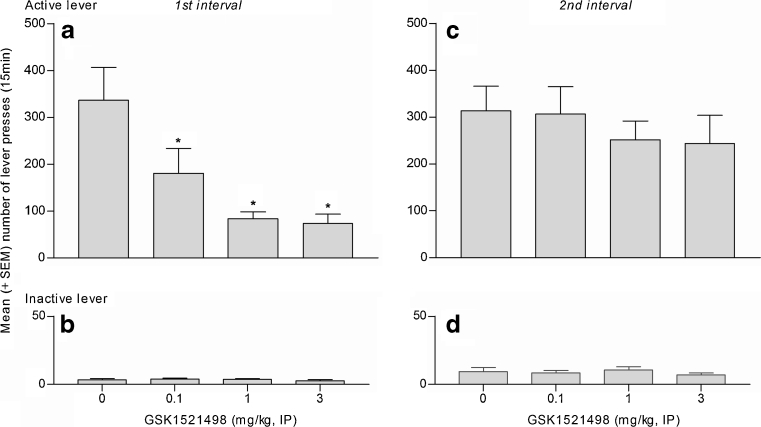
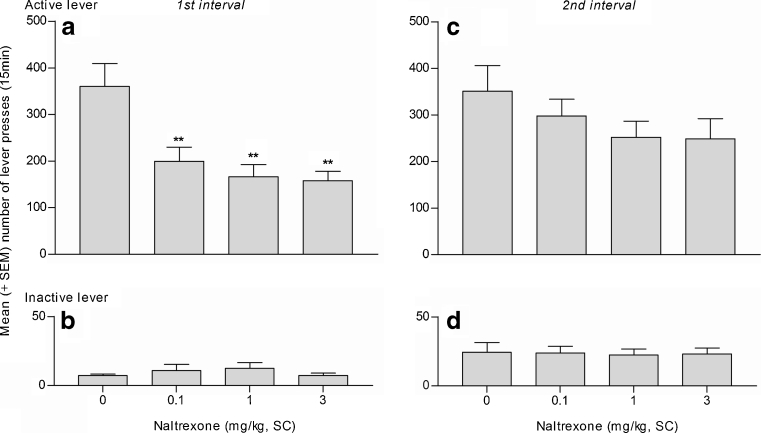
Rats were first trained to self-administer cocaine or heroin and then to seek the drugs over prolonged periods of time under a second-order schedule of reinforcement, in which responding is maintained by contingent presentation of a drug-associated conditioned reinforcer. On a stable baseline, animals were treated with either GSK1521498 (0.1, 1, 3 mg/kg; IP) or NTX (0.1, 1, 3 mg/kg; SC) before each test session.
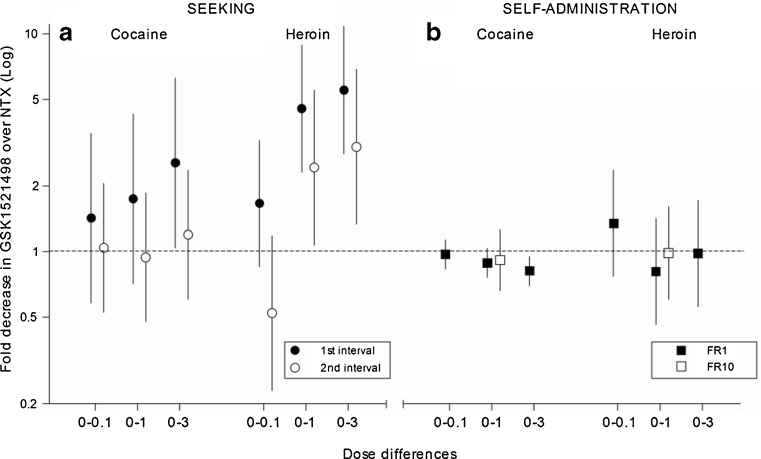
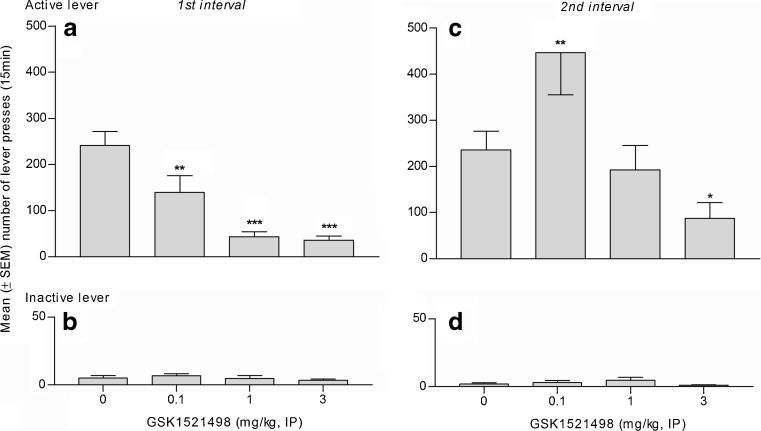
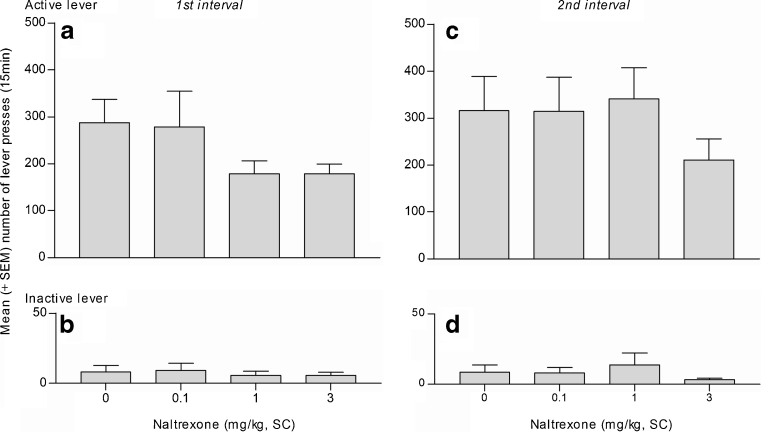
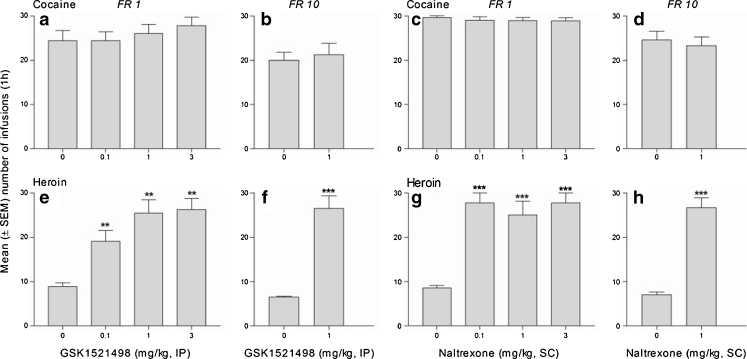
Cocaine seeking was dose-dependently decreased following GSK1521498 treatment. However, the same treatment had no effect on cocaine self-administration under a continuous reinforcement schedule. Treatment with NTX had a less pronounced but similar effect. GSK1521498, but not NTX, dose-dependently reduced heroin seeking both before and after infusion of the drug although both increased heroin self-administration under continuous reinforcement.
These data suggest that GSK1521498, by reducing opioid receptor signaling at the μ-opioid receptor, may have therapeutic potential to reduce the propensity to seek cocaine or heroin and, additionally, to diminish the consequence of an initial relapse to heroin taking.
有证据表明内源性阿片类物质,特别是μ-阿片受体,参与情绪行为和奖励回路的调节,尤其是在海洛因成瘾和摄入奖励的享乐反应的背景下。μ-阿片受体拮抗剂纳曲酮(NTX)已被报道可有效预防酒精成瘾复发,并减少戒断期间对酒精和可卡因的渴望。
本实验的目的是研究新型选择性μ-阿片受体拮抗剂 GSK1521498 对可卡因和海洛因觅药的影响,以及对药物自我给药行为的主要强化作用。
大鼠首先接受可卡因或海洛因的自我给药训练,然后在二级强化时间表下长时间寻找药物,在此时间表中,反应由药物相关条件强化剂的偶然呈现来维持。在稳定的基线期,动物在每次测试前接受 GSK1521498(0.1、1、3mg/kg;IP)或 NTX(0.1、1、3mg/kg;SC)治疗。
GSK1521498 治疗后可卡因觅药呈剂量依赖性减少。然而,相同的治疗对连续强化时间表下的可卡因自我给药没有影响。NTX 治疗也有类似但效果较弱的作用。GSK1521498 但不是 NTX 依赖性地减少海洛因觅药,无论是在药物输注前还是输注后,尽管两者都增加了连续强化下的海洛因自我给药。
这些数据表明,GSK1521498 通过减少μ-阿片受体的阿片受体信号,可能具有减少可卡因或海洛因觅药倾向的治疗潜力,此外还可以减少初次海洛因复吸的后果。