Kelly Eamonn, Mundell Stuart J, Sava Anna, Roth Adelheid L, Felici Antonio, Maltby Kay, Nathan Pradeep J, Bullmore Edward T, Henderson Graeme
School of Physiology and Pharmacology, University of Bristol, Bristol, BS8 1TD, UK.
Psychopharmacology (Berl). 2015 Jan;232(1):305-14. doi: 10.1007/s00213-014-3666-3. Epub 2014 Jun 29.
The novel opioid receptor antagonist, GSK1421498, has been shown to attenuate reward-driven compulsive behaviours, such as stimulant drug seeking or binge eating, in animals and humans. Here, we report new data on the receptor pharmacology of GSK121498, in comparison to naltrexone, naloxone, 6-β-naltrexol and nalmefene.
To determine whether the novel opioid antagonist, GSK1521498, is an orthosteric or allosteric antagonist at the μ opioid receptor (MOPr) and whether it has neutral antagonist or inverse agonist properties.
A combination of radioligand binding assays and [(35)S]GTPγS binding assays was employed.
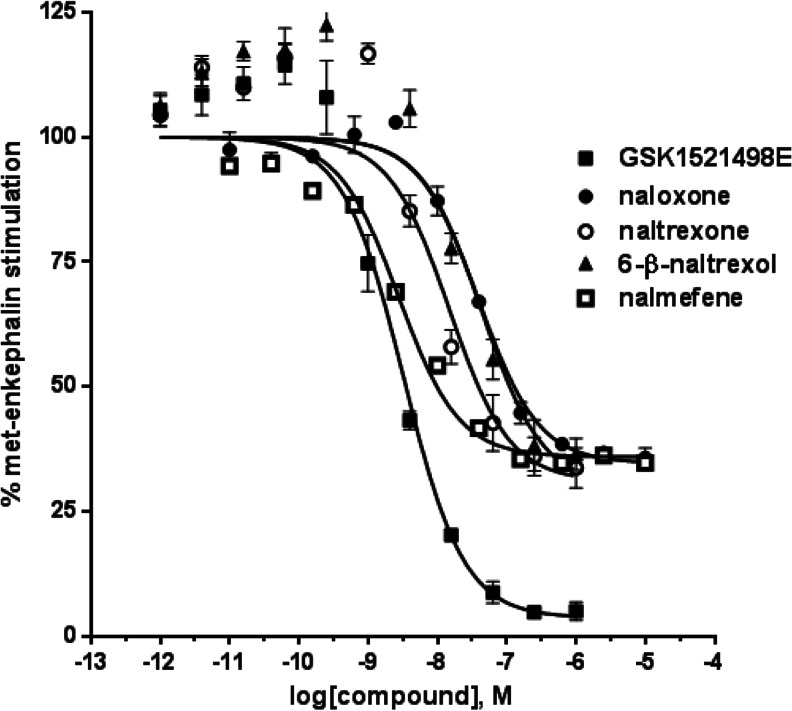
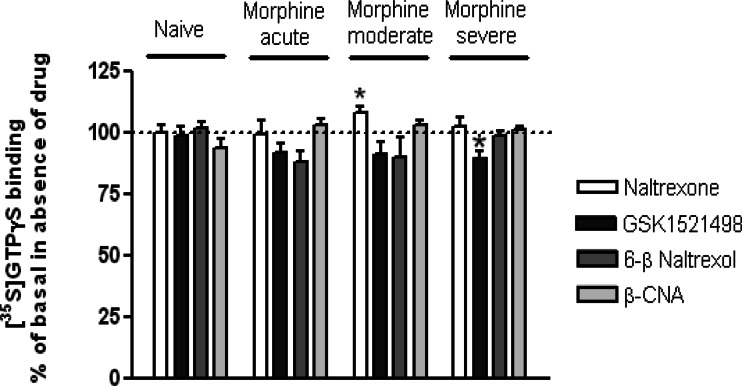
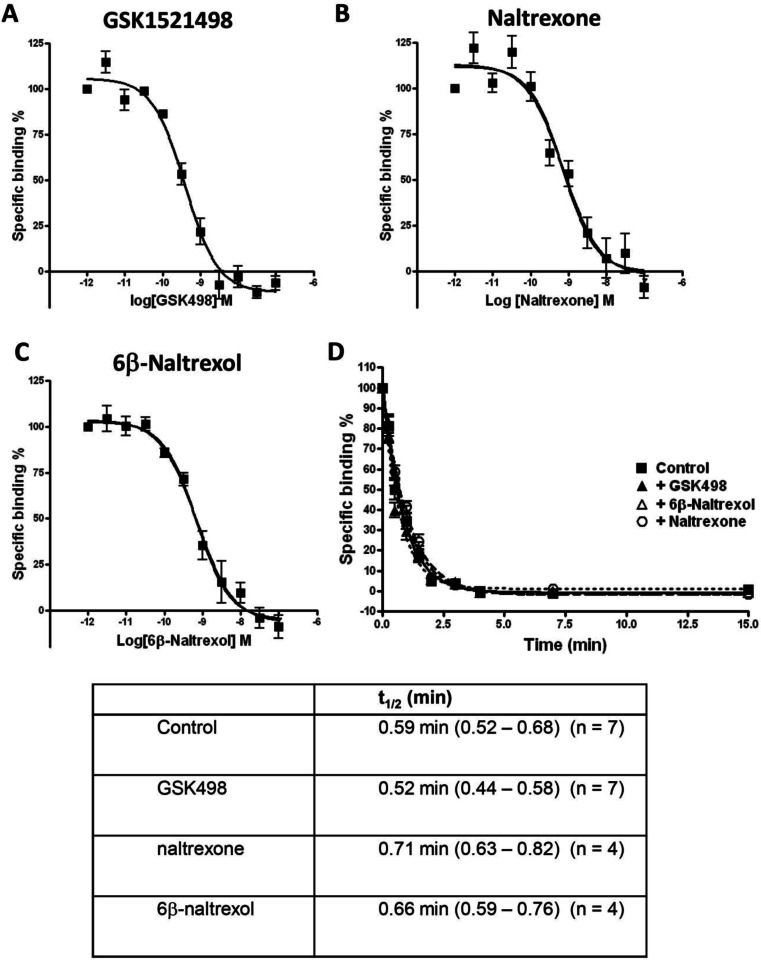
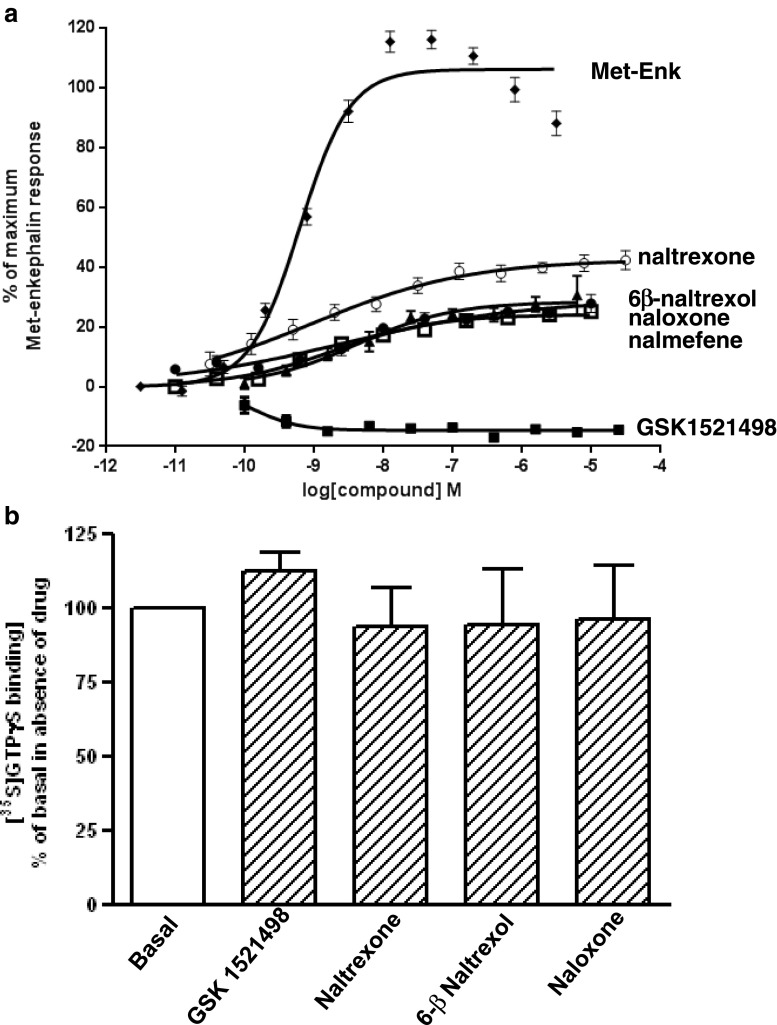
GSK1521498 completely displaced [(3)H]naloxone binding to MOPr and did not alter the rate of [(3)H]naloxone dissociation from MOPr observations compatible with it binding to the orthosteric site on MOPr. GSK1521498 exhibited inverse agonism when MOPr was overexpressed but not when the level of MOPr expression was low. In parallel studies under conditions of high receptor expression density, naloxone, naltrexone, 6-β-naltrexol and nalmefene exhibited partial agonism, not inverse agonism as has been reported previously for naloxone and naltrexone. In brain tissue from mice receiving a prolonged morphine pre-treatment, GSK1521498 exhibited slight inverse agonism.
Differences between GSK1521498 and naltrexone in their effects on compulsive reward seeking are arguably linked to the more selective and complete MOPr antagonism of GSK1521498 versus the partial MOPr agonism of naltrexone. GSK1521498 is also pharmacologically differentiated by its inverse agonist efficacy at high levels of MOPr expression, but this may be less likely to contribute to behavioural differentiation at patho-physiological levels of expression.
新型阿片受体拮抗剂GSK1421498已被证明可减轻动物和人类中由奖励驱动的强迫行为,如寻求兴奋剂药物或暴饮暴食。在此,我们报告了与纳曲酮、纳洛酮、6-β-纳曲醇和纳美芬相比,GSK121498受体药理学的新数据。
确定新型阿片拮抗剂GSK1521498是μ阿片受体(MOPr)的正构拮抗剂还是变构拮抗剂,以及它是否具有中性拮抗剂或反向激动剂特性。
采用放射性配体结合试验和[(35)S]GTPγS结合试验相结合的方法。
GSK1521498完全取代[(3)H]纳洛酮与MOPr的结合,且不改变[(3)H]纳洛酮从MOPr解离的速率,这些观察结果表明它与MOPr的正构位点结合。当MOPr过表达时,GSK1521498表现出反向激动作用,但当MOPr表达水平较低时则不然。在高受体表达密度条件下的平行研究中,纳洛酮、纳曲酮、6-β-纳曲醇和纳美芬表现出部分激动作用,而非如先前报道的纳洛酮和纳曲酮那样表现出反向激动作用。在接受长期吗啡预处理的小鼠脑组织中,GSK1521498表现出轻微的反向激动作用。
GSK1521498和纳曲酮在对强迫性奖励寻求的影响上的差异,可以说是与GSK1521498对MOPr更具选择性和完全的拮抗作用以及纳曲酮的部分MOPr激动作用有关。GSK1521498在药理学上还因其在高水平MOPr表达时的反向激动剂效力而有所不同,但这在病理生理表达水平上对行为差异的贡献可能较小。