Ziauddeen H, Chamberlain S R, Nathan P J, Koch A, Maltby K, Bush M, Tao W X, Napolitano A, Skeggs A L, Brooke A C, Cheke L, Clayton N S, Sadaf Farooqi I, O'Rahilly S, Waterworth D, Song K, Hosking L, Richards D B, Fletcher P C, Bullmore E T
1] Medicines Discovery and Development, GlaxoSmithKline, Clinical Unit Cambridge, Addenbrooke's Centre for Clinical Investigations, Cambridge, UK [2] Department of Psychiatry, Behavioural & Clinical Neuroscience Institute, Cambridge Biomedical Campus, University of Cambridge, Cambridge, UK [3] Metabolic Research Laboratories, Institute of Metabolic Science, University of Cambridge, Cambridge, UK [4] Cambridgeshire and Peterborough NHS Foundation Trust (CPFT), Cambridge, UK.
Mol Psychiatry. 2013 Dec;18(12):1287-93. doi: 10.1038/mp.2012.154. Epub 2012 Nov 13.
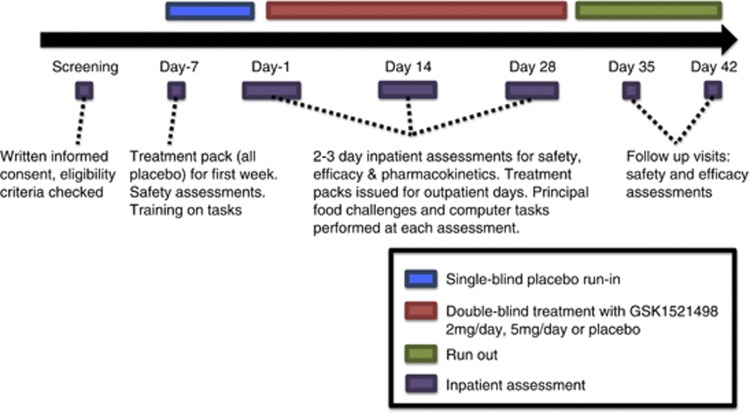
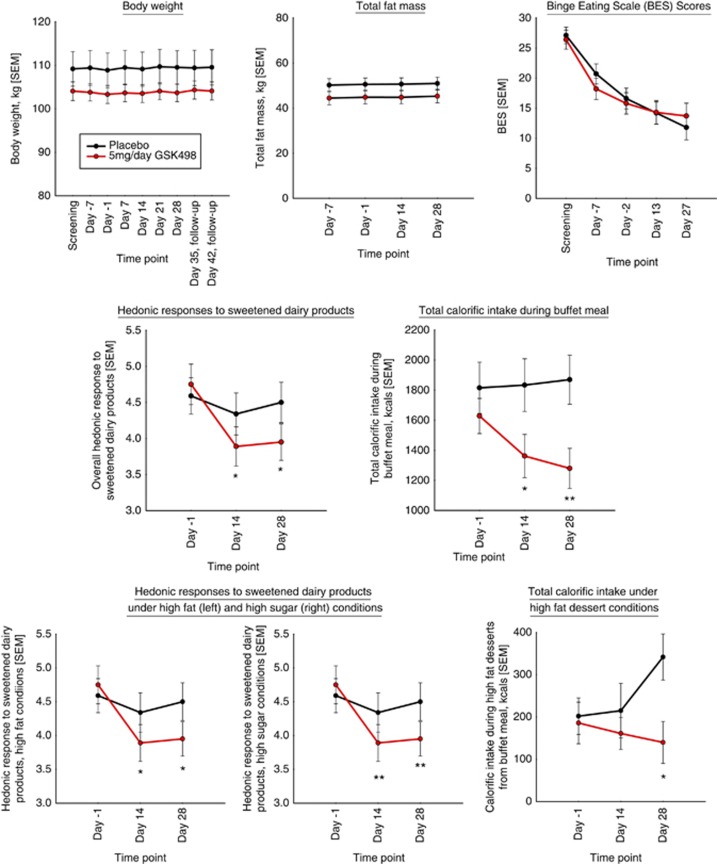
The opioid system is implicated in the hedonic and motivational processing of food, and in binge eating, a behaviour strongly linked to obesity. The aim of this study was to evaluate the effects of 4 weeks of treatment with the mu-opioid receptor antagonist GSK1521498 on eating behaviour in binge-eating obese subjects. Adults with body mass index ≥ 30 kg m(-2) and binge eating scale scores ≥ 19 received 1-week single-blind placebo run-in, and were then randomized to 28 days with either 2 mg day(-1) GSK1521498, 5 mg day(-1) GSK1521498 or placebo (N=21 per arm) in a double-blind parallel group design. The outcome measures were body weight, fat mass, hedonic and consummatory eating behaviour during inpatient food challenges, safety and pharmacokinetics. The primary analysis was the comparison of change scores in the higher-dose treatment group versus placebo using analysis of covariance at each relevant time point. GSK1521498 (2 mg and 5 mg) was not different from placebo in its effects on weight, fat mass and binge eating scores. However, compared with placebo, GSK1521498 5 mg day(-1) caused a significant reduction in hedonic responses to sweetened dairy products and reduced calorific intake, particularly of high-fat foods during ad libitum buffet meals, with some of these effects correlating with systemic exposure of GSK1521498. There were no significant effects of GSK1521498 2 mg day(-1) on eating behaviour, indicating dose dependency of pharmacodynamics. GSK1521498 was generally well tolerated and no previously unidentified safety signals were detected. The potential for these findings to translate into clinically significant effects in the context of binge eating and weight regain prevention requires further investigation.
阿片系统与食物的享乐和动机处理有关,也与暴饮暴食有关,暴饮暴食是一种与肥胖密切相关的行为。本研究的目的是评估μ-阿片受体拮抗剂GSK1521498治疗4周对暴饮暴食肥胖受试者饮食行为的影响。体重指数≥30 kg m(-2)且暴饮暴食量表得分≥19的成年人接受为期1周的单盲安慰剂导入期,然后在双盲平行组设计中随机分为28天服用2 mg/天的GSK1521498、5 mg/天的GSK1521498或安慰剂(每组N = 21)。观察指标包括体重、体脂、住院期间食物挑战时的享乐和满足性饮食行为、安全性和药代动力学。主要分析是在每个相关时间点使用协方差分析比较高剂量治疗组与安慰剂组的变化分数。GSK1521498(2 mg和5 mg)在对体重、体脂和暴饮暴食得分的影响上与安慰剂无差异。然而,与安慰剂相比,5 mg/天的GSK1521498可显著降低对加糖乳制品的享乐反应,并减少热量摄入,尤其是在随意自助餐期间对高脂肪食物的热量摄入,其中一些影响与GSK1521498的全身暴露相关。2 mg/天的GSK1521498对饮食行为无显著影响,表明药效学存在剂量依赖性。GSK1521498总体耐受性良好,未检测到先前未发现的安全信号。这些发现能否转化为在暴饮暴食和预防体重反弹方面具有临床意义的效果,还需要进一步研究。