Division Neuropsychology, Institute of Psychology, University of Zurich, Zurich, Switzerland.
PLoS One. 2013;8(1):e53199. doi: 10.1371/journal.pone.0053199. Epub 2013 Jan 3.
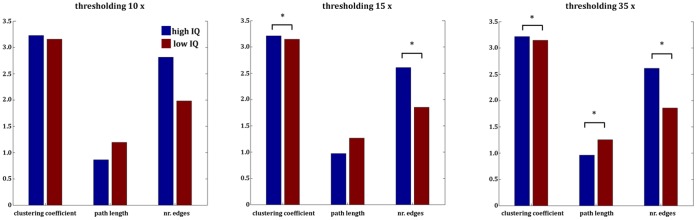
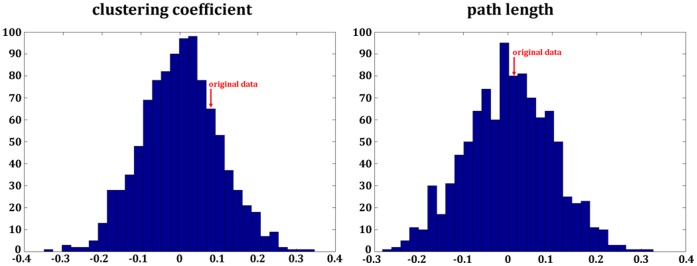
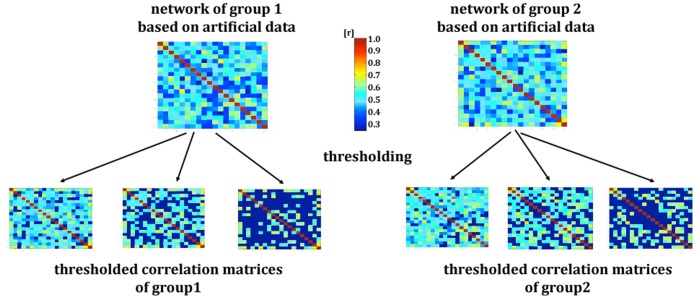
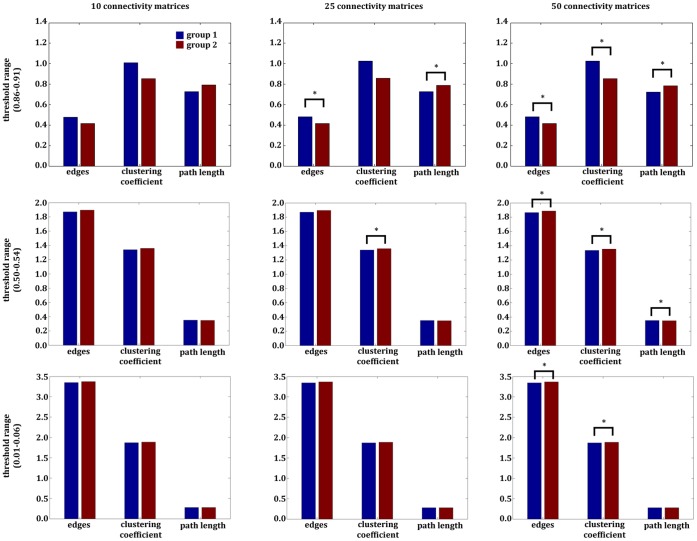
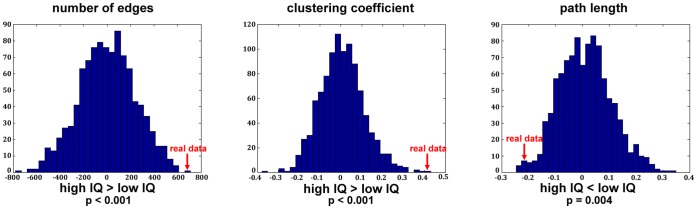
Graph theory deterministically models networks as sets of vertices, which are linked by connections. Such mathematical representation of networks, called graphs are increasingly used in neuroscience to model functional brain networks. It was shown that many forms of structural and functional brain networks have small-world characteristics, thus, constitute networks of dense local and highly effective distal information processing. Motivated by a previous small-world connectivity analysis of resting EEG-data we explored implications of a commonly used analysis approach. This common course of analysis is to compare small-world characteristics between two groups using classical inferential statistics. This however, becomes problematic when using measures of inter-subject correlations, as it is the case in commonly used brain imaging methods such as structural and diffusion tensor imaging with the exception of fibre tracking. Since for each voxel, or region there is only one data point, a measure of connectivity can only be computed for a group. To empirically determine an adequate small-world network threshold and to generate the necessary distribution of measures for classical inferential statistics, samples are generated by thresholding the networks on the group level over a range of thresholds. We believe that there are mainly two problems with this approach. First, the number of thresholded networks is arbitrary. Second, the obtained thresholded networks are not independent samples. Both issues become problematic when using commonly applied parametric statistical tests. Here, we demonstrate potential consequences of the number of thresholds and non-independency of samples in two examples (using artificial data and EEG data). Consequently alternative approaches are presented, which overcome these methodological issues.
图论将网络确定性地建模为顶点集,这些顶点通过连接相互连接。这种被称为图的网络的数学表示形式越来越多地被用于神经科学中,以对功能性大脑网络进行建模。已经表明,许多形式的结构和功能大脑网络都具有小世界特性,因此构成了密集局部和高效远程信息处理的网络。受先前对静息 EEG 数据的小世界连通性分析的启发,我们探索了一种常用分析方法的影响。这种常见的分析过程是使用经典推断统计学来比较两组之间的小世界特征。然而,当使用主体间相关性的度量时,这会变得成问题,因为在常用的大脑成像方法中,如结构和扩散张量成像,除了纤维跟踪外,情况都是如此。由于对于每个体素或区域只有一个数据点,因此只能为一个群组计算连通性的度量。为了经验确定适当的小世界网络阈值并为经典推断统计学生成必要的度量分布,通过在群组级别上在一系列阈值上对网络进行阈值处理来生成样本。我们认为,这种方法主要存在两个问题。首先,阈值网络的数量是任意的。其次,获得的阈值网络不是独立的样本。当使用常用的参数统计检验时,这两个问题都会变得成问题。在这里,我们在两个示例(使用人工数据和 EEG 数据)中展示了阈值数量和样本非独立性的潜在后果。因此,提出了克服这些方法问题的替代方法。