Center for Experimental Medicine, Lanzhou General Hospital, Lanzhou Military Command, Lanzhou, Gansu, China.
PLoS One. 2013;8(1):e53236. doi: 10.1371/journal.pone.0053236. Epub 2013 Jan 2.
Hematological abnormalities often occur several days before kidney injury in patients with hemorrhagic fever with renal syndrome (HFRS). We aimed to investigate the prevalence and prognostic value of the early hematological markers in patients with HFRS caused by Hantaan virus (HTNV) infection.
In a retrospective cohort study, we analyzed the case records of 112 patients with acute HTNV infection and evaluated the hematological markers for early prediction and risk stratification of HFRS patients with acute kidney injury (AKI).
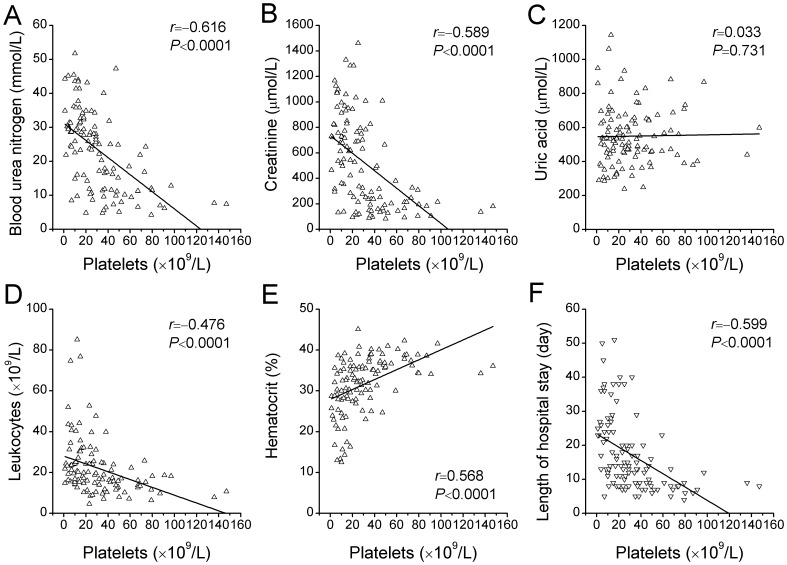
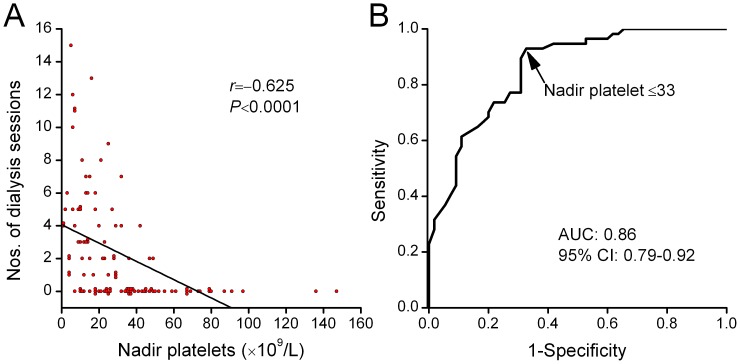
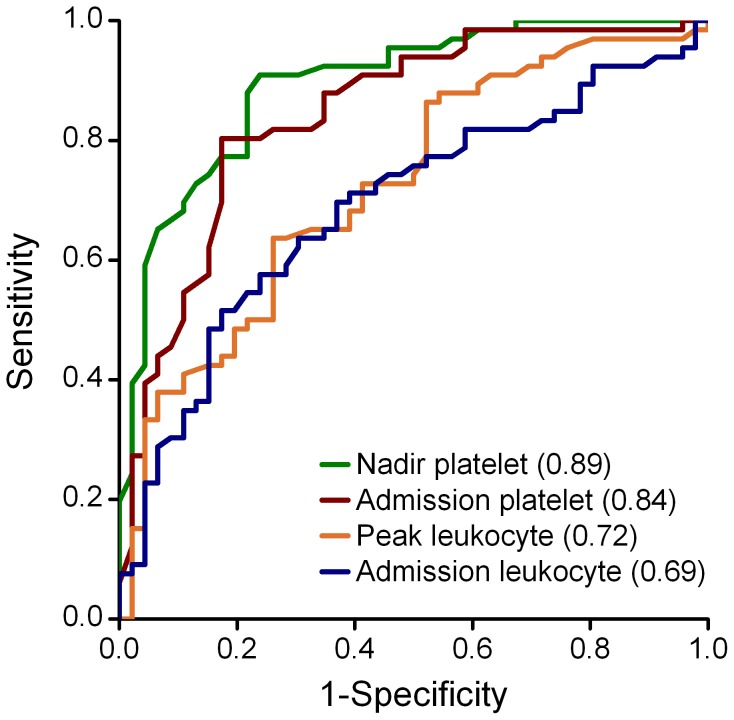
Of 112 patients analyzed, 66 (59%) developed severe AKI, defined as either receipt of acute dialysis or increased serum creatinine ≥ 354 µmol/L. The prognostic accuracy of hematological markers, as quantified by the area under the receiver-operating-characteristic curve (AUC), was highest with the nadir platelet count (AUC, 0.89; 95% CI, 0.83-0.95), as compared with the admission platelet count (AUC, 0.84; 95% CI, 0.77-0.92), and the admission and peak leukocyte counts. The nadir platelet count correlated moderately with the levels of peak blood urea nitrogen (r = -0.616) and serum creatinine (r = -0.589), the length of hospital stay (r = -0.599), and the number of dialysis sessions that each patient received during hospital stay (r = -0.625). By multivariate analysis, decreased nadir platelet count remained independently associated with the development of severe AKI (odds ratio, 27.57; 95% CI, 6.96-109.16; P<0.0001).
Thrombocytopenia, rather than leukocytosis, is independently associated with subsequent severe AKI among patients with acute HTNV infection.
肾综合征出血热(HFRS)患者的肾脏损伤前常会出现血液学异常。我们旨在研究汉坦病毒(HTNV)感染引起的 HFRS 患者早期血液学标志物的流行率及其对急性肾损伤(AKI)的预测和危险分层价值。
在一项回顾性队列研究中,我们分析了 112 例急性 HTNV 感染患者的病历,并评估了血液学标志物对 HFRS 患者 AKI 的早期预测和危险分层作用。
在分析的 112 例患者中,66 例(59%)发生严重 AKI,定义为接受急性透析或血清肌酐升高≥354μmol/L。通过接受者操作特征曲线下面积(AUC)定量评估,血小板计数最低值的预测准确性最高(AUC,0.89;95%CI,0.83-0.95),优于入院时血小板计数(AUC,0.84;95%CI,0.77-0.92)和入院及峰值白细胞计数。血小板计数最低值与峰值血尿素氮(r = -0.616)和血清肌酐(r = -0.589)、住院时间(r = -0.599)和每位患者住院期间接受的透析次数(r = -0.625)中度相关。多变量分析显示,血小板计数最低值降低与严重 AKI 的发生独立相关(比值比,27.57;95%CI,6.96-109.16;P<0.0001)。
与白细胞增多相比,血小板减少与急性 HTNV 感染患者随后发生严重 AKI 独立相关。