Cambridge Intellectual and Developmental Disabilities Research Group, Department of Psychiatry, University of Cambridge, Douglas House, 18b Trumpington Road, Cambridge, CB2 8AH, UK.
Mol Autism. 2013 Jan 12;4(1):1. doi: 10.1186/2040-2392-4-1.
Autism Spectrum Conditions (ASC) are a set of pervasive neurodevelopmental conditions characterized by a wide range of lifelong signs and symptoms. Recent explanatory models of autism propose abnormal neural connectivity and are supported by studies showing decreased interhemispheric coherence in individuals with ASC. The first aim of this study was to test the hypothesis of reduced interhemispheric coherence in ASC, and secondly to investigate specific effects of task performance on interhemispheric coherence in ASC.
We analyzed electroencephalography (EEG) data from 15 participants with ASC and 15 typical controls, using Wavelet Transform Coherence (WTC) to calculate interhemispheric coherence during face and chair matching tasks, for EEG frequencies from 5 to 40 Hz and during the first 400 ms post-stimulus onset.
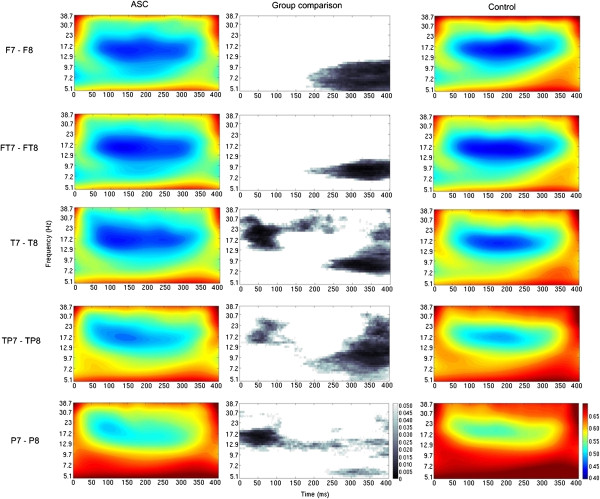
Results demonstrate a reduction of interhemispheric coherence in the ASC group, relative to the control group, in both tasks and for all electrode pairs studied. For both tasks, group differences were generally observed after around 150 ms and at frequencies lower than 13 Hz. Regarding within-group task comparisons, while the control group presented differences in interhemispheric coherence between faces and chairs tasks at various electrode pairs (FT7-FT8, TP7-TP8, P7-P8), such differences were only seen for one electrode pair in the ASC group (T7-T8). No significant differences in EEG power spectra were observed between groups.
Interhemispheric coherence is reduced in people with ASC, in a time and frequency specific manner, during visual perception and categorization of both social and inanimate stimuli and this reduction in coherence is widely dispersed across the brain.Results of within-group task comparisons may reflect an impairment in task differentiation in people with ASC relative to typically developing individuals.Overall, the results of this research support the value of WTC in examining the time-frequency microstructure of task-related interhemispheric EEG coherence in people with ASC.
自闭症谱系障碍(ASC)是一组普遍存在的神经发育障碍,其特征是存在广泛的终生体征和症状。最近的自闭症解释模型提出了异常的神经连接,并得到了研究的支持,这些研究表明,自闭症患者的大脑两半球之间的相干性降低。本研究的主要目的是检验 ASC 患者大脑两半球之间相干性降低的假设,其次是研究任务表现对 ASC 患者大脑两半球之间相干性的具体影响。
我们分析了 15 名 ASC 患者和 15 名典型对照组的脑电图(EEG)数据,使用小波变换相干性(WTC)计算面孔和椅子匹配任务期间大脑两半球之间的相干性,频率范围为 5 到 40 Hz,以及刺激后 400 毫秒内。
结果表明,与对照组相比,在两项任务中,所有研究的电极对都观察到 ASC 组大脑两半球之间的相干性降低。对于两项任务,大约在 150 毫秒后,在低于 13 Hz 的频率下,通常会观察到组间差异。关于组内任务比较,虽然对照组在各种电极对上(FT7-FT8、TP7-TP8、P7-P8)的面孔和椅子任务之间存在大脑两半球之间相干性的差异,但在 ASC 组仅在一个电极对上观察到这种差异(T7-T8)。两组之间的 EEG 功率谱没有观察到显著差异。
在视觉感知和对社会和非生物刺激进行分类时,ASC 患者大脑两半球之间的相干性以时间和频率特异性的方式降低,这种相干性的降低广泛分布在大脑中。组内任务比较的结果可能反映了 ASC 患者相对于正常发育个体在任务分化方面的障碍。总体而言,这项研究的结果支持 WTC 在检查 ASC 患者大脑两半球之间与任务相关的 EEG 相干性的时频微观结构中的价值。