United Arab Emirates University, College of Medicine and Health Sciences, Department of Family Medicine, Al Ain, UAE.
BMC Public Health. 2013 Jan 14;13:33. doi: 10.1186/1471-2458-13-33.
Although vitamin D deficiency has been studied in various adult populations, there are few data on the prevalence of this nutritional deficiency among healthy adolescents in the United Arab Emirates (UAE). This study was conducted to determine the prevalence of vitamin D deficiency and to examine its correlates in adolescents aged 15 to 18 years.
This was a cross-sectional study in urban schools. Healthy adolescents (N=315) from a sample of 8 schools were randomly selected from the 142 schools in Al Ain, Abu Dhabi Emirate. Outcomes measured included serum concentrations of 25-hydroxy vitamin D (25OHD), plasma lipids, blood sugar, blood pressure and anthropometric data, nutrition and lifestyle variables.
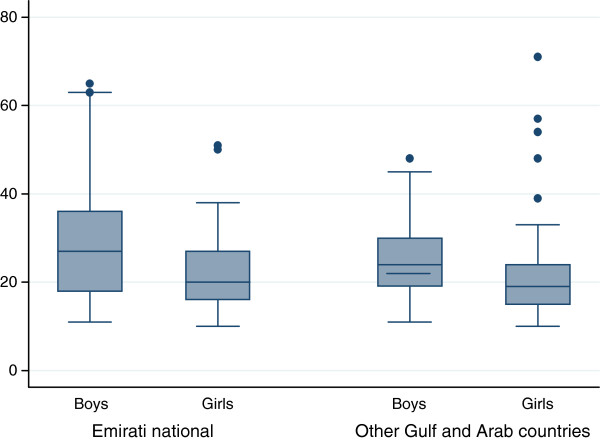
Fourty-one participants (19.7%) were vitamin D deficient (serum 25OHD level ≤15 ng/mL [≤37.5 nmol/L]. Using a cutoff level of 25(OH) D of ≤20 ng/ml [≤50 nmol/l] 143 participants (45.4%) were vitamin D insufficient. Overall 65.1% of study participants were either vitamin D deficient or insufficient. The prevalence of vitamin D deficiency varied between boys (10%) and girls (28%). In a final multivariate model, serum 25(OH) D concentrations were inversely correlated with female gender, consumption of fast food per week, and body mass index and positively correlated with physical activity scores after adjustment for age.
Vitamin D deficiency and insufficiency were highly prevalent in adolescents, and more common in girls.
尽管已经在各种成年人群体中研究了维生素 D 缺乏症,但在阿拉伯联合酋长国(UAE)的健康青少年中,关于这种营养缺乏症的患病率的数据很少。本研究旨在确定维生素 D 缺乏症的患病率,并研究其在 15 至 18 岁青少年中的相关性。
这是一项在城市学校进行的横断面研究。从艾因市的 142 所学校中随机抽取了 8 所学校的健康青少年(N=315),作为样本。测量的结果包括血清 25-羟维生素 D(25OHD)浓度、血脂、血糖、血压和人体测量数据、营养和生活方式变量。
41 名参与者(19.7%)患有维生素 D 缺乏症(血清 25OHD 水平≤15ng/mL [≤37.5nmol/L])。使用 25(OH)D 水平≤20ng/ml [≤50nmol/L]的截止值,有 143 名参与者(45.4%)患有维生素 D 不足。总体而言,65.1%的研究参与者存在维生素 D 缺乏或不足。维生素 D 缺乏症的患病率在男孩(10%)和女孩(28%)之间有所不同。在最终的多变量模型中,血清 25(OH)D 浓度与女性性别、每周食用快餐的次数、体重指数呈负相关,与体力活动评分呈正相关,调整年龄后相关性仍存在。
青少年中维生素 D 缺乏症和不足的患病率很高,女孩更为常见。