Marine Botany, Bremen Marine Ecology Centre for Research and Education, University of Bremen, Leobener Str. NW2, Bremen, Germany.
J Exp Bot. 2013 Feb;64(4):899-908. doi: 10.1093/jxb/ers369. Epub 2013 Jan 10.
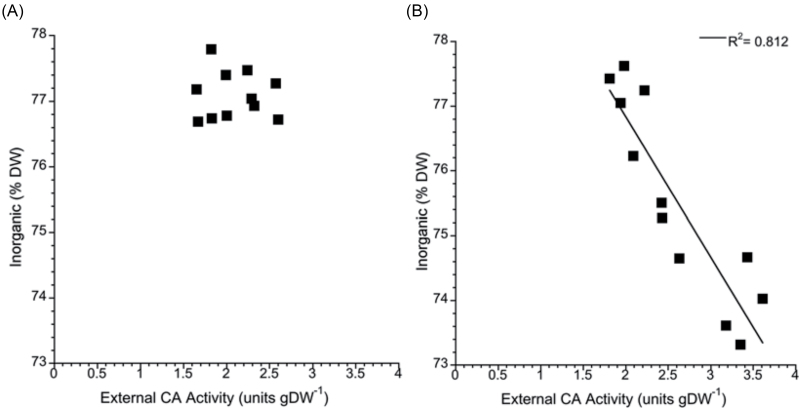
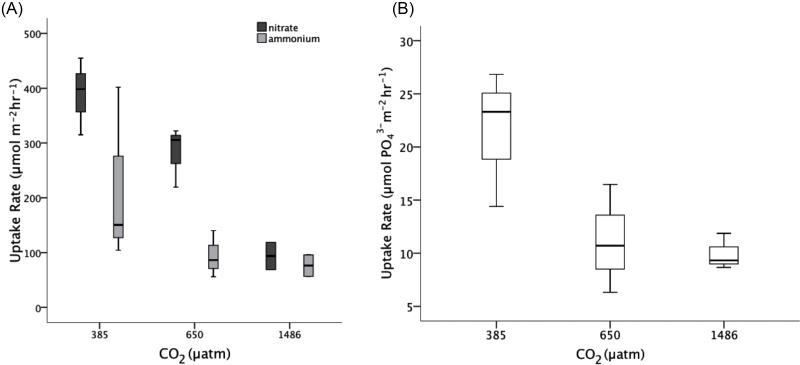
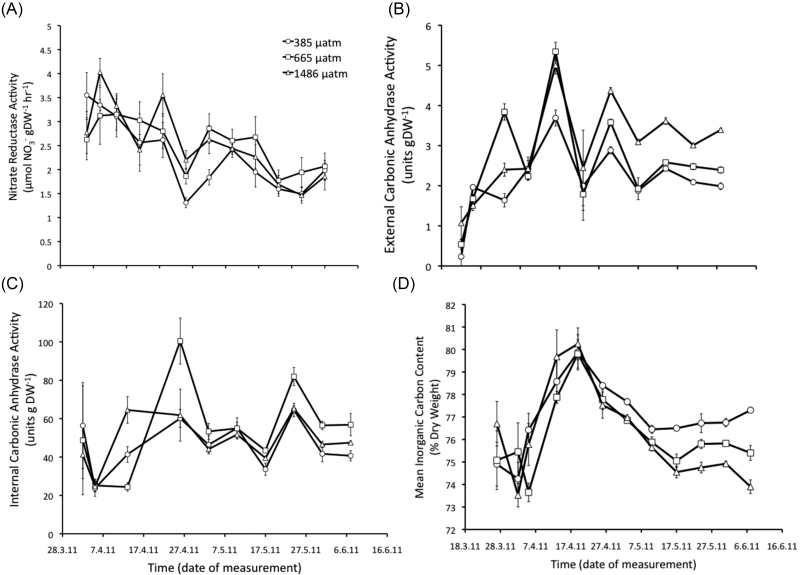
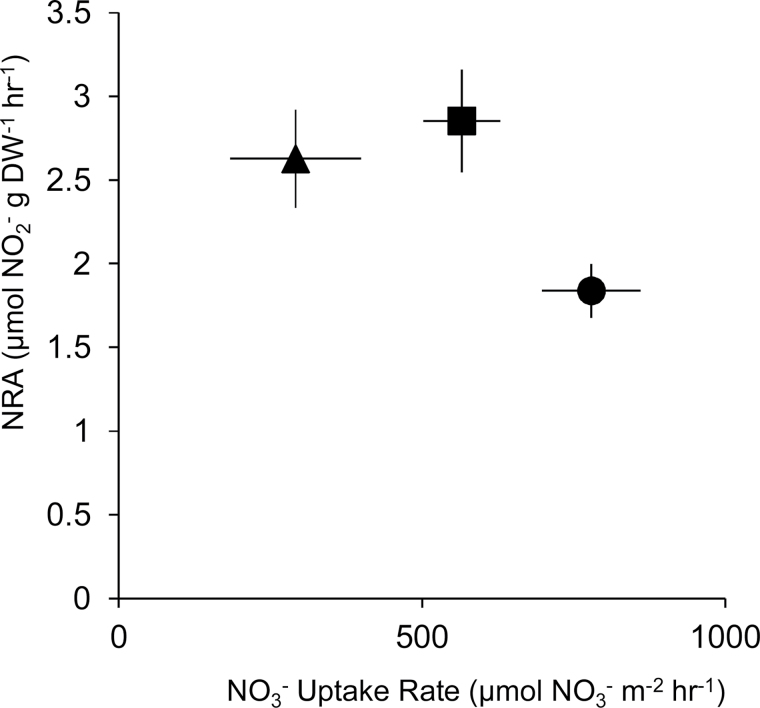
The concentration of CO(2) in global surface ocean waters is increasing due to rising atmospheric CO(2) emissions, resulting in lower pH and a lower saturation state of carbonate ions. Such changes in seawater chemistry are expected to impact calcification in calcifying marine organisms. However, other physiological processes related to calcification might also be affected, including enzyme activity. In a mesocosm experiment, macroalgal communities were exposed to three CO(2) concentrations (380, 665, and 1486 µatm) to determine how the activity of two enzymes related to inorganic carbon uptake and nutrient assimilation in Corallina officinalis, an abundant calcifying rhodophyte, will be affected by elevated CO(2) concentrations. The activity of external carbonic anhydrase, an important enzyme functioning in macroalgal carbon-concentrating mechanisms, was inversely related to CO(2) concentration after long-term exposure (12 weeks). Nitrate reductase, the enzyme responsible for reduction of nitrate to nitrite, was stimulated by CO(2) and was highest in algae grown at 665 µatm CO(2). Nitrate and phosphate uptake rates were inversely related to CO(2), while ammonium uptake was unaffected, and the percentage of inorganic carbon in the algal skeleton decreased with increasing CO(2). The results indicate that the processes of inorganic carbon and nutrient uptake and assimilation are affected by elevated CO(2) due to changes in enzyme activity, which change the energy balance and physiological status of C. officinalis, therefore affecting its competitive interactions with other macroalgae. The ecological implications of the physiological changes in C. officinalis in response to elevated CO(2) are discussed.
由于大气中二氧化碳排放量的增加,全球表层海洋水中的二氧化碳浓度正在增加,导致 pH 值降低和碳酸盐离子饱和度降低。海水化学的这种变化预计会影响钙化海洋生物的钙化作用。然而,与钙化有关的其他生理过程也可能受到影响,包括酶活性。在一项中观实验中,大型藻类群落暴露在三种二氧化碳浓度(380、665 和 1486 µatm)下,以确定与碳酸钙藻类 Corallina officinalis 中无机碳吸收和营养同化相关的两种酶的活性将如何受到升高的二氧化碳浓度的影响。碳酸钙酶,一种在大型藻类碳浓缩机制中起重要作用的酶,在长期暴露(12 周)后与二氧化碳浓度呈反比关系。硝酸还原酶,负责将硝酸盐还原为亚硝酸盐的酶,被二氧化碳刺激,在二氧化碳浓度为 665 µatm 的藻类中最高。硝酸盐和磷酸盐的吸收速率与二氧化碳呈反比,而铵的吸收不受影响,藻类骨骼中无机碳的百分比随着二氧化碳的增加而减少。结果表明,由于酶活性的变化,无机碳和营养物质吸收和同化的过程受到了升高的二氧化碳的影响,这改变了 C. officinalis 的能量平衡和生理状态,从而影响了它与其他大型藻类的竞争相互作用。讨论了 C. officinalis 对升高的二氧化碳做出生理反应的生态意义。