Experimental and Molecular Immunology and Neurogenetics, CNRS UMR 7355, University of Orleans Orleans, France.
Front Immunol. 2013 Jan 8;3:414. doi: 10.3389/fimmu.2012.00414. eCollection 2012.
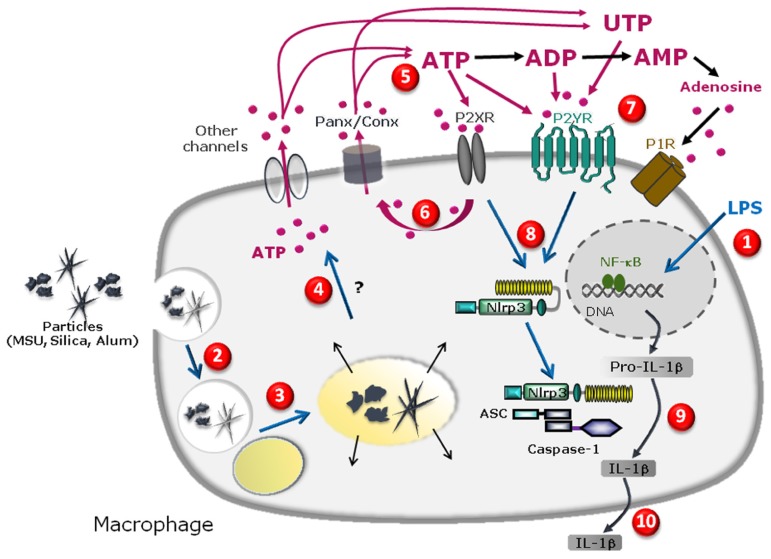
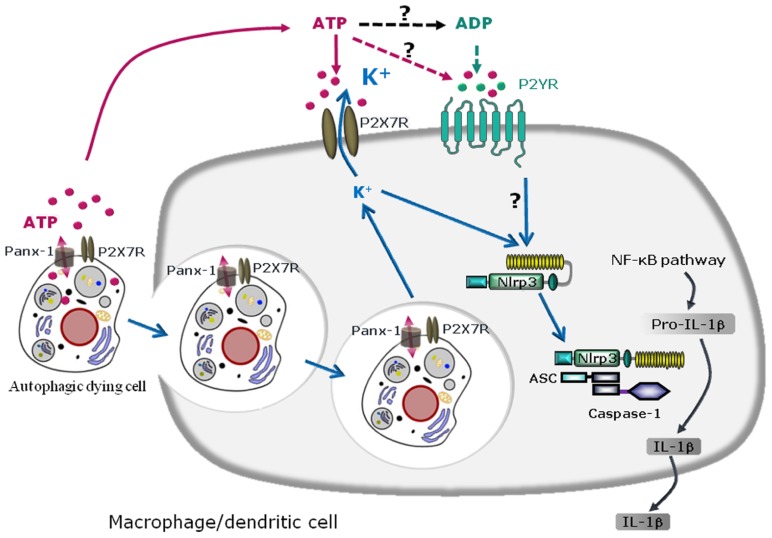
The NLRP3 inflammasome is a protein complex involved in IL-1β and IL-18 processing that senses pathogen- and danger-associated molecular patterns (PAMPs and DAMPs). One step- or two step-models have been proposed to explain the tight regulation of IL-1β production during inflammation. Moreover, cellular stimulation triggers adenosine triphosphate (ATP) release and subsequent activation of purinergic receptors at the cell surface. Importantly some studies have reported roles for extracellular ATP, in NLRP3 inflammasome activation in response to PAMPs and DAMPs. In this mini review, we will discuss the link between active ATP release, purinergic signaling and NLRP3 inflammasome activation. We will focus on the role of autocrine or paracrine ATP export in particle-induced NLRP3 inflammasome activation and discuss how particle activators are competent to induce maturation and secretion of IL-1β through a process that involves, as a first event, extracellular release of endogenous ATP through hemichannel opening, and as a second event, signaling through purinergic receptors that trigger NLRP3 inflammasome activation. Finally, we will review the evidence for ATP as a key pro-inflammatory mediator released by dying cells. In particular we will discuss how cancer cells dying via autophagy trigger ATP-dependent NLRP3 inflammasome activation in the macrophages engulfing them, eliciting an immunogenic response against tumors.
NLRP3 炎性体是一种参与白细胞介素-1β(IL-1β)和白细胞介素-18(IL-18)加工的蛋白复合物,能够感知病原体相关分子模式(PAMPs)和危险相关分子模式(DAMPs)。目前已经提出了一步或两步模型来解释炎症过程中 IL-1β 产生的严格调控。此外,细胞刺激会触发三磷酸腺苷(ATP)的释放,并随后激活细胞表面的嘌呤能受体。重要的是,一些研究报道了细胞外 ATP 在 NLRP3 炎性体对 PAMPs 和 DAMPs 的激活中的作用。在这篇综述中,我们将讨论活性 ATP 释放、嘌呤能信号转导与 NLRP3 炎性体激活之间的联系。我们将重点讨论自分泌或旁分泌 ATP 输出在颗粒诱导的 NLRP3 炎性体激活中的作用,并讨论颗粒激活剂如何通过涉及细胞外释放内源性 ATP 的过程来诱导 IL-1β 的成熟和分泌,作为第一个事件,通过半通道打开释放细胞外 ATP,作为第二个事件,通过嘌呤能受体信号转导触发 NLRP3 炎性体激活。最后,我们将回顾细胞死亡时释放的 ATP 作为关键促炎介质的证据。特别是,我们将讨论自噬导致的癌细胞死亡如何在吞噬它们的巨噬细胞中触发依赖于 ATP 的 NLRP3 炎性体激活,从而引发针对肿瘤的免疫应答。