Section of Gastrointestinal Neuroendocrinology, First Department of Propaedeutic Internal Medicine, Laiko Hospital, University of Athens Medical School, Agiou Thoma 17, Goudi, 11527 Athens, Greece.
Gastroenterol Res Pract. 2012;2012:287825. doi: 10.1155/2012/287825. Epub 2012 Dec 17.
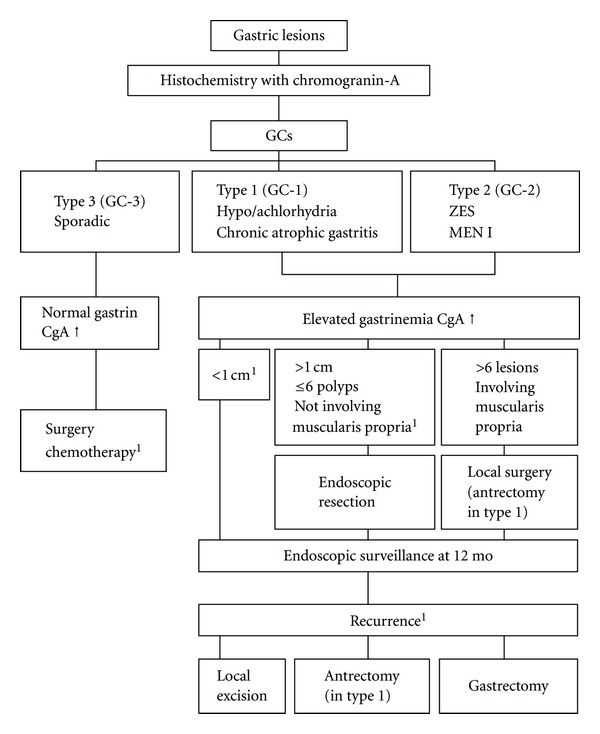
Gastric carcinoid tumors (GCs) are rare lesions representing less than 10% of carcinoid tumors and less than 1% of all stomach neoplasms. There are three distinct types of gastric carcinoids; type I includes the vast majority (70-85%) of these neoplasms that are closely linked to chronic atrophic gastritis. Type II which accounts for 5-10 %, is associated with Zollinger-Ellison syndrome and often occurs in the context of multiple endocrine neoplasia type 1. Type III, finally, represents 15-25% of gastric carcinoids and is characterized by a far more aggressive course. The optimal clinical approach to GCs remains to be elucidated, depending upon type, size, and number of carcinoids. While there is universal agreement about the surgical treatment of type III GCs, current options for type I and II include simple surveillance, endoscopic polypectomy, surgical excision associated with or without surgical antrectomy, or total gastrectomy. Moreover, the introduction of somatostatin analogues could represent another therapeutic option.
胃类癌肿瘤(GCs)是罕见的病变,占类癌肿瘤的不到 10%,占所有胃部肿瘤的不到 1%。胃类癌有三种不同类型;I 型包括绝大多数(70-85%)与慢性萎缩性胃炎密切相关的此类肿瘤。II 型占 5-10%,与 Zollinger-Ellison 综合征相关,常发生在多发性内分泌肿瘤 1 型的背景下。III 型最后,占胃类癌的 15-25%,其特点是病程更为侵袭性。GCs 的最佳临床治疗方法仍有待阐明,取决于肿瘤的类型、大小和数量。虽然对于 III 型 GCs 的手术治疗已达成共识,但 I 型和 II 型的当前治疗方案包括单纯观察、内镜息肉切除术、手术切除联合或不联合手术胃切除术,或全胃切除术。此外,生长抑素类似物的引入可能代表另一种治疗选择。