ETH Zürich, Computational Physics for Engineering Materials, Institute for Building Materials , Schafmattstrasse 6, HIF, CH-8093 Zürich, Switzerland.
Sci Rep. 2013;3:1052. doi: 10.1038/srep01052. Epub 2013 Jan 11.
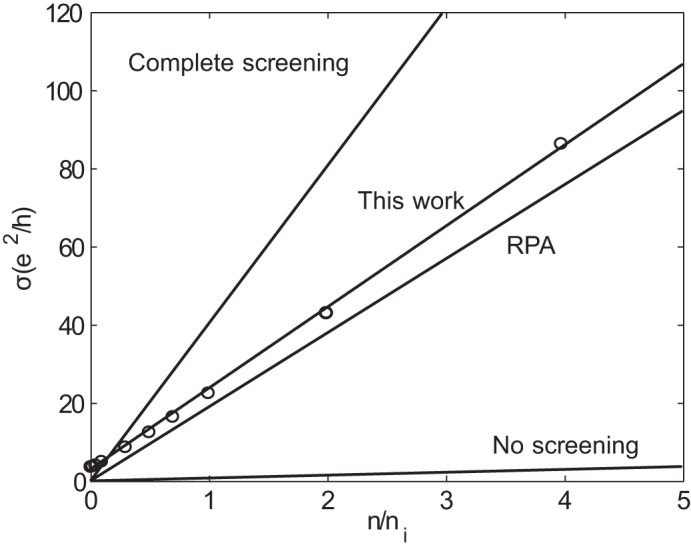
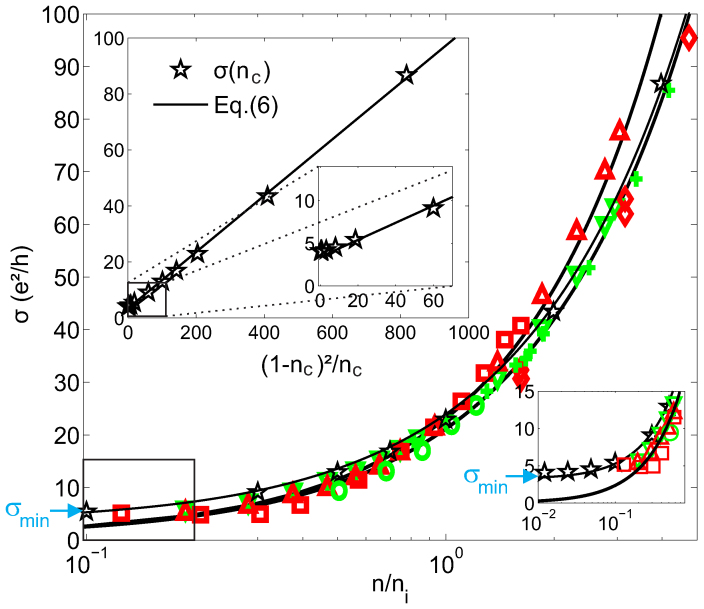
Based on the recently developed picture of an electronic ideal relativistic fluid at the Dirac point, we present an analytical model for the conductivity in graphene that is able to describe the linear dependence on the carrier density and the existence of a minimum conductivity. The model treats impurities as submerged rigid obstacles, forming a disordered medium through which graphene electrons flow, in close analogy with classical fluid dynamics. To describe the minimum conductivity, we take into account the additional carrier density induced by the impurities in the sample. The model, which predicts the conductivity as a function of the impurity fraction of the sample, is supported by extensive simulations for different values of ε, the dimensionless strength of the electric field, and provides excellent agreement with experimental data.
基于最近在狄拉克点处开发的电子理想相对论流体的图像,我们提出了一个能够描述载流子密度线性依赖性和存在最小电导率的石墨烯电导率分析模型。该模型将杂质视为浸没的刚性障碍物,通过它们形成一个无序介质,使石墨烯电子在其中流动,这与经典流体动力学非常相似。为了描述最小电导率,我们考虑了样品中杂质引起的额外载流子密度。该模型预测了电导率作为样品杂质分数的函数,它与不同 ε 值(电场无量纲强度)的广泛模拟结果相吻合,并与实验数据非常吻合。