Department of Fundamental Microbiology, University of Lausanne, 1015 Lausanne, Switzerland.
Microb Biotechnol. 2013 Sep;6(5):503-14. doi: 10.1111/1751-7915.12031. Epub 2013 Jan 15.
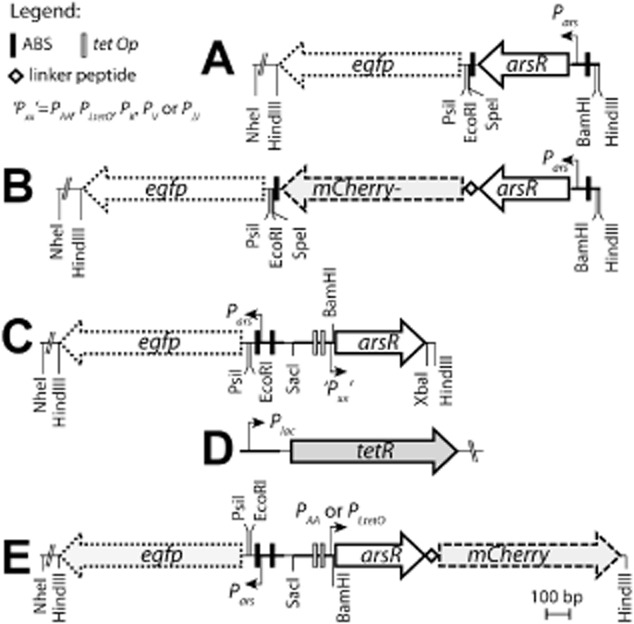
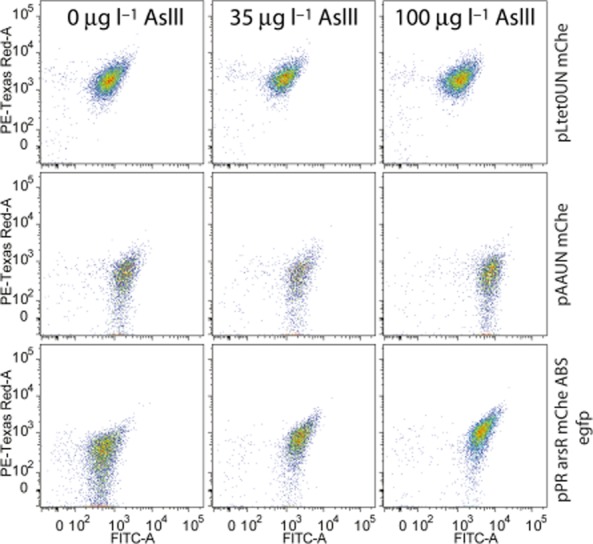
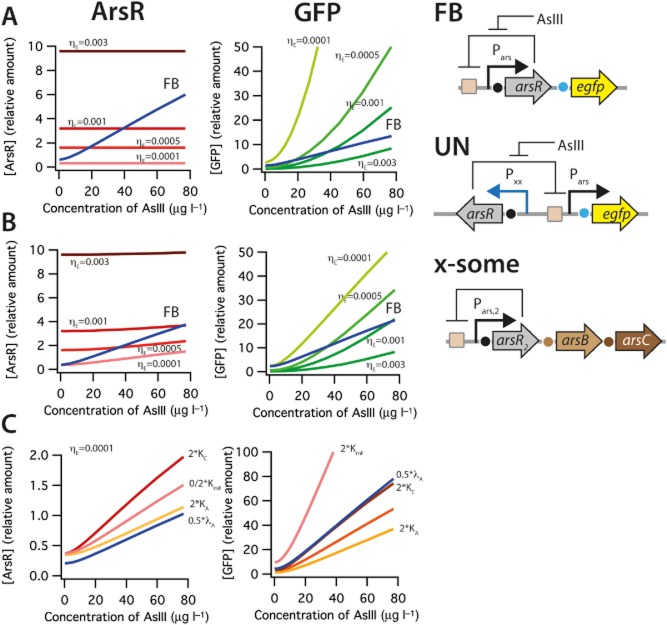
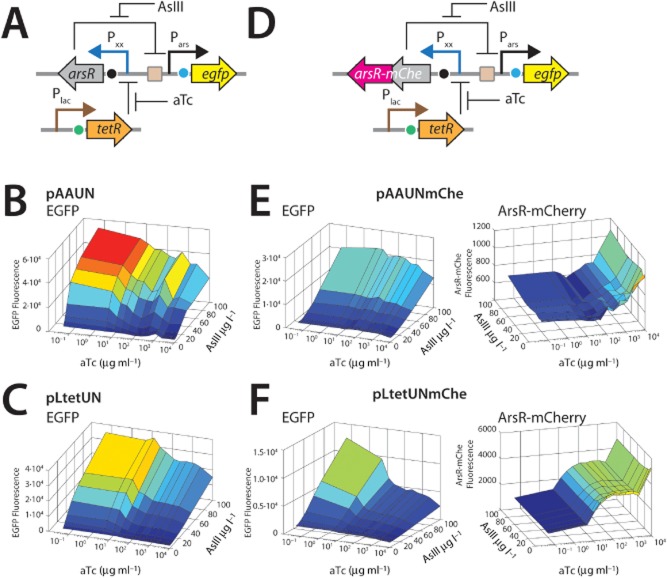
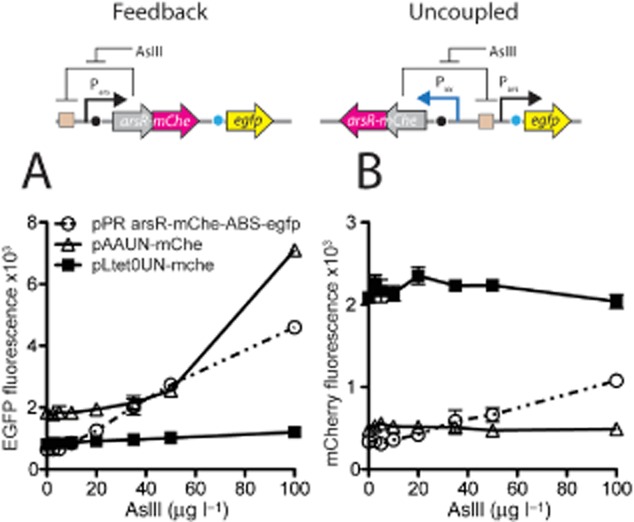
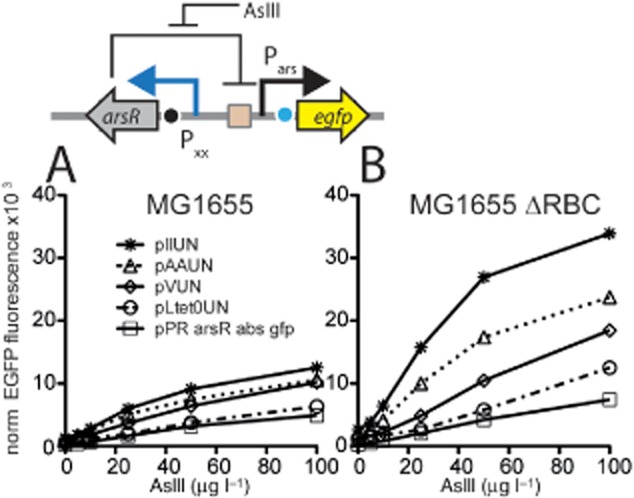
Escherichia coli-based bioreporters for arsenic detection are typically based on the natural feedback loop that controls ars operon transcription. Feedback loops are known to show a wide range linear response to the detriment of the overall amplification of the incoming signal. While being a favourable feature in controlling arsenic detoxification for the cell, a feedback loop is not necessarily the most optimal for obtaining highest sensitivity and response in a designed cellular reporter for arsenic detection. Here we systematically explore the effects of uncoupling the topology of arsenic sensing circuitry on the developed reporter signal as a function of arsenite concentration input. A model was developed to describe relative ArsR and GFP levels in feedback and uncoupled circuitry, which was used to explore new ArsR-based synthetic circuits. The expression of arsR was then placed under the control of a series of constitutive promoters, which differed in promoter strength, and which could be further modulated by TetR repression. Expression of the reporter gene was maintained under the ArsR-controlled Pars promoter. ArsR expression in the systems was measured by using ArsR-mCherry fusion proteins. We find that stronger constitutive ArsR production decreases arsenite-dependent EGFP output from Pars and vice versa. This leads to a tunable series of arsenite-dependent EGFP outputs in a variety of systematically characterized circuitries. The higher expression levels and sensitivities of the response curves in the uncoupled circuits may be useful for improving field-test assays using arsenic bioreporters.
基于大肠杆菌的砷生物传感器通常基于控制 Ars 操纵子转录的自然反馈回路。众所周知,反馈回路对输入信号的整体放大具有广泛的线性响应,而不利于砷的解毒。虽然对于细胞控制砷解毒来说是一个有利的特征,但在设计用于砷检测的细胞报告器中,反馈回路不一定是获得最高灵敏度和响应的最佳选择。在这里,我们系统地研究了砷感应电路拓扑解耦对开发的砷检测报告器信号的影响,作为亚砷酸盐浓度输入的函数。我们开发了一个模型来描述反馈和非耦电路中 ArsR 和 GFP 水平的相对关系,该模型用于探索新的基于 ArsR 的合成电路。然后,arsR 的表达受一系列组成型启动子的控制,这些启动子在启动子强度上有所不同,并且可以通过 TetR 抑制进一步调节。报告基因的表达受 ArsR 控制的 Pars 启动子控制。系统中 ArsR 的表达通过 ArsR-mCherry 融合蛋白进行测量。我们发现,更强的组成型 ArsR 产生会降低 Pars 依赖的 EGFP 输出,反之亦然。这导致在各种系统表征的电路中产生一系列可调谐的亚砷酸盐依赖的 EGFP 输出。非耦电路中响应曲线的更高表达水平和灵敏度可能有助于改进使用砷生物传感器的现场测试分析。