School of Chemistry and Chemical Engineering, Shihezi University, Shihezi 832003, China.
College of Chemical and Biological Engineering & ZJU-Hangzhou Global Scientific and Technological Innovation Center, Zhejiang University, Hangzhou 311200, China.
Anal Chem. 2022 May 24;94(20):7210-7218. doi: 10.1021/acs.analchem.2c00055. Epub 2022 May 10.
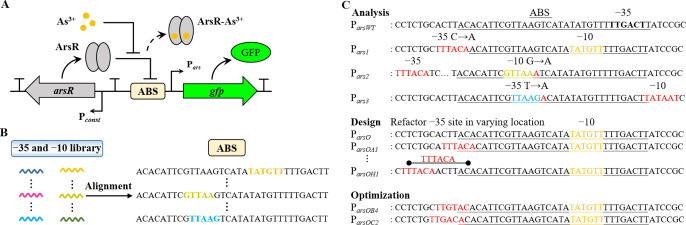
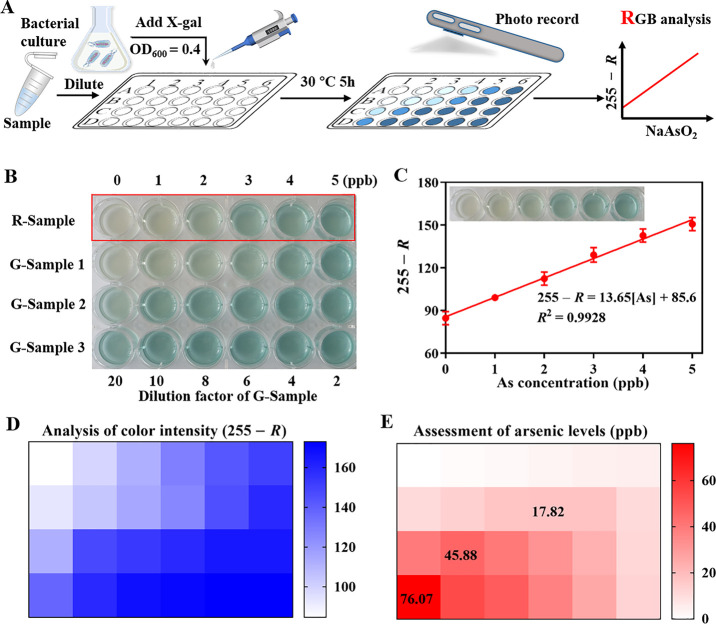
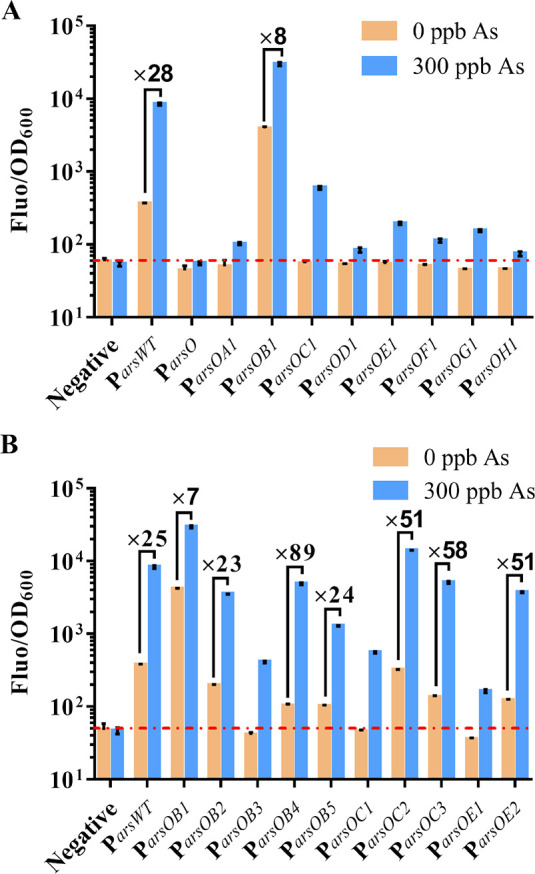
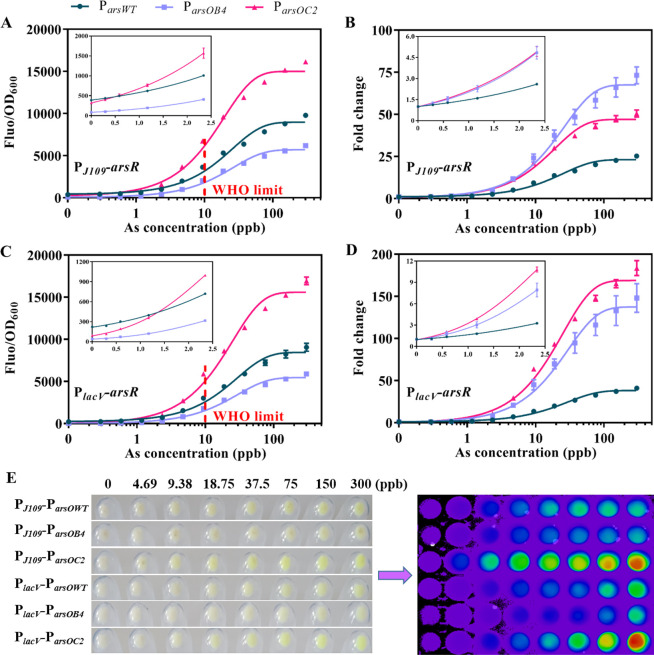
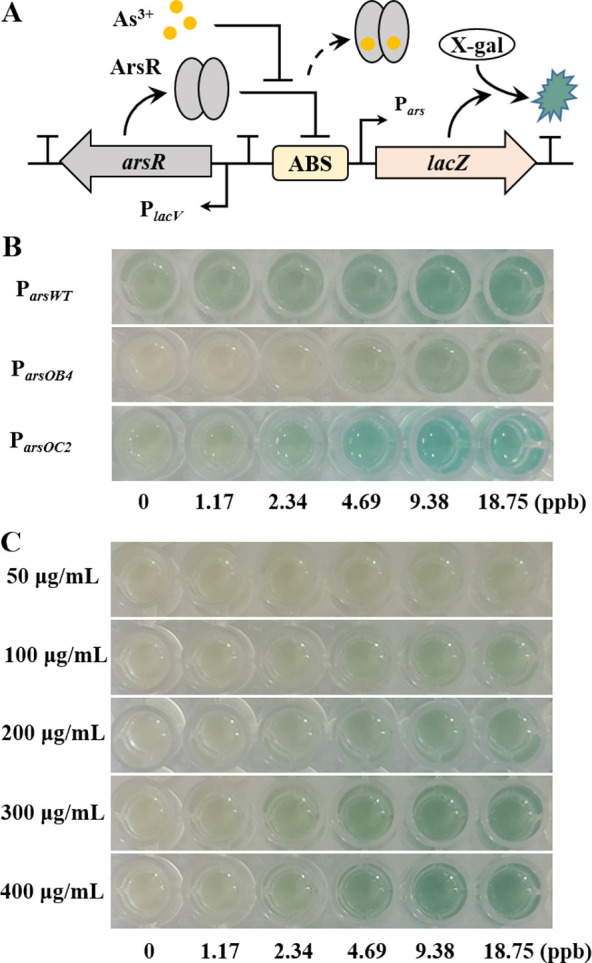
Whole-cell biosensors for arsenic contamination are typically designed based on natural bacterial sensing systems, which are often limited by their poor performance for precisely tuning the genetic response to environmental stimuli. Promoter design remains one of the most important approaches to address such issues. Here, we use the arsenic-responsive ArsR-P regulation system from MG1655 as the sensing element and coupled or as the reporter gene to construct the genetic circuit for characterizing the refactored promoters. We first analyzed the ArsR binding site and a library of RNA polymerase binding sites to mine potential promoter sequences. A set of tightly regulated P promoters by ArsR was designed by placing the ArsR binding sites into the promoter's core region, and a novel promoter with maximal repression efficiency and optimal fold change was obtained. The fluorescence sensor P-P constructed with the optimized P promoter showed a fold change of up to 63.80-fold (with green fluorescence visible to the naked eye) at 9.38 ppb arsenic, and the limit of detection was as low as 0.24 ppb. Further, the optimized colorimetric sensor P-P- with a linear response between 0 and 5 ppb was used to perform colorimetric reactions in 24-well plates combined with a smartphone application for the quantification of the arsenic level in groundwater. This study offers a new approach to improve the performance of bacterial sensing promoters and will facilitate the on-site application of arsenic whole-cell biosensors.
用于砷污染的全细胞生物传感器通常基于天然细菌感应系统设计,而这些系统通常受到其对环境刺激的遗传响应进行精确调整的性能限制。启动子设计仍然是解决此类问题的最重要方法之一。在这里,我们使用来自 MG1655 的砷响应 ArsR-P 调控系统作为感应元件,并将 或 作为报告基因来构建用于表征重构启动子的遗传回路。我们首先分析了 ArsR 结合位点和 RNA 聚合酶结合位点文库,以挖掘潜在的启动子序列。通过将 ArsR 结合位点置于启动子的核心区域,设计了一组由 ArsR 严格调控的 P 启动子,获得了具有最大抑制效率和最佳倍变化的新型启动子。用优化的 P 启动子构建的荧光传感器 P-P 在 9.38 ppb 砷时表现出高达 63.80 倍的倍变化(肉眼可见绿色荧光),检测限低至 0.24 ppb。此外,优化的比色传感器 P-P-在 0 到 5 ppb 之间具有线性响应,可与智能手机应用程序结合在 24 孔板中进行比色反应,用于定量地下水的砷含量。这项研究为提高细菌感应启动子的性能提供了一种新方法,并将促进砷全细胞生物传感器的现场应用。