MRC Centre for Causal Analyses in Translational Epidemiology, School of Social and Community Medicine, University of Bristol, Bristol, UK.
J Epidemiol Community Health. 2013 Apr;67(4):358-64. doi: 10.1136/jech-2012-201892. Epub 2013 Jan 15.
Socioeconomic inequalities are a key policy challenge. Studies to date have not taken a unified approach to assess how socioeconomic inequalities in health, behaviour and educational attainment change as children age.
We examined maternal education inequalities in multiple offspring health, behavioural and educational outcomes and how these changed across childhood and adolescence in the Avon Longitudinal Study of Parents and Children, a cohort born in 1991/1992 in South-West England (N=5560-11 463).
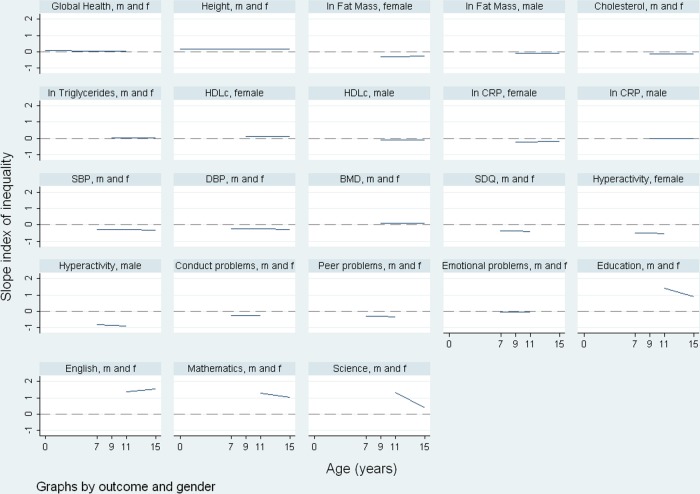
Inequalities were observed for some health measures (blood pressure (BP), height, cholesterol, bone mineral density (BMD) and fat-mass (females)) but not in other measures (parent-assessed child health, triglycerides, fat-mass (males), high-density lipoprotein-cholesterol, C reactive protein). The strongest health inequality was systolic BP (mean difference comparing highest to lowest maternal education -0.28 SD (95% CI -0.35 to -0.20), approximately 2.6 mm Hg. Wide inequalities, similar in magnitude to BP, were observed for behavioural outcomes. Even greater inequalities were observed for offspring academic achievement (mean difference comparing highest to lowest maternal education 1.43 SD (95% CI 1.37 to 1.50), a difference of 22%). For all behavioural outcomes and some health indicators, inequality was stable over childhood. For some outcomes (BP, BMD and most education outcomes), inequality narrowed as children got older. Only for height and attainment in English tests was there evidence of widening inequalities with age.
Our results suggest that within this cohort, maternal education inequalities in offspring health, behaviour and educational attainment are established in childhood but do not increase up to adolescence. Maternal education inequalities in behaviour and educational attainment were considerably larger than in health measures.
社会经济不平等是一个关键的政策挑战。迄今为止的研究尚未采用统一的方法来评估儿童年龄增长时健康、行为和教育程度的社会经济不平等如何变化。
我们研究了母亲教育程度不平等对多个子女健康、行为和教育结果的影响,以及在英格兰西南部出生于 1991/1992 年的 Avon Longitudinal Study of Parents and Children 队列中,这些不平等如何在儿童期和青春期发生变化(N=5560-11463)。
观察到一些健康指标(血压(BP)、身高、胆固醇、骨矿物质密度(BMD)和脂肪量(女性))存在不平等,但其他指标(父母评估的儿童健康、甘油三酯、脂肪量(男性)、高密度脂蛋白胆固醇、C 反应蛋白)则不存在。最强的健康不平等是收缩压(比较最高和最低母亲教育程度的平均差异-0.28 SD(95%CI-0.35 至-0.20),大约 2.6 毫米汞柱。观察到行为结果存在类似规模的广泛不平等。子女学业成绩(比较最高和最低母亲教育程度的平均差异 1.43 SD(95%CI1.37 至 1.50))存在更大的不平等,差异为 22%。对于所有行为结果和一些健康指标,不平等在儿童期保持稳定。对于一些结果(BP、BMD 和大多数教育结果),随着儿童年龄的增长,不平等程度缩小。只有身高和英语测试成绩的不平等随着年龄的增长而扩大。
我们的研究结果表明,在这个队列中,子女健康、行为和教育程度的母亲教育不平等在儿童期就已经存在,但在青春期前不会增加。行为和教育程度的母亲教育不平等远远大于健康指标。