National School of Public Health, Oswaldo Cruz Foundation/FIOCRUZ, Rio de Janeiro, Brazil.
BMC Pregnancy Childbirth. 2013 Jan 16;13:1. doi: 10.1186/1471-2393-13-1.
Social conditions, social relationships and neighbourhood environment, the components of social capital, are important determinants of health. The objective of this study was to investigate the association of neighbourhood and individual social capital with consistent self-rated health in women between the first trimester of pregnancy and six months postpartum.
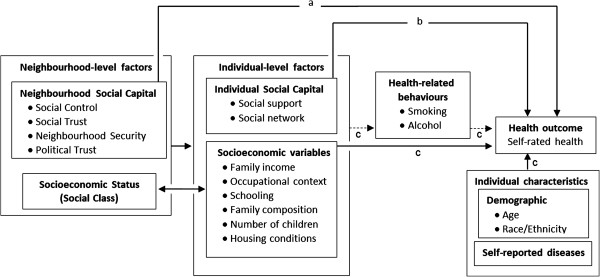
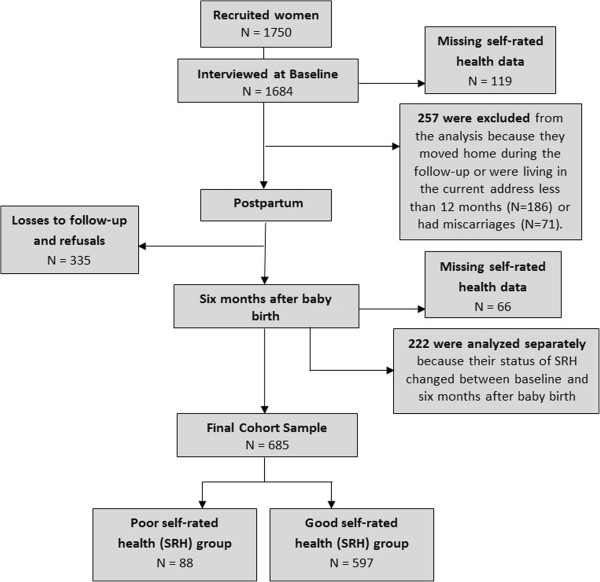
A multilevel cohort study in 34 neighbourhoods was performed on 685 Brazilian women recruited at antenatal units in two cities in the State of Rio de Janeiro, Brazil. Self-rated health (SRH) was assessed in the 1st trimester of pregnancy (baseline) and six months after childbirth (follow-up). The participants were divided into two groups: 1. Good SRH--good SRH at baseline and follow-up, and, 2. Poor SRH--poor SRH at baseline and follow-up. Exploratory variables collected at baseline included neighbourhood social capital (neighbourhood-level variable), individual social capital (social support and social networks), demographic and socioeconomic characteristics, health-related behaviours and self-reported diseases. A hierarchical binomial multilevel analysis was performed to test the association between neighbourhood and individual social capital and SRH, adjusted for covariates.
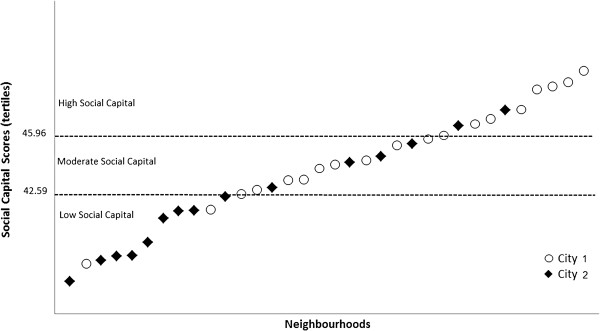
The Good SRH group reported higher scores of social support and social networks than the Poor SRH group. Although low neighbourhood social capital was associated with poor SRH in crude analysis, the association was not significant when individual socio-demographic variables were included in the model. In the final model, women reporting poor SRH both at baseline and follow-up had lower levels of social support (positive social interaction) [OR 0.82 (95% CI: 0.73-0.90)] and a lower likelihood of friendship social networks [OR 0.61 (95% CI: 0.37-0.99)] than the Good SRH group. The characteristics that remained associated with poor SRH were low level of schooling, Black and Brown ethnicity, more children, urinary infection and water plumbing outside the house.
Low individual social capital during pregnancy, considered here as social support and social network, was independently associated with poor SRH in women whereas neighbourhood social capital did not affect women's SRH during pregnancy and the months thereafter. From pregnancy and up to six months postpartum, the effect of individual social capital explained better the consistency of SRH over time than neighbourhood social capital.
社会条件、社会关系和邻里环境是社会资本的组成部分,它们是健康的重要决定因素。本研究的目的是调查邻里和个体社会资本与女性在妊娠第一孕期至产后六个月期间持续自我报告健康状况之间的关联。
在巴西里约热内卢州的两个城市的产前单位招募了 685 名巴西女性,进行了一项包含 34 个邻里的多层次队列研究。在妊娠第一孕期(基线)和产后六个月(随访)评估自我报告健康状况(SRH)。参与者分为两组:1.良好 SRH-在基线和随访时良好的 SRH;2.不良 SRH-在基线和随访时不良的 SRH。基线时收集的探索性变量包括邻里社会资本(邻里水平变量)、个体社会资本(社会支持和社交网络)、人口统计学和社会经济特征、与健康相关的行为和自我报告的疾病。进行分层二项式多水平分析,以检验邻里和个体社会资本与 SRH 之间的关联,调整协变量。
良好 SRH 组报告的社会支持和社交网络得分高于不良 SRH 组。尽管在粗分析中,低邻里社会资本与不良 SRH 相关,但当个体社会人口统计学变量纳入模型时,这种关联并不显著。在最终模型中,在基线和随访时均报告不良 SRH 的女性,其社会支持水平较低(积极的社会互动)[比值比 0.82(95%置信区间:0.73-0.90)],友谊社交网络的可能性较低[比值比 0.61(95%置信区间:0.37-0.99)],与良好 SRH 组相比。与不良 SRH 相关的特征还包括低教育水平、黑人和棕色人种、更多的孩子、尿路感染和房屋外的水管。
妊娠期间个体社会资本较低,这里定义为社会支持和社交网络,与女性不良 SRH 独立相关,而邻里社会资本并不影响女性妊娠期间及之后几个月的 SRH。从妊娠到产后六个月,个体社会资本对 SRH 随时间一致性的解释优于邻里社会资本。