Embrapa Recursos Genéticos e Biotecnologia, Genetics Lab, PO Box 02372, Brasília, CEP 70770-917 Distrito Federal, Brazil.
BMC Genomics. 2013 Jan 16;14:17. doi: 10.1186/1471-2164-14-17.
Brachiaria ruziziensis is one of the most important forage species planted in the tropics. The application of genomic tools to aid the selection of superior genotypes can provide support to B. ruziziensis breeding programs. However, there is a complete lack of information about the B. ruziziensis genome. Also, the availability of genomic tools, such as molecular markers, to support B. ruziziensis breeding programs is rather limited. Recently, next-generation sequencing technologies have been applied to generate sequence data for the identification of microsatellite regions and primer design. In this study, we present a first validated set of SSR markers for Brachiaria ruziziensis, selected from a de novo partial genome assembly of single-end Illumina reads.
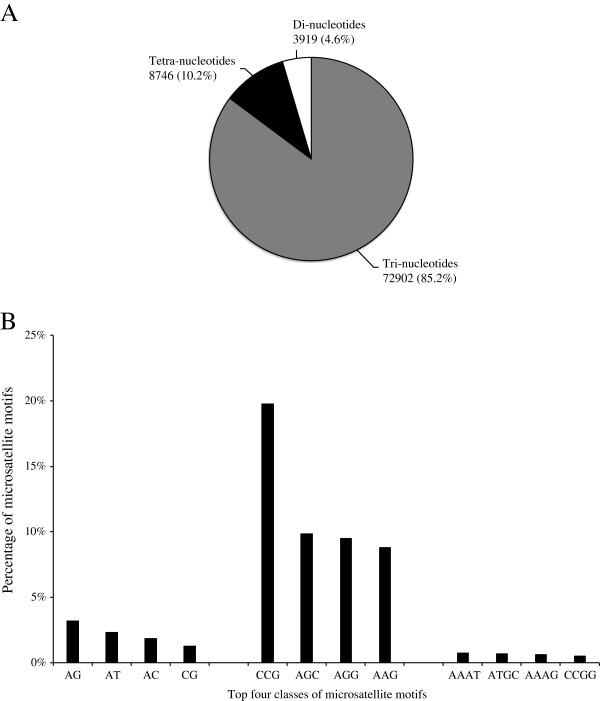
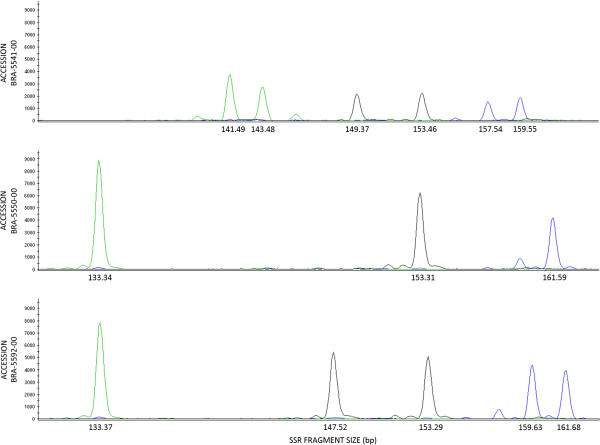
A total of 85,567 perfect microsatellite loci were detected in contigs with a minimum 10X coverage. We selected a set of 500 microsatellite loci identified in contigs with minimum 100X coverage for primer design and synthesis, and tested a subset of 269 primer pairs, 198 of which were polymorphic on 11 representative B. ruziziensis accessions. Descriptive statistics for these primer pairs are presented, as well as estimates of marker transferability to other relevant brachiaria species. Finally, a set of 11 multiplex panels containing the 30 most informative markers was validated and proposed for B. ruziziensis genetic analysis.
We show that the detection and development of microsatellite markers from genome assembled Illumina single-end DNA sequences is highly efficient. The developed markers are readily suitable for genetic analysis and marker assisted selection of Brachiaria ruziziensis. The use of this approach for microsatellite marker development is promising for species with limited genomic information, whose breeding programs would benefit from the use of genomic tools. To our knowledge, this is the first set of microsatellite markers developed for this important species.
热研 2 号狗尾草是热带地区种植的最重要的饲料物种之一。基因组工具的应用有助于选择优良基因型,可以为热研 2 号狗尾草的选育计划提供支持。然而,关于热研 2 号狗尾草基因组的信息完全缺乏。此外,支持热研 2 号狗尾草选育计划的基因组工具(如分子标记)的可用性相当有限。最近,下一代测序技术已被应用于生成微卫星区域的鉴定和引物设计的序列数据。在本研究中,我们提出了一套用于热研 2 号狗尾草的 SSR 标记,这些标记是从单端 Illumina 读取的从头部分基因组组装中选择的。
在最小 10X 覆盖的连续体中检测到总共 85567 个完美的微卫星位点。我们选择了一组最小 100X 覆盖的连续体中鉴定的 500 个微卫星位点用于引物设计和合成,并测试了一小部分 269 对引物,其中 198 对 11 个代表性热研 2 号狗尾草品种具有多态性。介绍了这些引物的描述性统计数据,以及对其他相关狗尾草物种的标记可转移性的估计。最后,验证并提出了一组包含 30 个最具信息量标记的 11 个多重面板,用于热研 2 号狗尾草的遗传分析。
我们表明,从组装的 Illumina 单端 DNA 序列中检测和开发微卫星标记是非常有效的。开发的标记非常适合热研 2 号狗尾草的遗传分析和标记辅助选择。对于基因组信息有限的物种,这种方法用于微卫星标记的开发很有前景,其选育计划将受益于基因组工具的使用。据我们所知,这是为这个重要物种开发的第一组微卫星标记。