Hendre Prasad Suresh, Phanindranath Regur, Annapurna V, Lalremruata Albert, Aggarwal Ramesh K
Centre for Cellular and Molecular Biology (CCMB), Uppal Road, Tarnaka, Hyderabad- 500 007, Andhra Pradesh, India.
BMC Plant Biol. 2008 Apr 30;8:51. doi: 10.1186/1471-2229-8-51.
Species-specific microsatellite markers are desirable for genetic studies and to harness the potential of MAS-based breeding for genetic improvement. Limited availability of such markers for coffee, one of the most important beverage tree crops, warrants newer efforts to develop additional microsatellite markers that can be effectively deployed in genetic analysis and coffee improvement programs. The present study aimed to develop new coffee-specific SSR markers and validate their utility in analysis of genetic diversity, individualization, linkage mapping, and transferability for use in other related taxa.
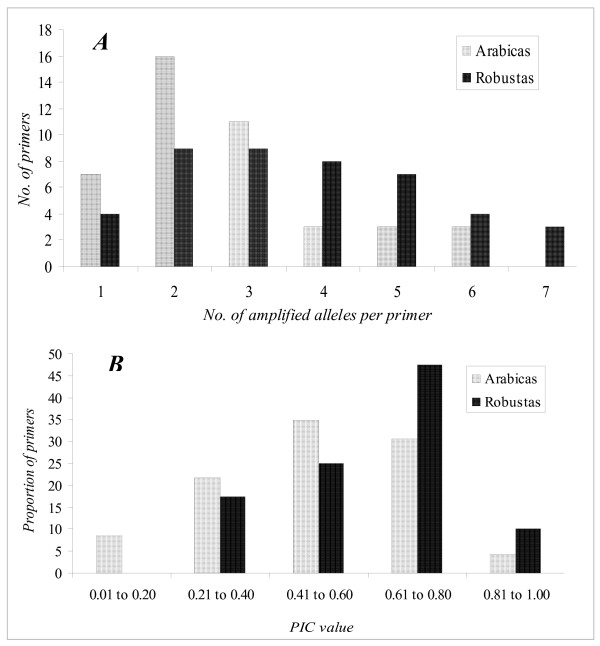
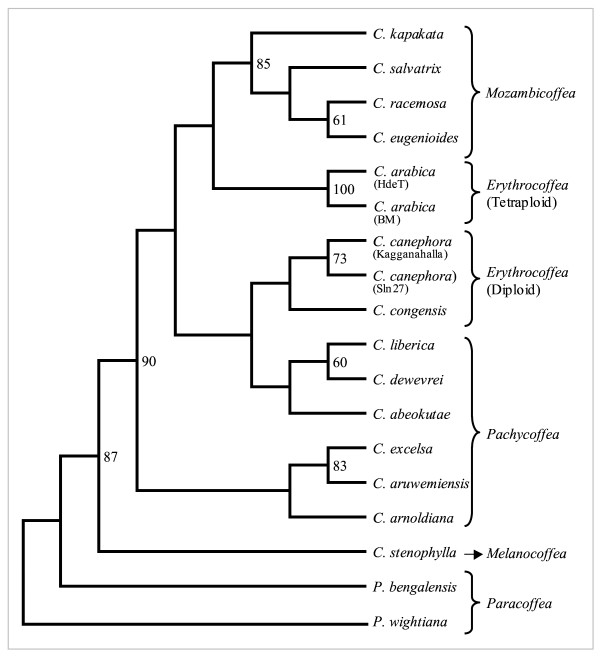
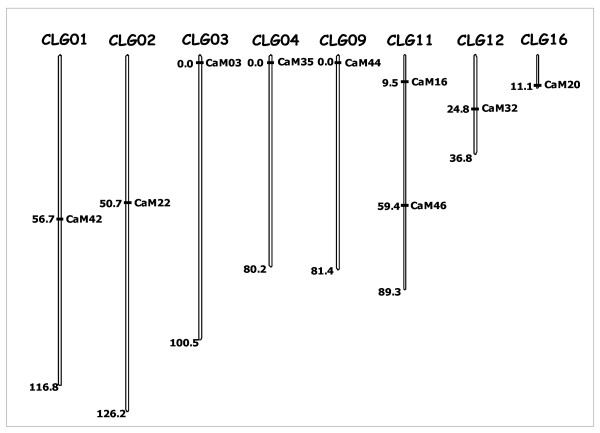
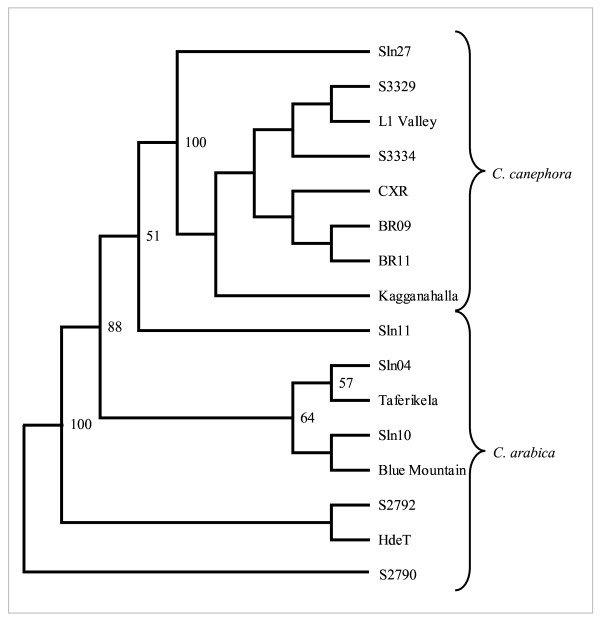
A small-insert partial genomic library of Coffea canephora, was probed for various SSR motifs following conventional approach of Southern hybridisation. Characterization of repeat positive clones revealed a very high abundance of DNRs (1/15 Kb) over TNRs (1/406 kb). The relative frequencies of different DNRs were found as AT >> AG > AC, whereas among TNRs, AGC was the most abundant repeat. The SSR positive sequences were used to design 58 primer pairs of which 44 pairs could be validated as single locus markers using a panel of arabica and robusta genotypes. The analysis revealed an average of 3.3 and 3.78 alleles and 0.49 and 0.62 PIC per marker for the tested arabicas and robustas, respectively. It also revealed a high cumulative PI over all the markers using both sib-based (10-6 and 10-12 for arabicas and robustas respectively) and unbiased corrected estimates (10-20 and 10-43 for arabicas and robustas respectively). The markers were tested for Hardy-Weinberg equilibrium, linkage dis-equilibrium, and were successfully used to ascertain generic diversity/affinities in the tested germplasm (cultivated as well as species). Nine markers could be mapped on robusta linkage map. Importantly, the markers showed ~92% transferability across related species/genera of coffee.
The conventional approach of genomic library was successfully employed although with low efficiency to develop a set of 44 new genomic microsatellite markers of coffee. The characterization/validation of new markers demonstrated them to be highly informative, and useful for genetic studies namely, genetic diversity in coffee germplasm, individualization/bar-coding for germplasm protection, linkage mapping, taxonomic studies, and use as conserved orthologous sets across secondary genepool of coffee. Further, the relative frequency and distribution of different SSR motifs in coffee genome indicated coffee genome to be relatively poor in microsatellites compared to other plant species.
物种特异性微卫星标记对于遗传研究以及利用基于标记辅助选择(MAS)的育种潜力进行遗传改良至关重要。对于咖啡这种最重要的饮料树作物之一,此类标记的可用性有限,因此需要做出新的努力来开发更多微卫星标记,以便有效地应用于遗传分析和咖啡改良计划。本研究旨在开发新的咖啡特异性简单序列重复(SSR)标记,并验证其在遗传多样性分析、个体识别、连锁图谱构建以及在其他相关分类群中的可转移性方面的效用。
按照传统的Southern杂交方法,用小插入片段的卡内弗拉咖啡部分基因组文库对各种SSR基序进行探测。对重复阳性克隆的表征显示,二核苷酸重复(DNRs,1/15 Kb)的丰度远高于三核苷酸重复(TNRs,1/406 kb)。发现不同DNRs的相对频率为AT >> AG > AC,而在TNRs中,AGC是最丰富的重复序列。利用SSR阳性序列设计了58对引物,其中44对引物可通过一组阿拉比卡和罗布斯塔基因型验证为单一位点标记。分析显示,对于测试的阿拉比卡咖啡和罗布斯塔咖啡,每个标记平均分别有3.3和3.78个等位基因,多态信息含量(PIC)分别为0.49和0.62。同时还发现,使用基于同胞的估计值(阿拉比卡咖啡和罗布斯塔咖啡分别为10-6和10-12)以及无偏校正估计值(阿拉比卡咖啡和罗布斯塔咖啡分别为10-20和10-43)时,所有标记的累积个体识别率都很高。对这些标记进行了哈迪-温伯格平衡和连锁不平衡测试,并成功用于确定测试种质(包括栽培种和野生种)中的遗传多样性/亲缘关系。九个标记可以定位到罗布斯塔咖啡的连锁图谱上。重要的是,这些标记在咖啡的相关物种/属间显示出约92%的可转移性。
虽然效率较低,但成功采用传统的基因组文库方法开发了一组44个新的咖啡基因组微卫星标记。新标记的表征/验证表明它们具有很高的信息含量,可用于遗传研究,即咖啡种质的遗传多样性分析、种质保护的个体识别/条形码识别、连锁图谱构建、分类学研究以及作为咖啡二级基因库中的保守直系同源集。此外,咖啡基因组中不同SSR基序的相对频率和分布表明,与其他植物物种相比,咖啡基因组中的微卫星相对较少。