Institute of Plant and Microbial Biology, Academia Sinica, Taipei, Taiwan.
BMC Genomics. 2013 Jan 16;14:22. doi: 10.1186/1471-2164-14-22.
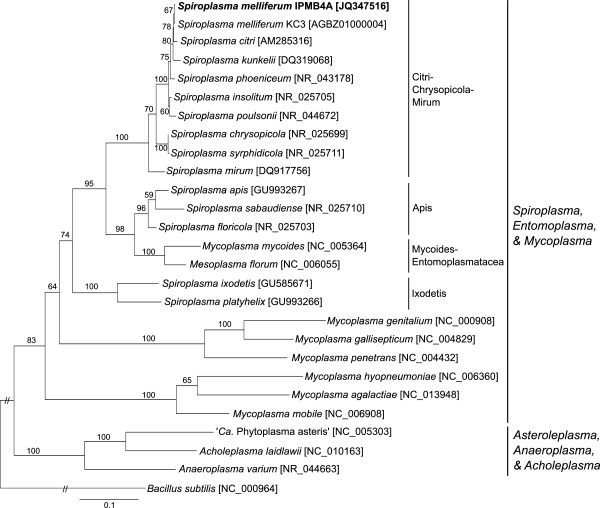
The genus Spiroplasma contains a group of helical, motile, and wall-less bacteria in the class Mollicutes. Similar to other members of this class, such as the animal-pathogenic Mycoplasma and the plant-pathogenic 'Candidatus Phytoplasma', all characterized Spiroplasma species were found to be associated with eukaryotic hosts. While most of the Spiroplasma species appeared to be harmless commensals of insects, a small number of species have evolved pathogenicity toward various arthropods and plants. In this study, we isolated a novel strain of honeybee-associated S. melliferum and investigated its genetic composition and evolutionary history by whole-genome shotgun sequencing and comparative analysis with other Mollicutes genomes.
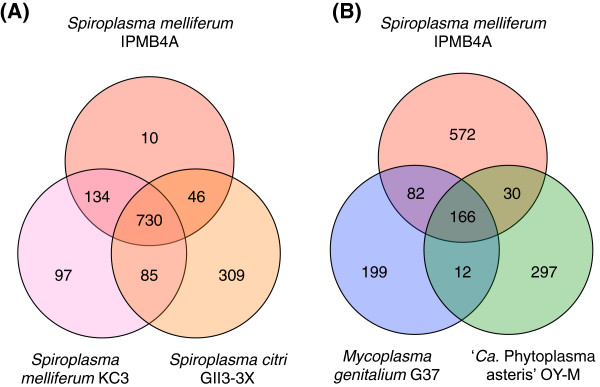
The whole-genome shotgun sequencing of S. melliferum IPMB4A produced a draft assembly that was ~1.1 Mb in size and covered ~80% of the chromosome. Similar to other Spiroplasma genomes that have been studied to date, we found that this genome contains abundant repetitive sequences that originated from plectrovirus insertions. These phage fragments represented a major obstacle in obtaining a complete genome sequence of Spiroplasma with the current sequencing technology. Comparative analysis of S. melliferum IPMB4A with other Spiroplasma genomes revealed that these phages may have facilitated extensive genome rearrangements in these bacteria and contributed to horizontal gene transfers that led to species-specific adaptation to different eukaryotic hosts. In addition, comparison of gene content with other Mollicutes suggested that the common ancestor of the SEM (Spiroplasma, Entomoplasma, and Mycoplasma) clade may have had a relatively large genome and flexible metabolic capacity; the extremely reduced genomes of present day Mycoplasma and 'Candidatus Phytoplasma' species are likely to be the result of independent gene losses in these lineages.
The findings in this study highlighted the significance of phage insertions and horizontal gene transfer in the evolution of bacterial genomes and acquisition of pathogenicity. Furthermore, the inclusion of Spiroplasma in comparative analysis has improved our understanding of genome evolution in Mollicutes. Future improvements in the taxon sampling of available genome sequences in this group are required to provide further insights into the evolution of these important pathogens of humans, animals, and plants.
螺旋体属包含一类在柔膜体纲中的无壁、螺旋形、能动细菌。与该纲中的其他成员(如动物病原体支原体和植物病原体“候选植原体”)相似,所有已鉴定的螺旋体物种都被发现与真核宿主有关。虽然大多数螺旋体物种似乎是昆虫无害的共生体,但少数物种已进化为对各种节肢动物和植物具有致病性。在这项研究中,我们分离到一株新型的与蜜蜂相关的 S. melliferum,并通过全基因组鸟枪法测序和与其他柔膜体纲基因组的比较分析来研究其遗传组成和进化历史。
对 S. melliferum IPMB4A 的全基因组鸟枪法测序产生了一个约 1.1 Mb 大小的草图组装,覆盖了染色体的约 80%。与迄今为止研究过的其他螺旋体基因组相似,我们发现该基因组包含大量源自 plectrovirus 插入的重复序列。这些噬菌体片段在使用当前测序技术获得完整的螺旋体基因组序列方面构成了主要障碍。与其他螺旋体基因组的比较分析表明,这些噬菌体可能促进了这些细菌的广泛基因组重排,并促成了水平基因转移,导致了对不同真核宿主的物种特异性适应。此外,与其他柔膜体纲的基因含量比较表明,SEM(螺旋体、昆虫原体和支原体)进化枝的共同祖先可能具有相对较大的基因组和灵活的代谢能力;当今支原体和“候选植原体”物种的极度简化基因组可能是这些谱系中独立基因丢失的结果。
本研究的结果强调了噬菌体插入和水平基因转移在细菌基因组进化和获得致病性方面的重要性。此外,将螺旋体纳入比较分析提高了我们对柔膜体纲基因组进化的理解。需要进一步改进该组中现有基因组序列的分类采样,以提供对这些人类、动物和植物重要病原体进化的进一步了解。