Mudgalkar Nikhil, Bele Samir D, Valsangkar Sameer, Bodhare Trupti N, Gorre Mahipal
Department of Anaesthesia, Prathima Institute of Medical Sciences, Nagnur, Karimnagar, Andhra Pradesh, India.
Indian J Anaesth. 2012 Nov;56(6):553-7. doi: 10.4103/0019-5049.104573.
Visual analog scales (VAS) and numeric analog scales (NAS) are used to assess post-operative pain, but few studies indicate their usefulness in rural illiterate population in India.
This study was designed to 1) Compare the impact of literacy on the ability to indicate pain rating on VAS and NAS in post-operative rural patients. 2) Assess the level of agreement between the pain scales.
Cross sectional, hospital based study.
Informed consent was obtained from patients prior to undergoing surgical procedures in a teaching hospital. Post surgery, patients who were conscious and coherent, were asked to rate pain on both VAS and NAS. The pain ratings were obtained within 24 hours of surgery and within 5 minutes of each other.
Percentages, chi square test, regression analysis.
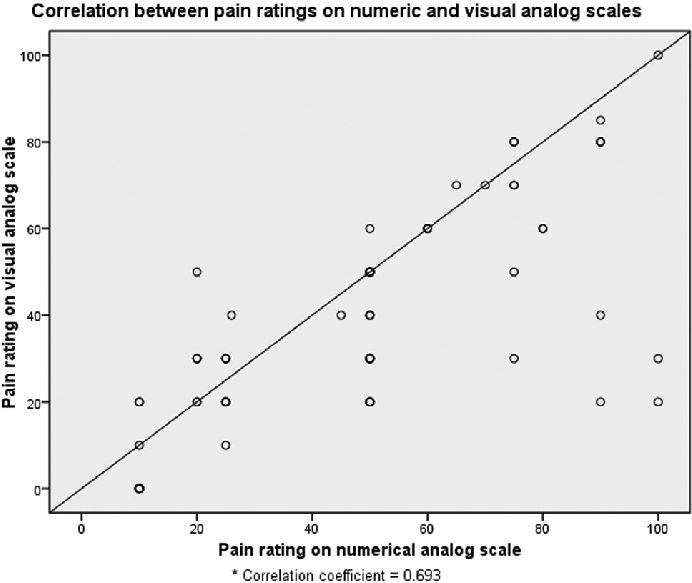
A total of 105 patients participated in the study. 43 (41%) of the sample was illiterate. 82 (78.1%) were able to rate pain on VAS while 81 (77.1%) were able to rate pain on NAS. There was no significant association between pain ratings and type of surgery, duration of surgery and nature of anaesthesia. In multivariate analysis, age, sex and literacy had no significant association with the ability to rate pain on VAS (P value 0.652, 0.967, 0.328 respectively). Similarly, no significant association was obtained between age, sex and literacy and ability to rate pain on NAS (P value 0.713, 0.405, 0.875 respectively). Correlation coefficient between the scales was 0.693.
VAS and NAS can be used interchangeably in Indian rural population as post-operative pain assessment tools irrespective of literacy status.
视觉模拟评分法(VAS)和数字模拟评分法(NAS)用于评估术后疼痛,但很少有研究表明它们在印度农村文盲人群中的实用性。
本研究旨在1)比较识字能力对农村术后患者使用VAS和NAS进行疼痛评分的影响。2)评估两种疼痛评分量表之间的一致性水平。
基于医院的横断面研究。
在一家教学医院,患者在接受外科手术前获得知情同意。术后,要求意识清醒且神志连贯的患者使用VAS和NAS对疼痛进行评分。疼痛评分在术后24小时内且彼此间隔不超过5分钟时获得。
百分比、卡方检验、回归分析。
共有105名患者参与研究。样本中有43名(41%)为文盲。82名(78.1%)能够使用VAS进行疼痛评分,而81名(77.1%)能够使用NAS进行疼痛评分。疼痛评分与手术类型、手术持续时间和麻醉方式之间无显著关联。在多变量分析中,年龄、性别和识字能力与使用VAS进行疼痛评分的能力无显著关联(P值分别为0.6