Virologie et Immunologie Moléculaires, INRA, Jouy-en-Josas, France.
PLoS Pathog. 2013 Jan;9(1):e1003098. doi: 10.1371/journal.ppat.1003098. Epub 2013 Jan 10.
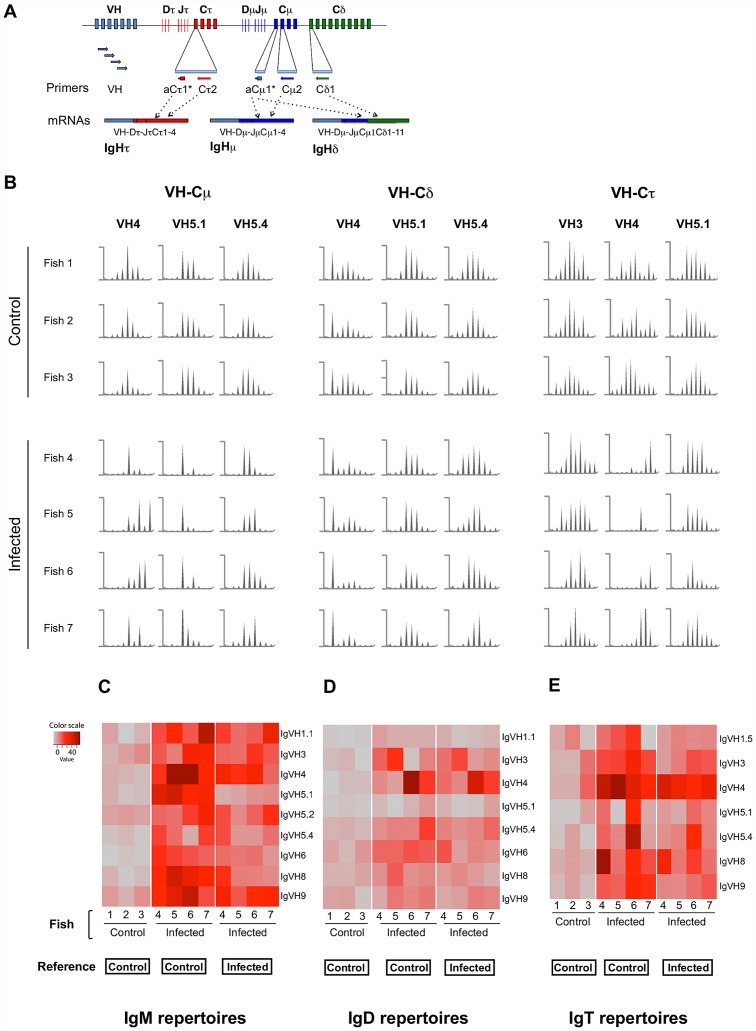
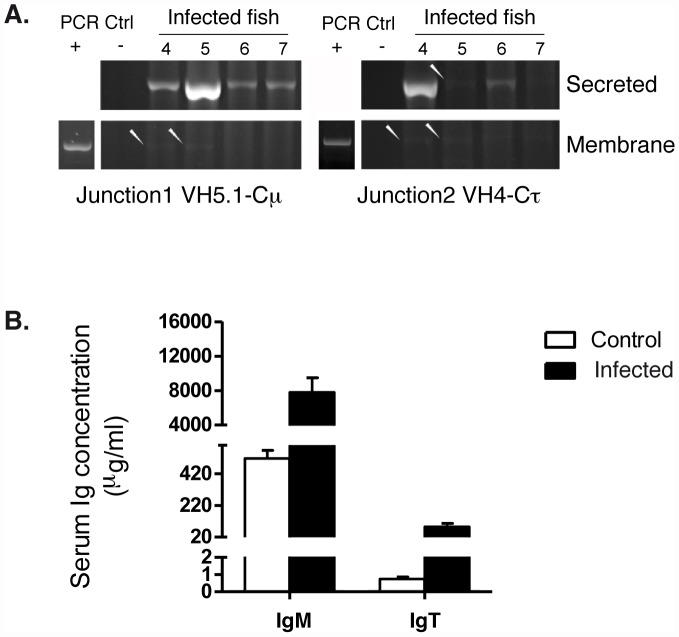
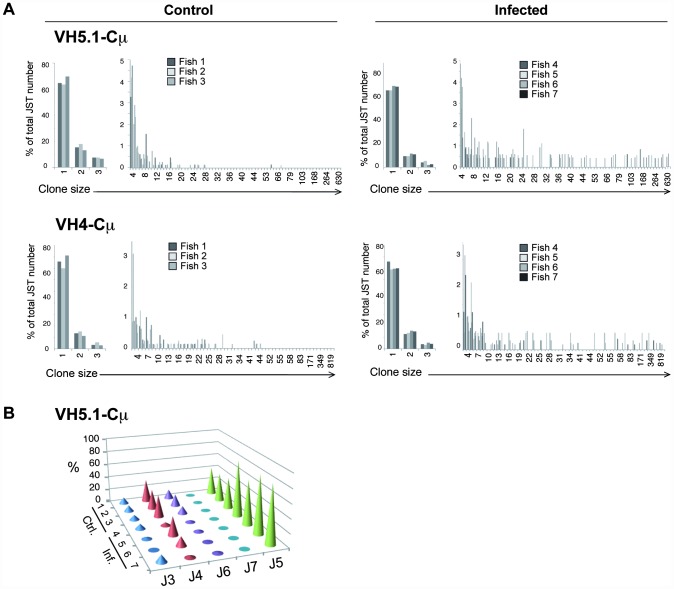
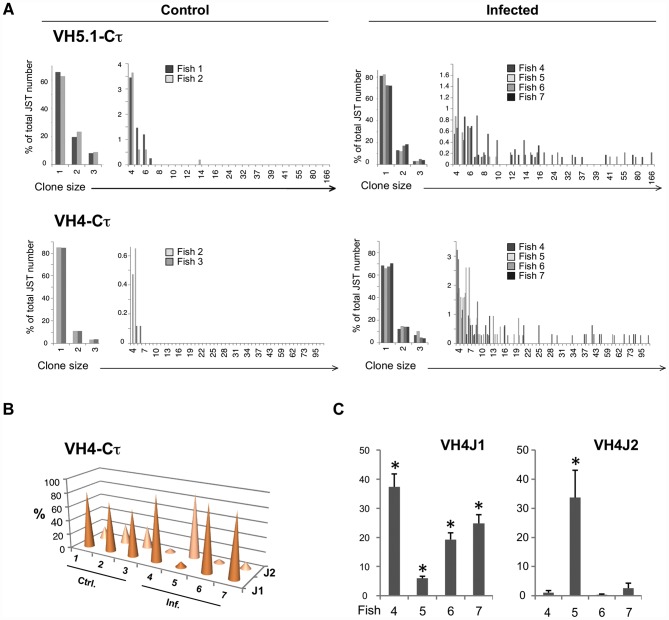
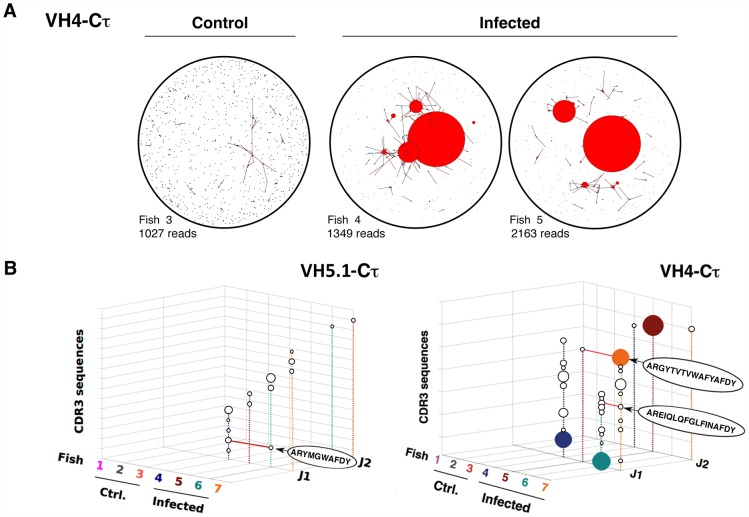
Upon infection, B-lymphocytes expressing antibodies specific for the intruding pathogen develop clonal responses triggered by pathogen recognition via the B-cell receptor. The constant region of antibodies produced by such responding clones dictates their functional properties. In teleost fish, the clonal structure of B-cell responses and the respective contribution of the three isotypes IgM, IgD and IgT remain unknown. The expression of IgM and IgT are mutually exclusive, leading to the existence of two B-cell subsets expressing either both IgM and IgD or only IgT. Here, we undertook a comprehensive analysis of the variable heavy chain (VH) domain repertoires of the IgM, IgD and IgT in spleen of homozygous isogenic rainbow trout (Onchorhynchus mykiss) before, and after challenge with a rhabdovirus, the Viral Hemorrhagic Septicemia Virus (VHSV), using CDR3-length spectratyping and pyrosequencing of immunoglobulin (Ig) transcripts. In healthy fish, we observed distinct repertoires for IgM, IgD and IgT, respectively, with a few amplified μ and τ junctions, suggesting the presence of IgM- and IgT-secreting cells in the spleen. In infected animals, we detected complex and highly diverse IgM responses involving all VH subgroups, and dominated by a few large public and private clones. A lower number of robust clonal responses involving only a few VH were detected for the mucosal IgT, indicating that both IgM(+) and IgT(+) spleen B cells responded to systemic infection but at different degrees. In contrast, the IgD response to the infection was faint. Although fish IgD and IgT present different structural features and evolutionary origin compared to mammalian IgD and IgA, respectively, their implication in the B-cell response evokes these mouse and human counterparts. Thus, it appears that the general properties of antibody responses were already in place in common ancestors of fish and mammals, and were globally conserved during evolution with possible functional convergences.
在感染后,表达针对入侵病原体的特异性抗体的 B 淋巴细胞会通过 B 细胞受体对病原体识别做出克隆反应。由这些反应克隆产生的抗体的恒定区决定了它们的功能特性。在硬骨鱼类中,B 细胞反应的克隆结构以及三种免疫球蛋白(IgM、IgD 和 IgT)各自的贡献仍然未知。B 细胞反应的克隆结构和分别表达 IgM 和 IgD 或仅表达 IgT 的两个 B 细胞亚群的存在导致 IgM 和 IgT 的表达相互排斥。在这里,我们使用 CDR3 长度谱分析和免疫球蛋白(Ig)转录物的焦磷酸测序,对虹鳟(Onchorhynchus mykiss)同基因纯合子的脾脏中的 IgM、IgD 和 IgT 的可变重链(VH)结构域库进行了全面分析,这些研究是在感染弹状病毒——病毒性出血性败血症病毒(VHSV)之前和之后进行的。在健康的鱼类中,我们观察到 IgM、IgD 和 IgT 分别具有独特的库,其中存在少数扩增的 μ 和 τ 接头,表明脾脏中存在 IgM 和 IgT 分泌细胞。在感染的动物中,我们检测到复杂且高度多样化的 IgM 反应,涉及所有 VH 亚群,并且由少数大的公共和私人克隆主导。针对粘膜 IgT 检测到数量较少的稳健克隆反应,仅涉及少数 VH,这表明系统性感染会引发 IgM(+)和 IgT(+)脾脏 B 细胞的反应,但程度不同。相比之下,IgD 对感染的反应很微弱。尽管鱼类 IgD 和 IgT 与哺乳动物 IgD 和 IgA 相比具有不同的结构特征和进化起源,但它们在 B 细胞反应中的作用引起了这些小鼠和人类的对应物。因此,似乎鱼类和哺乳动物的共同祖先已经具备了抗体反应的一般特性,并且在进化过程中保持了全球保守,具有可能的功能趋同。