National Marine Fisheries Service, National Oceanic and Atmospheric Administration, Northwest Fisheries Science Center, Fish Ecology Division, Seattle, Washington, United States of America.
PLoS One. 2013;8(1):e54134. doi: 10.1371/journal.pone.0054134. Epub 2013 Jan 11.
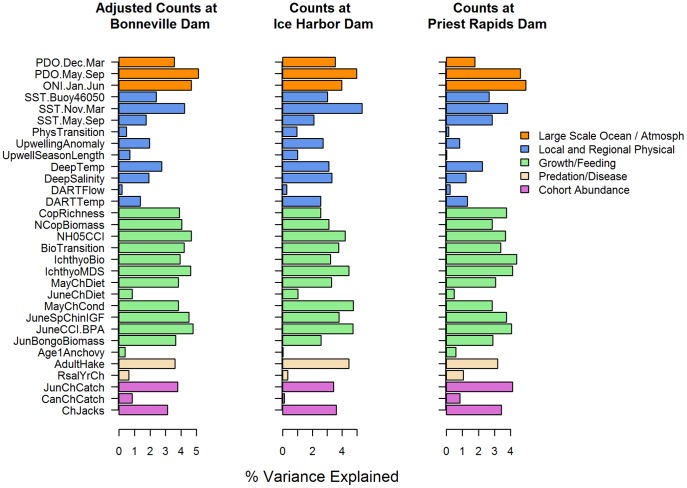
Most modeling and statistical approaches encourage simplicity, yet ecological processes are often complex, as they are influenced by numerous dynamic environmental and biological factors. Pacific salmon abundance has been highly variable over the last few decades and most forecasting models have proven inadequate, primarily because of a lack of understanding of the processes affecting variability in survival. Better methods and data for predicting the abundance of returning adults are therefore required to effectively manage the species. We combined 31 distinct indicators of the marine environment collected over an 11-year period into a multivariate analysis to summarize and predict adult spring Chinook salmon returns to the Columbia River in 2012. In addition to forecasts, this tool quantifies the strength of the relationship between various ecological indicators and salmon returns, allowing interpretation of ecosystem processes. The relative importance of indicators varied, but a few trends emerged. Adult returns of spring Chinook salmon were best described using indicators of bottom-up ecological processes such as composition and abundance of zooplankton and fish prey as well as measures of individual fish, such as growth and condition. Local indicators of temperature or coastal upwelling did not contribute as much as large-scale indicators of temperature variability, matching the spatial scale over which salmon spend the majority of their ocean residence. Results suggest that effective management of Pacific salmon requires multiple types of data and that no single indicator can represent the complex early-ocean ecology of salmon.
大多数建模和统计方法都鼓励简洁,但生态过程往往很复杂,因为它们受到许多动态环境和生物因素的影响。过去几十年里,太平洋鲑鱼的数量变化很大,大多数预测模型都被证明是不够的,主要是因为缺乏对影响存活率变化的过程的理解。因此,需要更好的方法和数据来预测返回成年个体的数量,以便有效地管理该物种。我们将 11 年间收集的 31 种不同的海洋环境指标结合到一个多元分析中,以总结和预测 2012 年哥伦比亚河春季奇努克鲑鱼的成年回游数量。除了预测,这个工具还量化了各种生态指标与鲑鱼回游数量之间关系的强度,允许对生态系统过程进行解释。指标的相对重要性有所不同,但出现了一些趋势。春季奇努克鲑鱼的成年回游数量最好用底栖生态过程的指标来描述,如浮游动物和鱼类猎物的组成和丰度,以及个体鱼类的生长和状况等指标。局部温度指标或沿海涌升流的贡献不如温度变化的大尺度指标大,这与鲑鱼在海洋中大部分时间居住的空间尺度相匹配。研究结果表明,太平洋鲑鱼的有效管理需要多种类型的数据,没有单一的指标可以代表鲑鱼早期海洋生态的复杂性。