Programme National de Lutte Contre la Cecité, Niamey, Niger.
PLoS Negl Trop Dis. 2013;7(1):e1983. doi: 10.1371/journal.pntd.0001983. Epub 2013 Jan 10.
Control programs for trachoma use mass antibiotic distributions to treat ocular Chlamydia trachomatis in an effort to eliminate this disease worldwide. To determine whether children infected with ocular Chlamydia are more likely to present later for examination than those who are uninfected, we compare the order of presentation for examination of children 0-5 years, and the presence of ocular Chlamydia by PCR in 4 villages in Niger where trachoma is endemic.
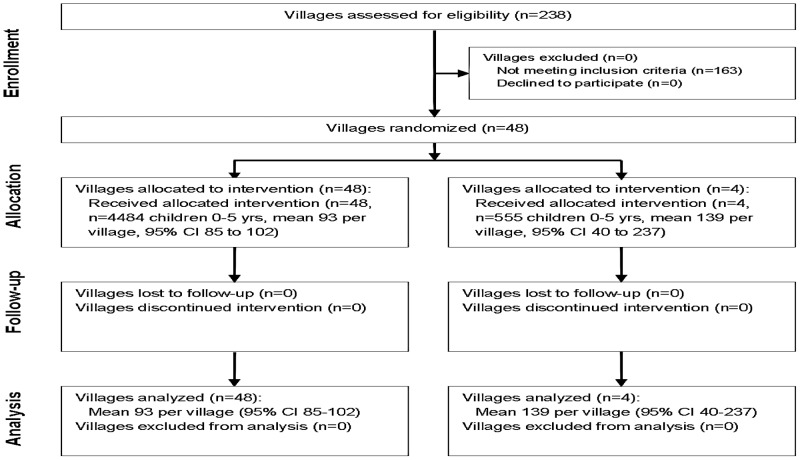
We conducted a cluster-randomized, controlled trial where 48 randomly selected villages in Niger are divided into 4 study arms of different mass treatment strategies. In a substudy of the main trial, we randomly selected 1 village from each of the 4 study arms (4 total villages) and we evaluated the odds of ocular Chlamydia versus the rank order of presentation for examination and laboratory assessment before treatment was offered.
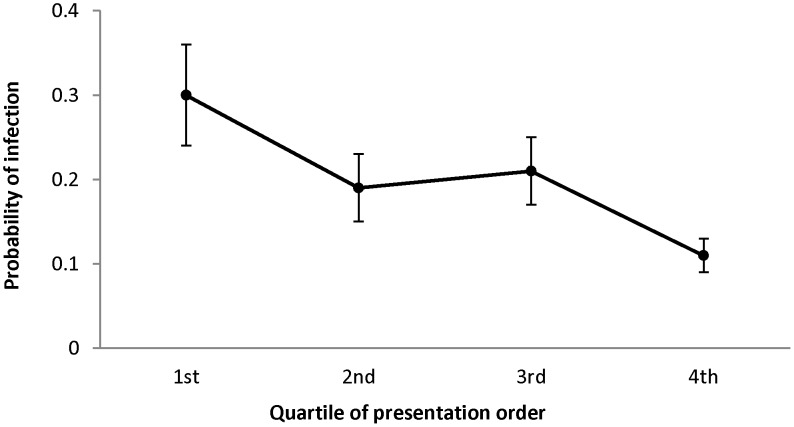
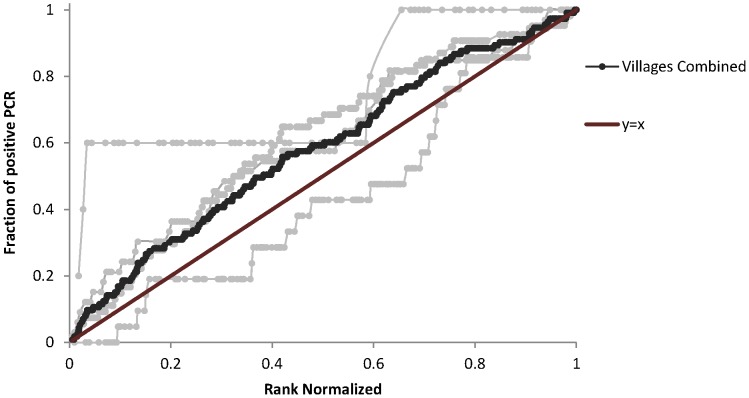
We found the odds of harboring ocular Chlamydia dropped by more than 70% from the first child examined to the last child examined (OR 0.27, 95% CI 0.13-0.59, P = 0.001) in the 4 randomly selected villages. We found the odds of active trachoma dropped by 80% from the first child examined to the last child examined (OR 0.20, 95% CI 0.10-0.4, P<0.0001) in the 48 villages in the main trial.
This study demonstrates that even if the WHO recommended 80% treatment coverage is not reached in certain settings, children 0-5 years with the greatest probability of ocular Chlamydia have higher odds of receiving attention because they are the first to present. These results suggest there may be diminishing returns when using scarce resources to track down the last few children in a mass treatment program.
ClinicalTrials.gov NCT00792922.
沙眼控制项目使用大规模抗生素分发来治疗眼部沙眼衣原体,以努力在全球范围内消除这种疾病。为了确定感染眼部沙眼衣原体的儿童是否比未感染者更有可能随后接受检查,我们比较了尼日尔四个流行沙眼的村庄中 0-5 岁儿童接受检查的顺序,以及 PCR 检测眼部沙眼衣原体的存在情况。
我们进行了一项集群随机对照试验,将尼日尔随机选择的 48 个村庄分为四个不同大规模治疗策略的研究组。在主要试验的子研究中,我们从四个研究组中的每个组中随机选择一个村庄(共 4 个村庄),并评估在提供治疗之前,眼部沙眼衣原体与检查顺序和实验室评估的几率。
我们发现,在四个随机选择的村庄中,从第一个接受检查的孩子到最后一个接受检查的孩子,眼部沙眼衣原体的几率下降了 70%以上(OR 0.27,95%CI 0.13-0.59,P=0.001)。在主要试验的 48 个村庄中,从第一个接受检查的孩子到最后一个接受检查的孩子,活动性沙眼的几率下降了 80%(OR 0.20,95%CI 0.10-0.4,P<0.0001)。
这项研究表明,即使在某些情况下没有达到世卫组织建议的 80%的治疗覆盖率,0-5 岁儿童中最有可能感染眼部沙眼衣原体的儿童也有更高的机会获得关注,因为他们是最先出现的。这些结果表明,在使用稀缺资源来追踪大规模治疗计划中的最后几个孩子时,可能会出现收益递减。
ClinicalTrials.gov NCT00792922。