London School of Hygiene and Tropical Medicine, London, United Kingdom.
PLoS Negl Trop Dis. 2010 Oct 5;4(10):e835. doi: 10.1371/journal.pntd.0000835.
The elimination of blinding trachoma focuses on controlling Chlamydia trachomatis infection through mass antibiotic treatment and measures to limit transmission. As the prevalence of disease declines, uncertainty increases over the most effective strategy for treatment. There are little long-term data on the effect of treatment on infection, especially in low prevalence settings, on which to base guidelines.
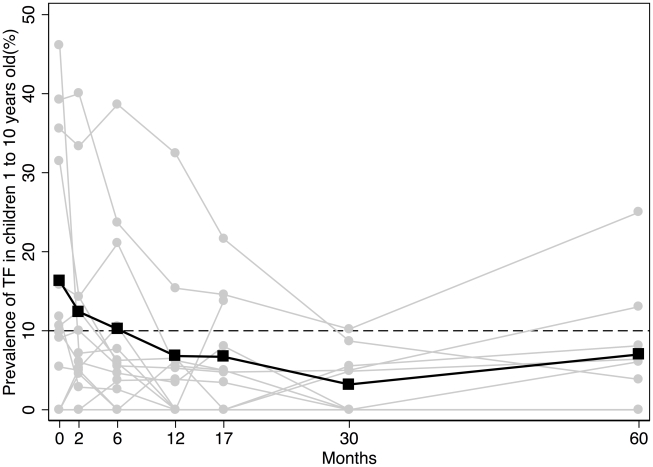
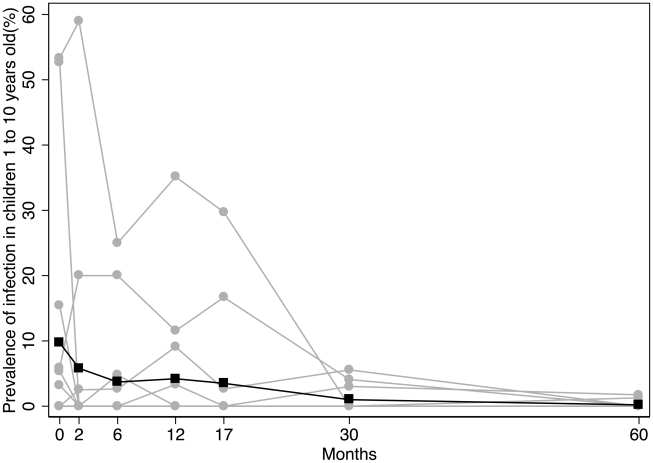
METHODOLOGY/PRINCIPAL FINDINGS: The population of a cluster of 14 Gambian villages with endemic trachoma was examined on seven occasions over five years (baseline, 2, 6, 12, 17, 30 and 60 months). Mass antibiotic treatment was given at baseline only. All families had accessible clean water all year round. New latrines were installed in each household after 17 months. Conjunctival swab samples were collected and tested for C. trachomatis by PCR. Before treatment the village-level prevalence of follicular trachoma in 1 to 9 year olds (TF(%1-9)) was 15.4% and C. trachomatis was 9.7%. Antibiotic treatment coverage was 83% of the population. In 12 villages all baseline infection cleared and few sporadic cases were detected during the following five years. In the other two villages treatment was followed by increased infection at two months, which was associated with extensive contact with other untreated communities. The prevalence of infection subsequently dropped to 0% in these 2 villages and 0.6% for the whole population by the end of the study in the absence of any further antibiotic treatment. However, several villages had a TF(%1-9) of >10%, the threshold for initiating or continuing mass antibiotic treatment, in the absence of any detectable C. trachomatis.
CONCLUSIONS/SIGNIFICANCE: A single round of mass antibiotic treatment may be sufficient in low prevalence settings to control C. trachomatis infection when combined with environmental conditions, which suppress transmission, such as a good water supply and sanitation.
消除致盲性沙眼的重点是通过大规模抗生素治疗和限制传播的措施来控制沙眼衣原体感染。随着疾病流行率的下降,对于在治疗方面最有效的策略,不确定性增加。在低流行地区,缺乏关于治疗对感染影响的长期数据,这对制定指南构成了挑战。
方法/主要发现:在五年内(基线、2、6、12、17、30 和 60 个月),对 14 个冈比亚村庄的人群进行了七次检查,这些村庄的人群中存在地方性沙眼。仅在基线时进行大规模抗生素治疗。所有家庭全年都有可获得的清洁水。在 17 个月后,每个家庭都安装了新的厕所。采集结膜拭子样本并通过 PCR 检测沙眼衣原体。在治疗前,1 至 9 岁儿童的滤泡性沙眼流行率(TF(%1-9))为 15.4%,沙眼衣原体为 9.7%。抗生素治疗覆盖率为 83%的人口。在 12 个村庄,所有基线感染均清除,在接下来的五年中很少发现散发病例。在另外两个村庄,治疗后两个月感染增加,这与与其他未治疗社区广泛接触有关。在没有进一步抗生素治疗的情况下,这两个村庄的感染率随后降至 0%,整个人群的感染率降至 0.6%。然而,在没有任何可检测到的沙眼衣原体的情况下,一些村庄的 TF(%1-9)仍>10%,这是启动或继续大规模抗生素治疗的阈值。
结论/意义:在低流行地区,当与抑制传播的环境条件(如良好的供水和卫生条件)相结合时,单次大规模抗生素治疗可能足以控制沙眼衣原体感染。