Fesharaki Hamid, Peyman Alireza, Rowshandel Mehdi, Peyman Mohammadreza, Alizadeh Pegah, Akhlaghi Mohammadreza, Ashtari Alireza
Isfahan Eye Research Center, Isfahan University of Medical Sciences, Isfahan, Iran.
Adv Biomed Res. 2012;1:67. doi: 10.4103/2277-9175.102971. Epub 2012 Oct 31.
This study performed to assess the safety of cataract extraction with phacoemulsification and intraocular lens (IOL) implantation in patients with high axial length compared with patients with normal axial length.
A total of 866 eyes were enrolled in this study; all subjects underwent phacoemulsification and IOL implantation for treatment of cataract. Seven hundred and nine eyes fell in the normal group with axial lengths ranging between 21 and 24.5 mm, and 157 eyes were considered myopic with axial length equal or greater than 26 mm. The two groups were compared regarding intraoperative surgical complications, such as vitreous loss, posterior capsular rupture, nucleolus drop, and undesirable implantation of IOL in the anterior chamber.
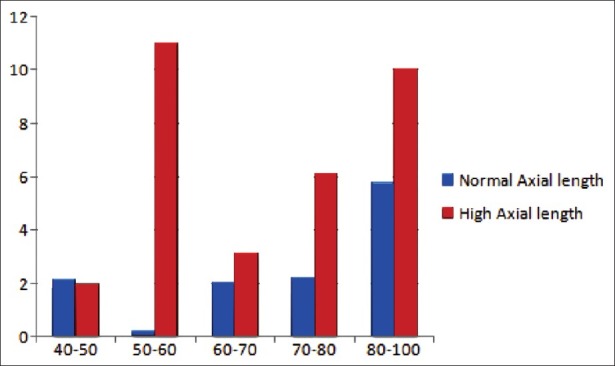
Age was a risk factor in both groups, with each year increase of age, the chance of incidence of intraoperative complications increased 1.04-folds (P = 0.03). And with 1 mm increase in axial length, the incidence of complications raised 1.22-folds (P = 0.007). There was no significant correlation between axial length and incidence of vitreous loss, although the incidence of posterior capsular rupture and nucleus fragment drops increased with increment in the axial length. Sex of the patients and side of the left or right eye were not found to be significant risk factors.
As the results illustrate, in this survey, age and high axial length were statistically significant risk factors for incidence of intraoperative complications of cataract surgery with phacoemulsification technique. Anticipation of these complications and also preparation and prophylactic measures may decrease incidence of these complications.
本研究旨在评估与正常眼轴长度患者相比,高眼轴长度患者行白内障超声乳化吸除联合人工晶状体(IOL)植入术的安全性。
本研究共纳入866只眼;所有受试者均接受白内障超声乳化吸除联合IOL植入术治疗。709只眼属于正常组,眼轴长度在21至24.5毫米之间,157只眼被视为近视,眼轴长度等于或大于26毫米。比较两组术中手术并发症,如玻璃体丢失、后囊膜破裂、核块掉落以及IOL在前房的不当植入情况。
年龄在两组中均为危险因素,年龄每增加一岁,术中并发症发生率增加1.04倍(P = 0.03)。眼轴长度每增加1毫米,并发症发生率增加1.22倍(P = 0.007)。尽管后囊膜破裂和核碎片掉落的发生率随眼轴长度增加而增加,但眼轴长度与玻璃体丢失发生率之间无显著相关性。未发现患者性别及左右眼别为显著危险因素。
如结果所示,在本次调查中,年龄和高眼轴长度是超声乳化技术白内障手术术中并发症发生率的统计学显著危险因素。对这些并发症的预期以及准备和预防措施可能会降低这些并发症的发生率。