Department of Internal and Integrative Medicine, Kliniken Essen-Mitte, Faculty of Medicine, University of Duisburg-Essen, Am Deimelsberg 34a, Essen 45276, Germany.
BMC Psychiatry. 2013 Jan 18;13:32. doi: 10.1186/1471-244X-13-32.
The aim of this review was to systematically review and meta-analyze the effects of yoga on symptoms of schizophrenia, quality of life, function, and hospitalization in patients with schizophrenia.
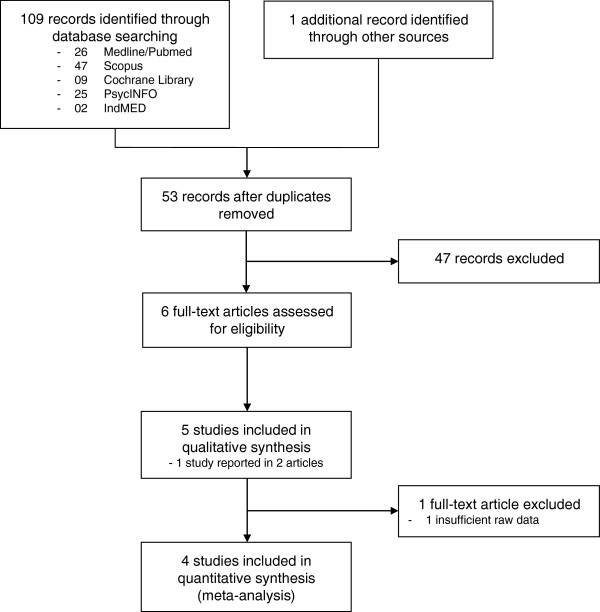
MEDLINE/Pubmed, Scopus, the Cochrane Library, PsycInfo, and IndMED were screened through August 2012. Randomized controlled trials (RCTs) comparing yoga to usual care or non-pharmacological interventions were analyzed when they assessed symptoms or quality of life in patients with schizophrenia. Cognitive function, social function, hospitalization, and safety were defined as secondary outcomes. Risk of bias was assessed using the risk of bias tool recommended by the Cochrane Back Review Group. Standardized mean differences (SMD) and 95% confidence intervals (CI) were calculated.
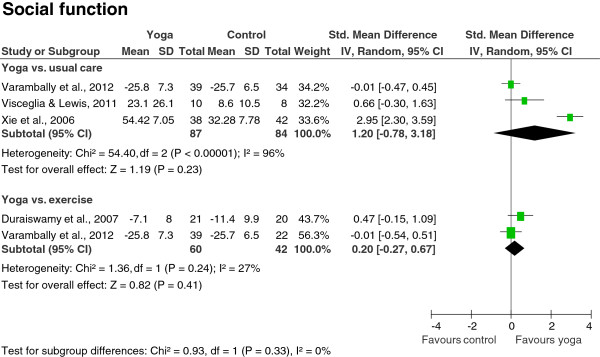
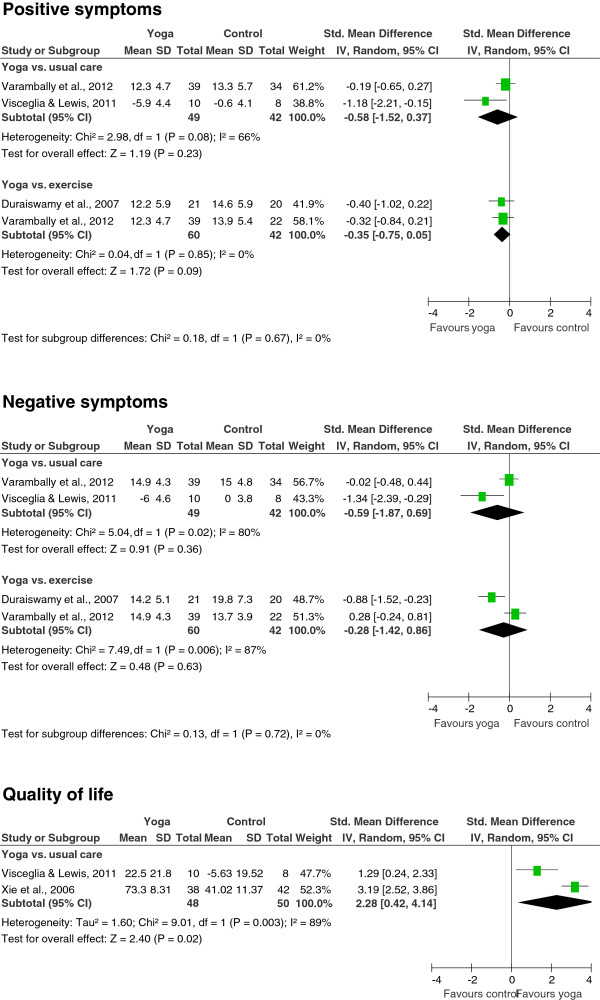
Five RCTs with a total of 337 patients were included; 2 RCTs had low risk of bias. Two RCTs compared yoga to usual care; 1 RCT compared yoga to exercise; and 2 3-arm RCTs compared yoga to usual care and exercise. No evidence was found for short-term effects of yoga compared to usual care on positive symptoms (SMD = -0.58; 95% CI -1.52 to 0.37; P = 0.23), or negative symptoms (SMD = -0.59; 95% CI -1.87 to 0.69; P = 0.36). Moderate evidence was found for short-term effects on quality of life compared to usual care (SMD = 2.28; 95% CI 0.42 to 4.14; P = 0.02). These effects were only present in studies with high risk of bias. No evidence was found for short-term effects on social function (SMD = 1.20; 95% CI -0.78 to 3.18; P = 0.23). Comparing yoga to exercise, no evidence was found for short-term effects on positive symptoms (SMD = -0.35; 95% CI -0.75 to 0.05; P = 0.09), negative symptoms (SMD = -0.28; 95% CI -1.42 to 0.86; P = 0.63), quality of life (SMD = 0.17; 95% CI -0.27 to 0.61; P = 0.45), or social function (SMD = 0.20; 95% CI -0.27 to 0.67; P = 0.41). Only 1 RCT reported adverse events.
This systematic review found only moderate evidence for short-term effects of yoga on quality of life. As these effects were not clearly distinguishable from bias and safety of the intervention was unclear, no recommendation can be made regarding yoga as a routine intervention for schizophrenia patients.
本综述旨在系统回顾和荟萃分析瑜伽对精神分裂症患者症状、生活质量、功能和住院的影响。
通过 2012 年 8 月前的 MEDLINE/Pubmed、Scopus、Cochrane 图书馆、PsycInfo 和 IndMED 筛选,分析了比较瑜伽与常规护理或非药物干预的随机对照试验(RCT),以评估精神分裂症患者的症状或生活质量。认知功能、社会功能、住院和安全性被定义为次要结局。使用 Cochrane 回顾性评价组推荐的偏倚风险工具评估偏倚风险。计算标准化均数差(SMD)和 95%置信区间(CI)。
共纳入 5 项 RCT,总计 337 例患者;其中 2 项 RCT 偏倚风险较低。2 项 RCT 比较了瑜伽与常规护理;1 项 RCT 比较了瑜伽与运动;2 项 3 臂 RCT 比较了瑜伽与常规护理和运动。与常规护理相比,瑜伽对阳性症状(SMD = -0.58;95%CI -1.52 至 0.37;P = 0.23)或阴性症状(SMD = -0.59;95%CI -1.87 至 0.69;P = 0.36)的短期效果无证据支持。与常规护理相比,瑜伽对生活质量的短期影响有中度证据(SMD = 2.28;95%CI 0.42 至 4.14;P = 0.02)。这些效果仅存在于高偏倚风险的研究中。瑜伽对社会功能的短期影响无证据支持(SMD = 1.20;95%CI -0.78 至 3.18;P = 0.23)。与运动相比,瑜伽对阳性症状(SMD = -0.35;95%CI -0.75 至 0.05;P = 0.09)、阴性症状(SMD = -0.28;95%CI -1.42 至 0.86;P = 0.63)、生活质量(SMD = 0.17;95%CI -0.27 至 0.61;P = 0.45)或社会功能(SMD = 0.20;95%CI -0.27 至 0.67;P = 0.41)的短期效果无证据支持。只有 1 项 RCT 报告了不良反应。
本系统综述仅发现瑜伽对生活质量的短期影响有中度证据。由于这些影响与偏倚无法明显区分,且干预的安全性尚不清楚,因此不能推荐瑜伽作为精神分裂症患者的常规干预措施。