Grotjohann Tim, Testa Ilaria, Reuss Matthias, Brakemann Tanja, Eggeling Christian, Hell Stefan W, Jakobs Stefan
Department of NanoBiophotonics , Max Planck Institute for Biophysical Chemistry , Göttingen , Germany.
Elife. 2012 Dec 31;1:e00248. doi: 10.7554/eLife.00248.
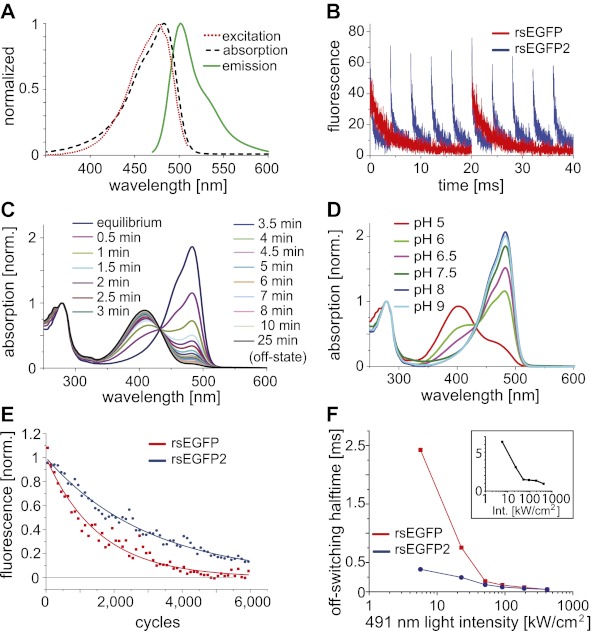
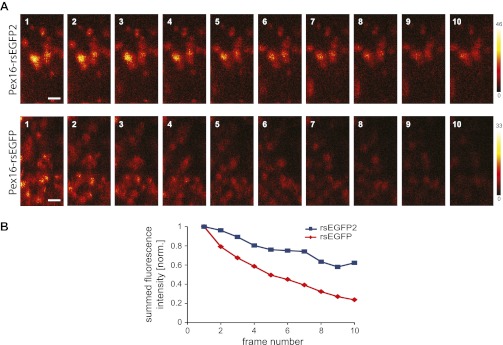
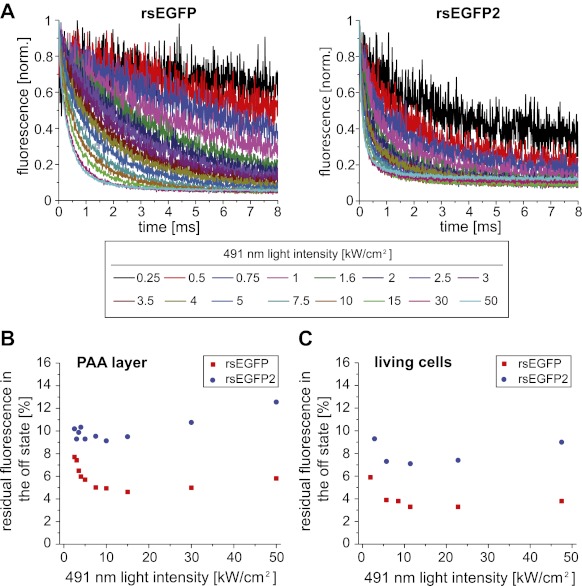
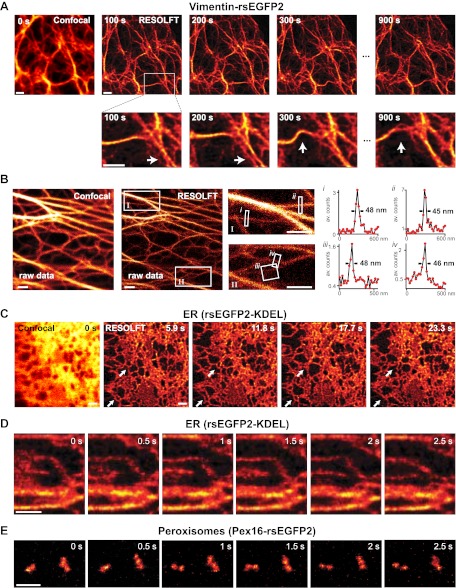
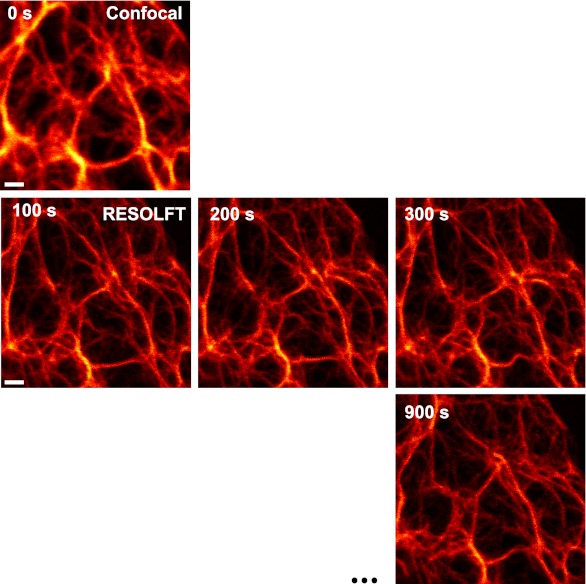
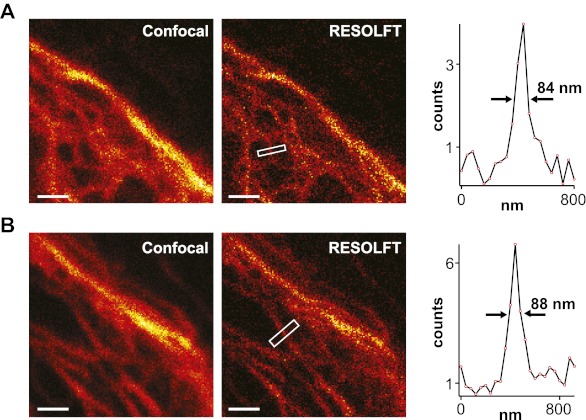
The super-resolution microscopy called RESOLFT relying on fluorophore switching between longlived states, stands out by its coordinate-targeted sequential sample interrogation using low light levels. While RESOLFT has been shown to discern nanostructures in living cells, the reversibly photoswitchable green fluorescent protein (rsEGFP) employed in these experiments was switched rather slowly and recording lasted tens of minutes. We now report on the generation of rsEGFP2 providing faster switching and the use of this protein to demonstrate 25-250 times faster recordings.DOI:http://dx.doi.org/10.7554/eLife.00248.001.
一种名为RESOLFT的超分辨率显微镜,它依赖于荧光团在长寿命状态之间的切换,通过使用低光水平进行坐标靶向的顺序样本询问而脱颖而出。虽然RESOLFT已被证明能够分辨活细胞中的纳米结构,但这些实验中使用的可逆光开关绿色荧光蛋白(rsEGFP)切换相当缓慢,记录持续了数十分钟。我们现在报告rsEGFP2的产生,其具有更快的切换速度,并使用这种蛋白质来证明记录速度提高了25至250倍。DOI:http://dx.doi.org/10.7554/eLife.00248.001 。