Polonsky Jonathan, Luquero Francisco, Francois Gwenola, Rousseau Caroline, Caleo Grazia, Ciglenecki Iza, Delacre Clara, Siddiqui M Ruby, Terzian Mego, Verhenne Leen, Porten Klaudia, Checchi Francesco
Epicentre, Paris, France.
PLoS Curr. 2013 Jan 7;5:ecurrents.dis.6aec18e84816c055b8c2a06456811c7a. doi: 10.1371/currents.dis.6aec18e84816c055b8c2a06456811c7a.
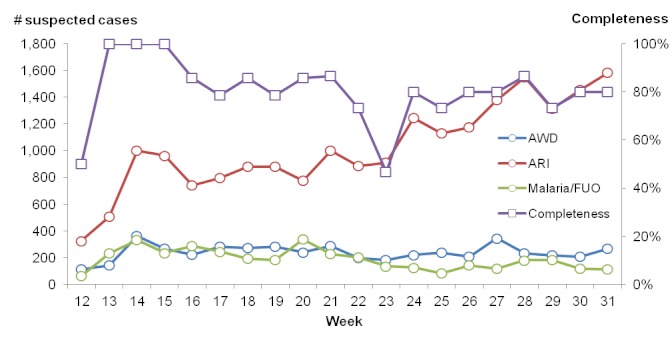
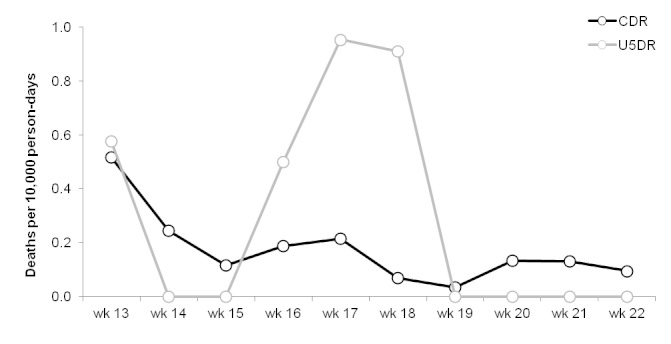
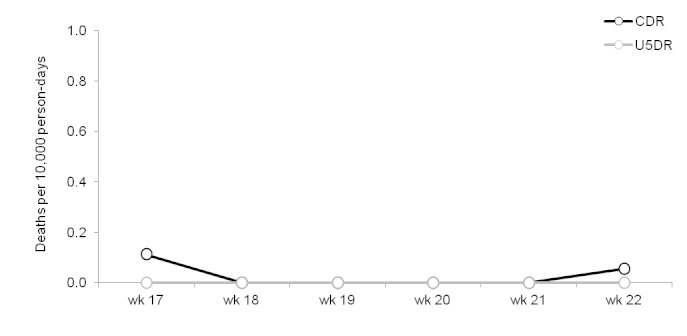
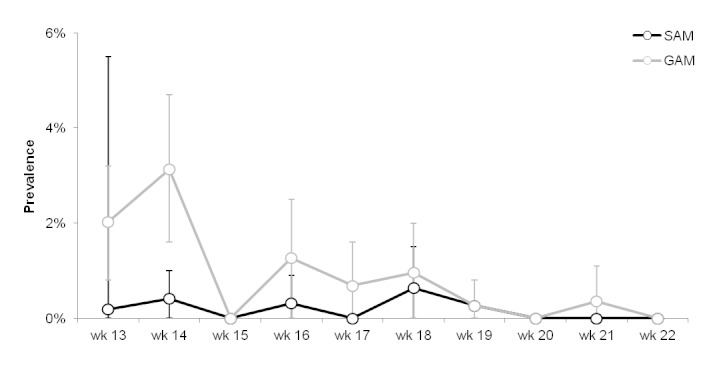
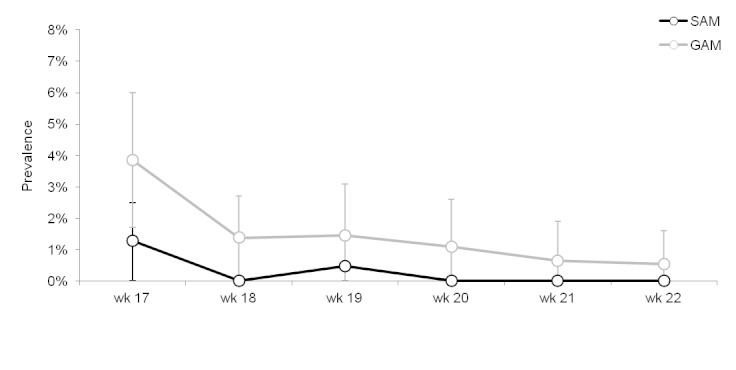
Background In January 2010, Haiti was struck by a powerful earthquake, killing and wounding hundreds of thousands and leaving millions homeless. In order to better understand the severity of the crisis, and to provide early warning of epidemics or deteriorations in the health status of the population, Médecins Sans Frontières established surveillance for infections of epidemic potential and for death rates and malnutrition prevalence. Methods Trends in infections of epidemic potential were detected through passive surveillance at health facilities serving as sentinel sites. Active community surveillance of death rates and malnutrition prevalence was established through weekly home visits. Results There were 102,054 consultations at the 15 reporting sites during the 26 week period of operation. Acute respiratory infections, acute watery diarrhoea and malaria/fever of unknown origin accounted for the majority of proportional morbidity among the diseases under surveillance. Several alerts were triggered through the detection of immediately notifiable diseases and increasing trends in some conditions. Crude and under-5 death rates, and acute malnutrition prevalence, were below emergency thresholds. Conclusion Disease surveillance after disasters should include an alert and response component, requiring investment of resources in informal networks that improve sensitivity to alerts as well as on the more common systems of data collection, compilation and analysis. Information sharing between partners is necessary to strengthen early warning systems. Community-based surveillance of mortality and malnutrition is feasible but requires careful implementation and validation.
背景 2010年1月,海地遭受强烈地震袭击,造成数十万人伤亡,数百万人无家可归。为了更好地了解危机的严重程度,并对疫情或民众健康状况恶化发出早期预警,无国界医生组织对具有流行潜力的感染以及死亡率和营养不良患病率进行了监测。方法 通过在作为哨点的医疗机构进行被动监测,检测具有流行潜力的感染趋势。通过每周的家访对死亡率和营养不良患病率进行社区主动监测。结果 在26周的运营期内,15个报告点共进行了102,054次会诊。急性呼吸道感染、急性水样腹泻和不明原因的疟疾/发热占所监测疾病中比例发病率的大部分。通过检测应立即通报的疾病和某些情况的上升趋势触发了几次警报。粗死亡率、5岁以下儿童死亡率和急性营养不良患病率均低于紧急阈值。结论 灾害后的疾病监测应包括警报和应对部分,需要在非正式网络中投入资源,以提高对警报的敏感度以及更常见的数据收集、汇编和分析系统。合作伙伴之间的信息共享对于加强早期预警系统至关重要。基于社区的死亡率和营养不良监测是可行的,但需要仔细实施和验证。