Reina Ortiz Miguel, Le Nicole K, Sharma Vinita, Hoare Ismael, Quizhpe Edy, Teran Enrique, Naik Eknath, Salihu Hamisu M, Izurieta Ricardo
Department of Global Health, College of Public Health, University of South Florida, Tampa, FL, USA.
Fundación Raíces, Esmeraldas, Ecuador.
Sci Rep. 2017 Nov 13;7(1):15408. doi: 10.1038/s41598-017-15706-w.
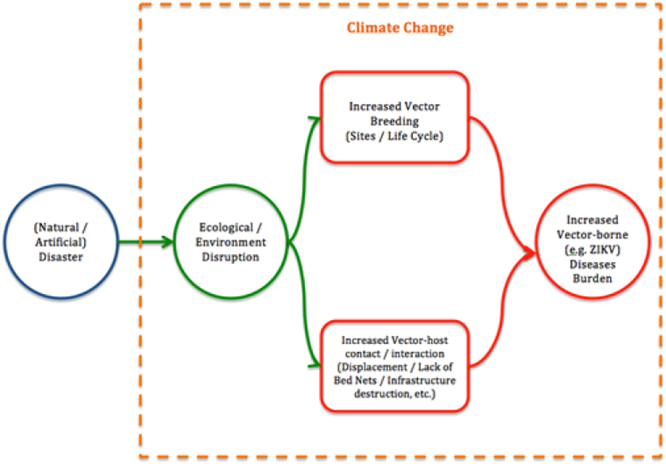
A recent major earthquake (M7.8), coupled with appropriate climatic conditions, led to significant destruction in Ecuador. Temperature variations, which may be induced by anthropogenic climate change, are often associated with changes in rainfall, humidity and pressure. Temperature and humidity are associated with ecological modifications that may favour mosquito breeding. We hypothesized that the disruptive ecological changes triggered by the earthquake, in the context of appropriate climatic conditions, led to an upsurge in Zika virus (ZIKV) infections. Here we show that, after controlling for climatic and socioeconomic conditions, earthquake severity was associated with incident ZIKV cases. Pre-earthquake mean maximum monthly temperature and post-earthquake mean monthly pressure were negatively associated with ZIKV incidence rates. These results demonstrate the dynamics of post-disaster vector-borne disease transmission, in the context of conducive/favourable climatic conditions, which are relevant in a climate change-affected world where disasters may occur in largely populated areas.
最近发生的一次大地震(7.8级),加上适宜的气候条件,给厄瓜多尔造成了重大破坏。温度变化可能由人为气候变化引起,通常与降雨、湿度和气压的变化有关。温度和湿度与可能有利于蚊子繁殖的生态变化有关。我们假设,在适宜的气候条件下,地震引发的破坏性生态变化导致了寨卡病毒(ZIKV)感染的激增。在此我们表明,在控制了气候和社会经济条件后,地震严重程度与寨卡病毒病例的发生有关。震前月平均最高温度和震后月平均气压与寨卡病毒发病率呈负相关。这些结果证明了在有利的气候条件下灾后媒介传播疾病的传播动态,这在一个受气候变化影响、可能在人口密集地区发生灾害的世界中具有重要意义。