Ayabe Makoto, Kumahara Hideaki, Morimura Kazuhiro, Tanaka Hiroaki
Faculty of Health and Sports Science, Fukuoka University, 8-19-1 Nanakuma, Jonan-ku, Fukuoka 814-0180, Japan.
BMC Res Notes. 2013 Jan 18;6:20. doi: 10.1186/1756-0500-6-20.
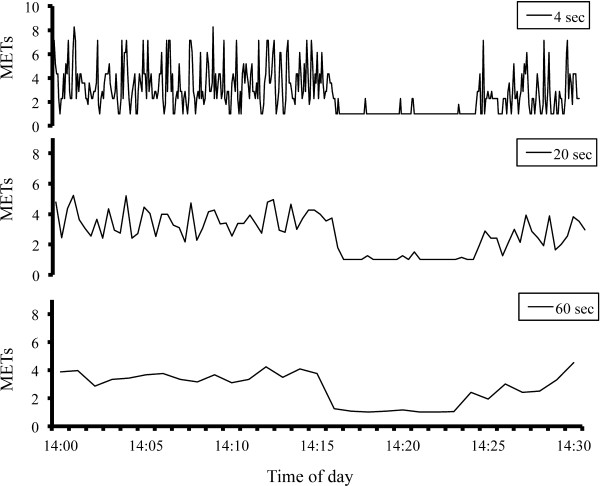
The purpose of the present investigation was to compare the bouts of daily physical activity (PA) determined by three different accelerometer epoch lengths under free-living conditions.
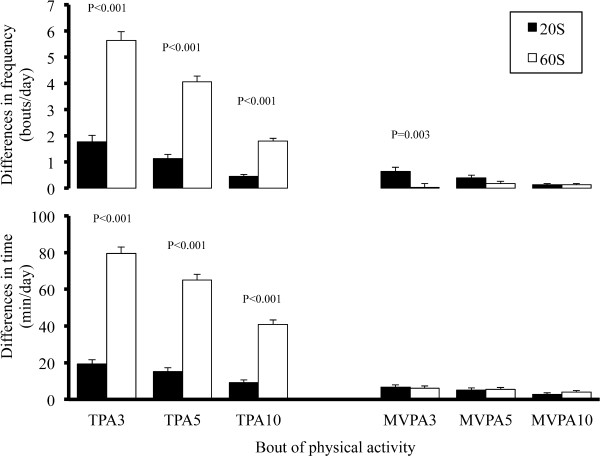
One hundred thirty-four adults (50 ± 7 years) wore an accelerometer (Lifecorder) for 7 consecutive days under free-living conditions in order to determine the time spent in physical activity of light intensity (LPA), moderate intensity (MPA), vigorous intensity (VPA), moderate to vigorous intensity (MVPA), and the total physical activity (TPA; sum of LPA, MPA and VPA). Additionally, all PA was divided according to the bout durations (sporadic, > 3 min, > 5 min, and > 10 min). These indices of PA were analyzed using three different epoch lengths (4 sec, 20 sec and 60 sec) derived from the accelerometer.
The LPA significantly increased in association with increases in the epoch length (48.7 ± 15.9 to 178.7 ± 62.6 min/day, p < 0.05). The amount of sporadic VPA determined by the shortest epoch length (2.9 ± 5.2 min/day) was significantly longer than the two remaining epoch lengths (1.1 ± 2.4 to 0.9 ± 2.5 min/day, p < 0.05). The times of the MVPA bouts lasting longer than 3 minutes determined using the 4-second epoch length (2.6 ± 5.4 to 7.7 ± 10.0 min/day) were significantly shorter than those determined using the other two settings (6.5 ± 10.5 to 13.8 ± 13.8 min/day, p < 0.05). The frequencies of the MVPA bouts lasting longer than 10 minutes determined using the 4-second epoch length (0.2 ± 0.3 bouts/day) were significantly lower than those determined using the other two settings (0.3 ± 0.4 bouts/day, p < 0.05).
The epoch length setting of the accelerometer affects the estimation of the PA bouts under free-living conditions in middle-aged to older adults.
本研究的目的是比较在自由生活条件下,由三种不同加速度计记录时长所确定的每日身体活动(PA)情况。
134名成年人(年龄50±7岁)在自由生活条件下连续7天佩戴加速度计(Lifecorder),以确定在轻度身体活动(LPA)、中度身体活动(MPA)、剧烈身体活动(VPA)、中度至剧烈身体活动(MVPA)中所花费的时间,以及总身体活动量(TPA;LPA、MPA和VPA之和)。此外,所有身体活动根据发作时长进行划分(零星发作、>3分钟、>5分钟和>10分钟)。使用从加速度计得出的三种不同记录时长(4秒、20秒和60秒)对这些身体活动指标进行分析。
LPA随记录时长增加而显著增加(从48.7±15.9分钟/天增至178.7±62.6分钟/天,p<0.05)。由最短记录时长所确定的零星VPA量(2.9±5.2分钟/天)显著长于另外两种记录时长(1.1±2.4至0.9±2.5分钟/天,p<0.05)。使用4秒记录时长所确定的持续超过3分钟的MVPA发作时间(2.6±5.4至7.7±10.0分钟/天)显著短于使用其他两种设置所确定的时间(6.5±10.5至13.8±13.8分钟/天,p<0.05)。使用4秒记录时长所确定的持续超过10分钟的MVPA发作频率(0.2±0.3次/天)显著低于使用其他两种设置所确定的频率(0.3±0.4次/天,p<0.05)。
加速度计的记录时长设置会影响中老年成年人在自由生活条件下身体活动发作情况的估计。