University of Western Sydney, School of Science and Health, Penrith, Australia.
University of Wollongong, Interdisciplinary Educational Research Institute, School of Education, Wollongong, Australia.
PLoS One. 2014 Mar 18;9(3):e92040. doi: 10.1371/journal.pone.0092040. eCollection 2014.
Accurate, objective measurement is important for understanding adolescents' physical activity (PA) behaviour. When using accelerometry to objectively measure PA, a decision must be made regarding how frequently data is recorded (i.e., epoch length). The purpose of this study was to examine i) PA bout length, and ii) the effect of variations in accelerometer epoch length on PA estimates during physical education (PE) and leisure time in adolescent boys.
Cross-sectional study.
Year 9 boys (N = 133; mean age ±SD = 14.36±0.48 years) wore accelerometers during two PE lessons, and for a period of seven consecutive days. Data were reintegrated from 1s into longer periods of 2, 5, 10, 30, and 60 seconds. ANOVAs were used to test for differences in PA estimates between epochs in leisure time and PE.
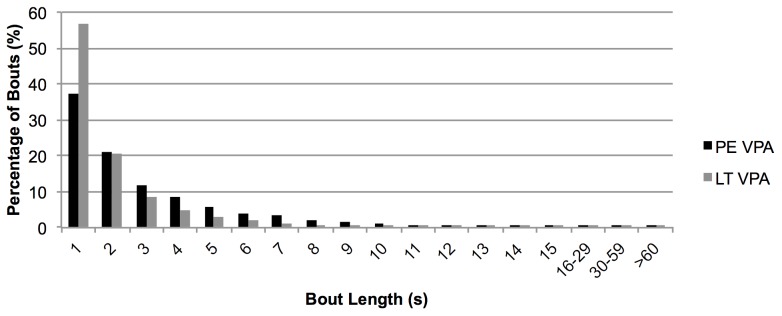
The mean length of vigorous PA (VPA) bouts was 3.5±2.0 seconds for PE and 2.5±1.7 seconds for leisure time, and mean length of moderate PA (MPA) bouts was 2.3±0.5 seconds for PE and 2.9±0.5 seconds for leisure time. During PE, estimates of MVPA, MPA, and light PA (LPA) increased as epoch increased from 1 second to 60 seconds, while VPA and sedentary behaviour estimates decreased. During leisure time, estimates of all PA intensities decreased as epoch increased from 1 second to 60 seconds, with the exception of sedentary behaviour, which increased as epoch length increased.
The context in which PA occurs can influence PA bout length measurement and the effect of variations in epoch length on PA estimates. Researchers measuring PA with accelerometry should be conscious of the possible influence of context on PA estimates.
准确、客观的测量对于理解青少年的身体活动(PA)行为很重要。当使用加速度计客观地测量 PA 时,必须就数据记录的频率(即时间片段长度)做出决定。本研究的目的是检查 i)PA 爆发长度,以及 ii)加速度计时间片段长度变化对青少年男孩在体育课(PE)和休闲时间 PA 估计的影响。
横断面研究。
9 年级男生(N = 133;平均年龄 ±标准差 = 14.36±0.48 岁)在两节 PE 课和连续七天的时间内佩戴加速度计。数据从 1 秒重新整合为 2、5、10、30 和 60 秒的更长时间段。使用方差分析检验休闲时间和 PE 中不同时间片段的 PA 估计值之间的差异。
PE 中剧烈 PA(VPA)爆发的平均长度为 3.5±2.0 秒,休闲时间为 2.5±1.7 秒,PE 中中度 PA(MPA)爆发的平均长度为 2.3±0.5 秒,休闲时间为 2.9±0.5 秒。在 PE 中,随着时间片段从 1 秒增加到 60 秒,MVPA、MPA 和轻 PA(LPA)的估计值增加,而 VPA 和久坐行为的估计值减少。在休闲时间,随着时间片段从 1 秒增加到 60 秒,所有 PA 强度的估计值都减少,除了久坐行为,随着时间片段长度的增加而增加。
PA 发生的背景会影响 PA 爆发长度的测量以及时间片段长度变化对 PA 估计的影响。使用加速度计测量 PA 的研究人员应该意识到背景对 PA 估计的可能影响。