Department of Psychiatry and Behavioral Sciences, Stanford University School of Medicine, Stanford, CA 94305-5722,
J Consult Clin Psychol. 2013 Aug;81(4):627-38. doi: 10.1037/a0031530. Epub 2013 Jan 21.
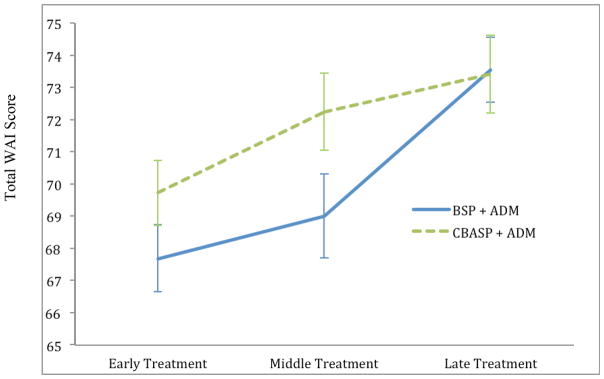
This study tested whether the quality of the patient-rated working alliance, measured early in treatment, predicted subsequent symptom reduction in chronically depressed patients. Secondarily, the study assessed whether the relationship between early alliance and response to treatment differed between patients receiving cognitive behavioral analysis system of psychotherapy (CBASP) vs. brief supportive psychotherapy (BSP).
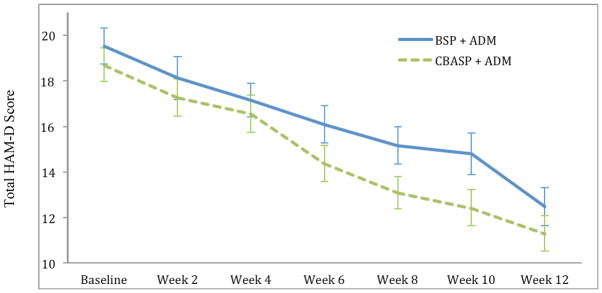
395 adults (57% female; Mage = 46; 91% Caucasian) who met criteria for chronic depression and did not fully remit during a 12-week algorithm-based, open-label pharmacotherapy trial were randomized to receive either 16-20 sessions of CBASP or BSP in addition to continued, algorithm-based antidepressant medication. Of these, 224 patients completed the Working Alliance Inventory-Short Form at Weeks 2 or 4 of treatment. Blind raters assessed depressive symptoms at 2-week intervals across treatment using the Hamilton Rating Scale for Depression. Linear mixed models tested the association between early alliance and subsequent symptom ratings while accounting for early symptom change.
A more positive early working alliance was associated with lower subsequent symptom ratings in both the CBASP and BSP, F(1, 1236) = 62.48, p < .001. In addition, the interaction between alliance and psychotherapy type was significant, such that alliance quality was more strongly associated with symptom ratings among those in the CBASP treatment group, F(1, 1234) = 8.31, p = .004.
The results support the role of the therapeutic alliance as a predictor of outcome across dissimilar treatments for chronic depression. Contrary to expectations, the therapeutic alliance was more strongly related to outcome in CBASP, the more directive of the 2 therapies.
本研究旨在检验治疗早期患者自评的工作联盟质量是否预测慢性抑郁患者随后的症状减轻。其次,该研究评估了在接受认知行为分析系统心理治疗(CBASP)与简短支持性心理治疗(BSP)的患者中,早期联盟与治疗反应之间的关系是否不同。
395 名符合慢性抑郁标准且在为期 12 周的基于算法的开放标签药物治疗试验中未完全缓解的成年人(57%为女性;Mage=46;91%为白种人)被随机分配接受 16-20 次 CBASP 或 BSP,外加持续的基于算法的抗抑郁药物治疗。其中,224 名患者在治疗的第 2 或 4 周完成了工作联盟量表-短式。盲法评估者在治疗过程中每 2 周使用汉密尔顿抑郁评定量表评估抑郁症状。线性混合模型检验了早期联盟与随后的症状评分之间的关联,同时考虑了早期症状变化。
在 CBASP 和 BSP 中,更积极的早期工作联盟与随后的症状评分较低相关,F(1,1236)=62.48,p<.001。此外,联盟与心理治疗类型之间的交互作用显著,即联盟质量与 CBASP 治疗组的症状评分相关性更强,F(1,1234)=8.31,p=.004。
研究结果支持治疗联盟作为慢性抑郁不同治疗方法的预测因子的作用。与预期相反,在更具指导意义的 2 种治疗方法之一的 CBASP 中,治疗联盟与结果的关系更密切。