Department of Preventive Medicine, Dong-A University College of Medicine, Busan, Korea.
J Korean Med Sci. 2013 Jan;28(1):16-24. doi: 10.3346/jkms.2013.28.1.16. Epub 2013 Jan 8.
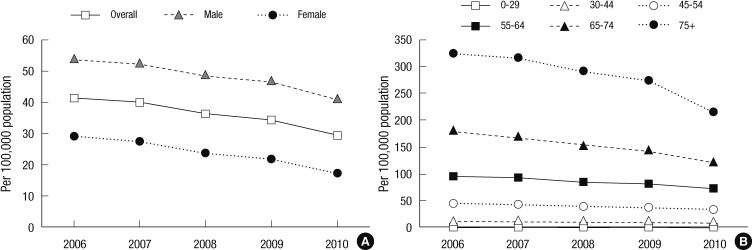
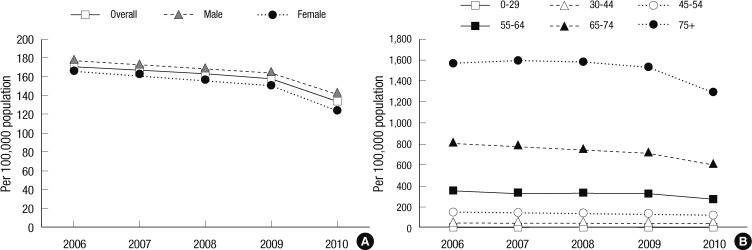
This study attempted to calculate and investigate the incidence of hospitalized acute myocardial infarction (AMI) and stroke in Korea. Using the National Health Insurance claim data, we investigated patients whose main diagnostic codes included AMI or stroke during 2006 to 2010. As a result, we found out that the number of AMI hospitalized patients had decreased since 2006 and amounted to 15,893 in 2010; and that the number of those with stroke had decreased since 2006 and amounted to 73,501 in 2010. The age-standardized incidence rate of hospitalized AMI, after adjustment for readmission, was 41.6 cases per 100,000-population in 2006, and had decreased to 29.4 cases in 2010 (for trend P < 0.001). In the case of stroke was estimated at 172.8 cases per 100,000-population in 2006, and had decreased to 135.1 cases in 2010 (for trend P < 0.001). In conclusion, the age-standardized incidence rates of both hospitalized AMI and stroke in Korea had decreased continuously during 2006 to 2010. We consider this decreasing trend due to the active use of pharmaceuticals, early vascular intervention, and the national cardio-cerebrovascular disease care project as the primary and secondary prevention efforts.
本研究旨在计算和调查韩国住院急性心肌梗死(AMI)和中风的发病率。我们使用国民健康保险索赔数据,调查了在 2006 年至 2010 年间主要诊断代码包括 AMI 或中风的患者。结果发现,自 2006 年以来,住院 AMI 患者人数减少,2010 年为 15893 人;自 2006 年以来,中风患者人数减少,2010 年为 73501 人。经再入院调整后,住院 AMI 的年龄标准化发病率在 2006 年为每 10 万人 41.6 例,2010 年降至每 10 万人 29.4 例(趋势 P<0.001)。在中风的情况下,2006 年每 10 万人的发病率估计为 172.8 例,2010 年降至每 10 万人 135.1 例(趋势 P<0.001)。总之,2006 年至 2010 年期间,韩国住院 AMI 和中风的年龄标准化发病率持续下降。我们认为这种下降趋势是由于积极使用药物、早期血管介入以及国家心脑血管疾病护理项目作为一级和二级预防措施。